






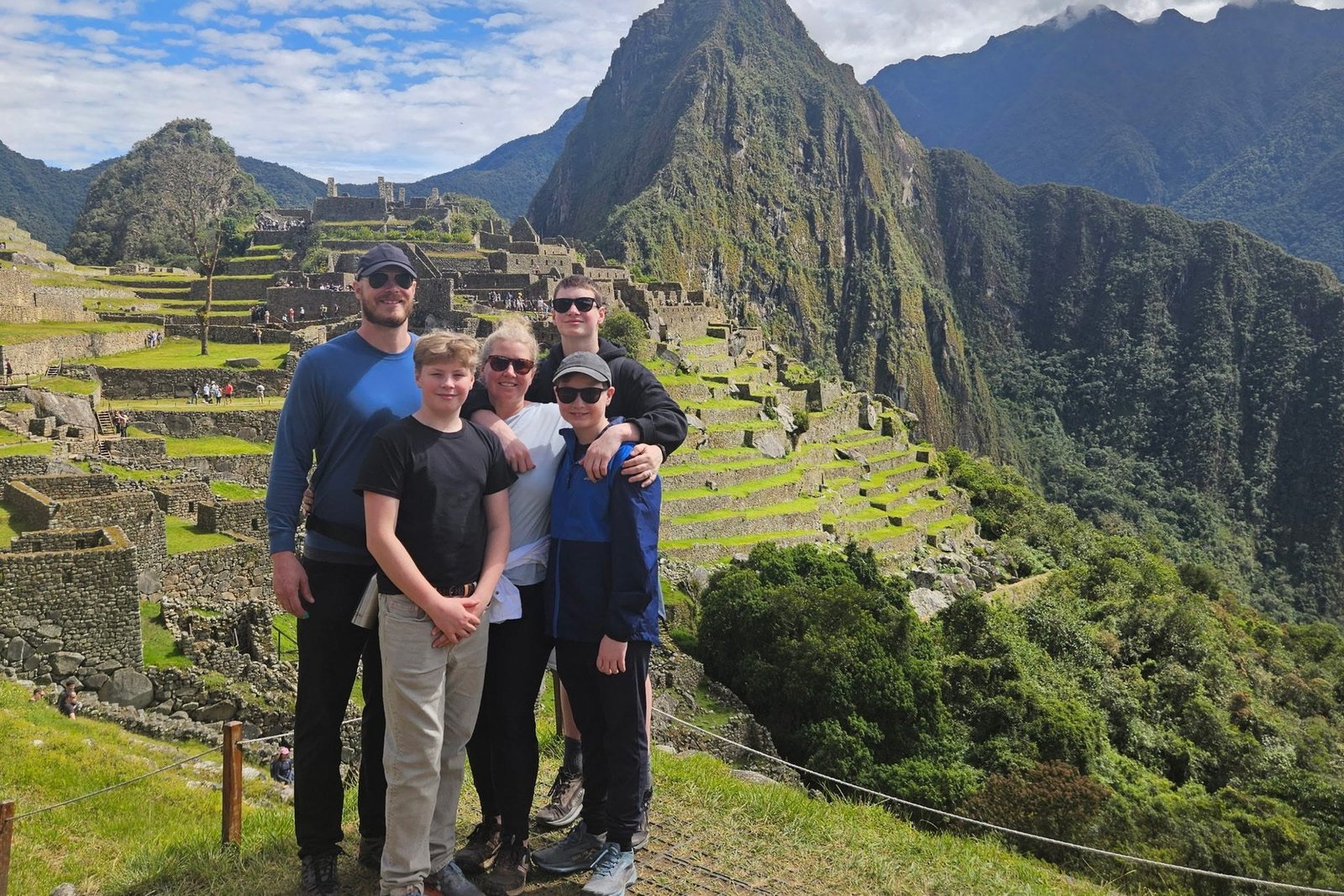

Some lessons kids just don’t learn in a school curriculum. That’s how Sarah Mann feels.
For the past four years, Mann has taken her three children, now 16, 14 and 12, out of school for major trips around the world, believing travel plays an important role in raising smart, well-rounded kids.
“I think our goal as parents — and I would think that the goal of teachers — is to raise smart, good humans, and I think that travel is a huge part of that,” said Mann, who lives with her family on Bainbridge Island, Washington. “I think understanding different cultures and knowing that where you live isn’t everything. To me, that’s something that you cannot get in the classroom, and it outweighs anything that they would miss during that time away.”
In April, the family explored Portugal for 10 days, stopping in cities such as Lisbon, Porto and Coimbra. Two years ago, they traveled to Peru, where they saw Machu Picchu and spent several nights in the Amazon.
On a monthlong trip through Europe about four years ago, they visited museums to put what the children were learning in school into a deeper context.
The big family trip is no longer limited to summer break. A survey of 1,000 U.S. parents by travel company Omio found that 67% had taken children ages 5 to 18 out of school for a family vacation, while another 24% would consider it.
“This data confirms what we are seeing across our platform: family travel isn’t bound by the school year anymore,” Omio Chief Marketing Officer Facundo Viguie Aleman said in a statement. “Parents are booking when it makes sense — for their budget, their schedule, their sanity.”
These parents aren’t just letting their children play hooky for the sake of it; they’re using these trips to bolster education and overall development. A 2020 study found that when families visit cultural attractions, their third-grade and kindergarten children score slightly higher in reading and math. Research also suggested that traveling together strengthens family bonds and that experiencing new cultures firsthand can expand a child’s worldview.
Blending Travel With Education
The idea for an extended trip first came to Mann after the COVID-19 pandemic halted travel for the family for about two years. As someone who grew up loving to travel, she knew her children couldn’t miss out.
On their travels, Mann doesn’t forgo her kids’ opportunity to learn just because they aren’t at their desks. They watch videos about the history and culture of the places they visit. For their Europe trip, she said she even made a PowerPoint presentation.
They fill their trips with tours, museums and outdoor activities such as hikes and boat excursions.
“I would assume that it would be somewhat of a different story if you are, say, going to sit at the beach in the Florida Keys for three weeks and taking your kids out of school,” she said. Oftentimes, their trips are an extension of school breaks.
According to the Omio survey, 44% of parents agreed that missing a few days of school is worth it to create meaningful family experiences.
Mann always informs the school of the family’s trips. Her children balance schoolwork with travel, even if it means having to work a little harder to offset their days away. They keep up with reading assignments, turn in projects before they are due and go in early to take tests they would otherwise miss.
So far, she said, her kids have never regretted putting in extra work to see the world.
More Flexibility, More Savings
Christina DeSomma is another parent who doesn’t let the school calendar limit her family’s vacations, and the financial benefits alone are worthwhile.
According to the survey, 92% of parents said they would consider pulling their kids out of school if it meant saving any amount of money. Better flight prices and hotel availability were the top reasons for respondents.
“Even a winter break, the biggest concern for me is that, obviously, the inflation of price during that time is tremendous,” said DeSomma, who has an 8-year-old and a 7-year-old. “You’re talking a $4,000 or $5,000 price difference.”
Besides the savings, traveling off-season allows DeSomma’s family to avoid destinations at their most crowded, a benefit cited by 16% of parents surveyed.
“I don’t want them to do that when these places are flooded with people, because usually, spring break, winter break, President’s Week, it is so flooded with the amount of people that are there,” she said. “It’s just not really as enjoyable as it would be just going during what they call ‘off time.’”
DeSomma has taken her children to Disney, Turks and Caicos, the Dominican Republic, Mexico and Jamaica. Her daughter, who is an animal lover, has learned about marine creatures by scuba diving and going on submarine rides on their trips.
A Stronger Family
For DeSomma, the benefits of travel outweigh the missed school days, especially as her family prepares for a two-week trip to Sicily, where her parents are from.
“My kids are going to get to see my dad’s house that he was born at when he was little, and where he grew up and my family that’s there,” she said. “It’s just such a beautiful thing to be able to do that for my kids. You know, if they miss a little bit of school, it’s all right; they might learn to speak another language.”
Mann’s perspective is similar. Not only does she cherish the quality time with her children, but she’s also seen her son develop problem-solving skills and confidence. Once, he figured out how to get from a class on the University of Washington campus back home when Seattle’s Link light rail system was down.
“It’s problem-solving when things don’t go right. It’s being patient when you need to be patient. It’s the skill of planning something and being able to research something and understand it,” she said. “There’s so much more than just, ‘Oh, we went to Europe for a week.’”
Read the full article here