





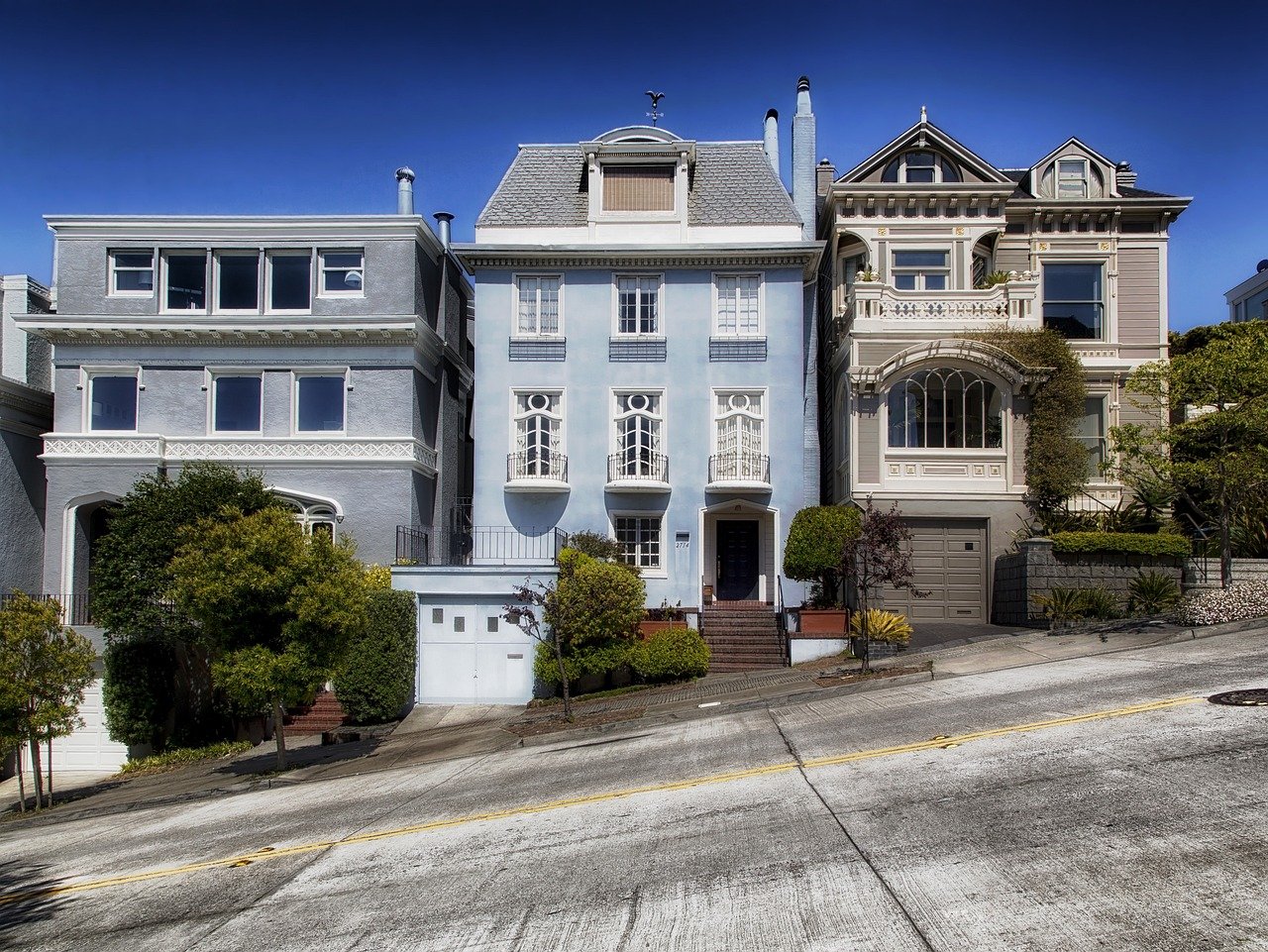

Sotelo Avenue in Forest Hill is the most prestigious street to own a home in San Francisco. I know. Someone on Broadway just spit out their $28 espresso.
Stay with me.
For 25 years I’ve watched San Franciscans argue about neighborhoods when neighborhoods are the wrong unit of measurement. As a resident and multiple property owner since 2001, I’m here to provide the definitive guide.
The reality is, a street is a lived experience. Two houses 400 feet apart in the same zip code can differ by 30% in price and 100% in quality of life, and the difference is almost never the house. It’s the street.
Tremendous AI Liquidity Coming To The San Francisco Real Estate Market
The reason this matters right now is money. A lot of it, arriving over the next decade as San Francisco experiences a boom loop.
The reason this matters right now is money. A lot of it, arriving soon with the upcoming IPOs and liquidity events of various AI companies such as Anthropic, OpenAI, Databricks, and more.
San Francisco’s chief economist thinks the IPOs generate over $10 billion for the city. Sales above $5 million already jumped 69% comparing the first quarter of 2025 to the first quarter of 2026.
So thousands of people in their early thirties are about to Google “best street to buy a house in San Francisco” with $8 million of after-tax money and no idea that the block matters more than the brand. This post is for them. And for the rest of us who want to know what we’re competing against.
Full disclosure before we start. I own property on the west side of San Francisco, so my bias is on the table where you can see it. But I also own properties on the North Side of San Francisco in Pacific Heights.
Read accordingly, and then go walk the streets yourself on a Tuesday at 8am and again on a Saturday at 2pm. That’s the main research that counts. But the reality is, unless you actually live on the street, you won’t really know, so my guide is here to help you gain the best perspective possible as a long-time San Francisco resident and multiple property owner.
How I Ranked The Top SF Streets: The Six S’s Of Street Prestige
Prestige is not the same as price. Price is what a street costs. Prestige is what a street keeps.
Plenty of expensive streets are miserable to live on. Plenty of quiet streets are underpriced because they never made a magazine. I scored each street on six factors, weighted by how much they actually protect your money over 20 years.
The six factors I score every street on, and how much each one counts.
Scarcity gets the top weight because it’s the only factor nobody can manufacture. You can renovate a kitchen. You cannot print more lots on a 650-home hillside laid out in 1912.
Serenity gets second because it’s the factor buyers underweight and owners never stop noticing. A busy street is a permanent tax on your life that shows up in your resale price whether or not you admit it.
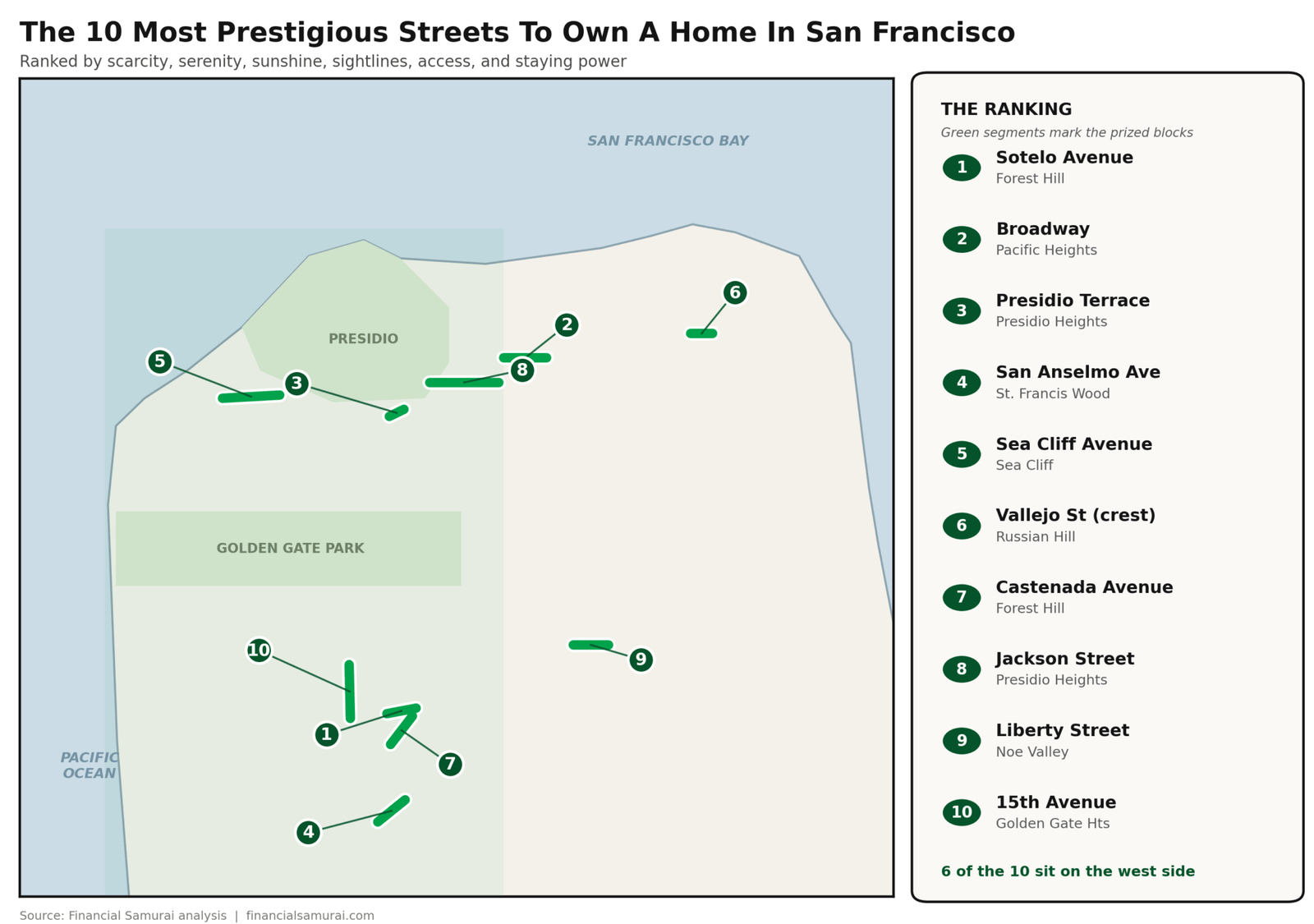
The ten most prestigious streets in San Francisco, highlighted in green. Six of the ten sit on the west side.
The Ranking At A Glance
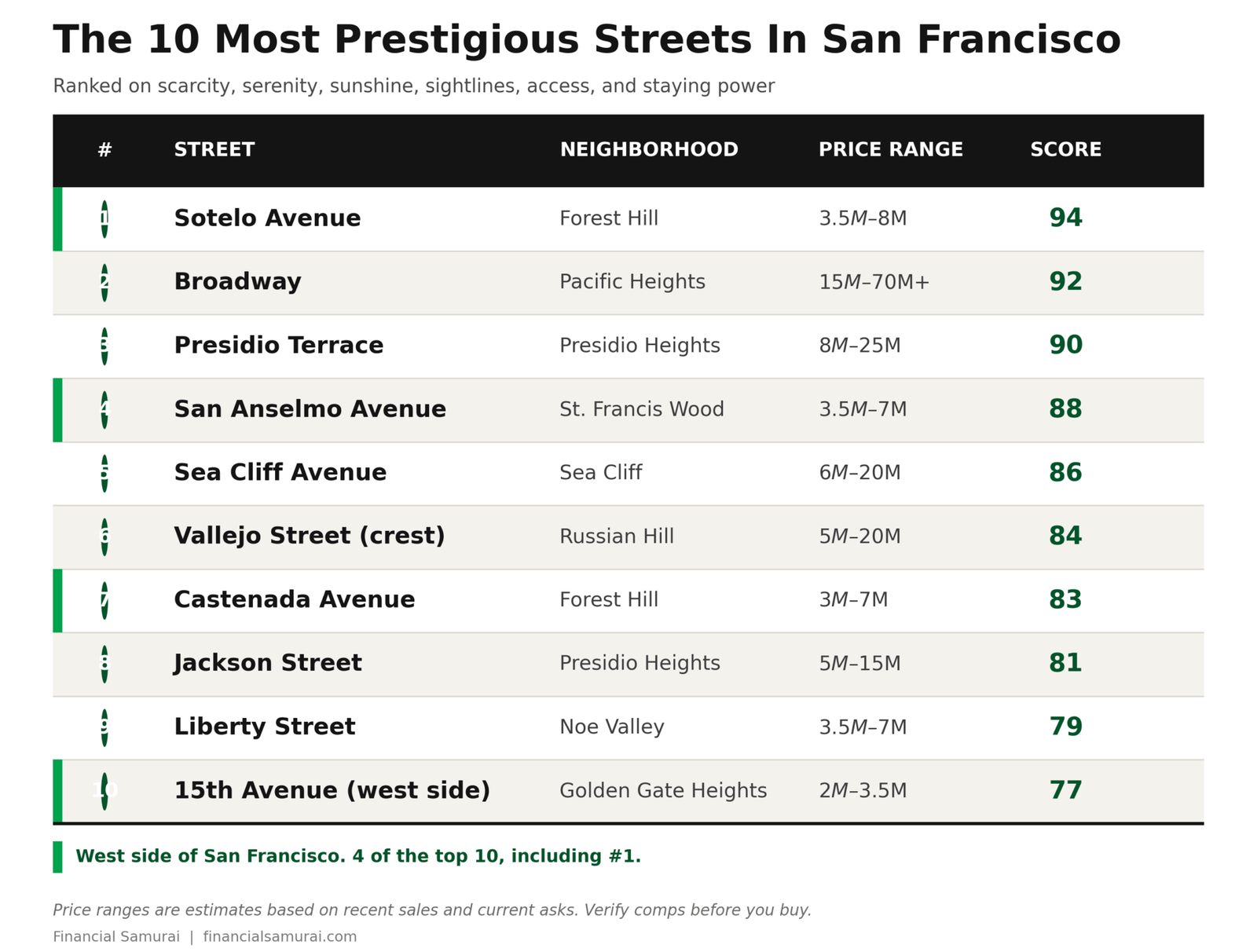
Price ranges are my estimates based on recent sales and current asks. Verify everything before you wire money.
1) Sotelo Avenue, Forest Hill
Forest Hill was master-planned in 1912 with roughly 650 homes total, streets wide enough for a horse and buggy, and a tree canopy that has now had a century to fill in. There is no version of the future where more Forest Hill gets built. That is the whole argument in one sentence.
Sotelo is the best street in it. It curves along the upper hillside, it dead-ends against open space rather than feeding a commuter route, and it gets the Golden Gate Bridge and bay sightlines that people fly across the world to photograph. Lots run large by San Francisco standards. Houses sit back from the street with actual front yards, which sounds trivial until you’ve lived somewhere your bedroom window is six feet from a bus stop.
Here’s the part nobody quantifies. Sotelo has almost zero through traffic. Nobody cuts across Sotelo to get anywhere because Pacheco is the street that handles most of the traffic. On a weekday morning you hear birds, and can easily keep the windows open when you sleep. In a city of 830,000 people that is a genuinely scarce commodity, and scarce commodities get repriced when a wall of money shows up.
Then there’s the Forest Hill Muni station, which is the quiet superpower of the entire west side. You can be downtown without a car in 15 minutes. You can be on 280 south toward Palo Alto in ten minutes. Hybrid work made optional commuting the most valuable kind, and Forest Hill is one of the only prestige pockets in the city that does both directions well.
The catch: fog. Not Outer Sunset fog, but you will get grey July mornings that the east side of the city, such as the Mission district, does not. If your entire identity is sunbathing, you may want to head more east. But the noise and traffic is intense.
Why it’s #1: maximum scarcity, near-perfect serenity, real views, transit both directions, and owners who hold for 30 years. Nothing else in the city scores across all six.
2) Broadway, Pacific Heights
Billionaire’s Row. Two to three blocks of north-facing lots between Divisadero and Lyon that look straight over the bay to Marin, with the Presidio on one flank and some of the most photographed mansions in the country lined up in a row.
This is the trophy asset of San Francisco real estate. It’s also the most liquid at the very top, because the buyer pool is global rather than local.
Laurene Powell Jobs paid roughly $71 million on the Row in 2024. In April 2026 a 15,000 square foot Pacific Heights home on Vallejo traded off-market for $56 million, with a losing bid reportedly at $52 million. Agents describe the current problem at the top of the market as a mansion shortage, which is a phrase I will be thinking about while I unclog my own gutters.
Why it’s not #1: Broadway is a real street with real traffic, and the very homes with the best views sit above a road people actually drive on. Prestige is off the charts, serenity is average, and the entry price is 4x to 8x the Forest Hill number for a house you will not enjoy 4x to 8x as much. You are buying a status asset, and there’s nothing wrong with that as long as you know that’s the trade.
3) Presidio Terrace, Presidio Heights
A private gated oval of about three dozen homes ringed by palm trees, previously home to Dianne Feinstein and Nancy Pelosi. It is the closest thing San Francisco has to a compound.
Scarcity is perfect. Serenity is perfect. The Presidio is across the street, which means 1,500 acres of forest and trails function as your front yard forever.
Why it’s not higher: two reasons. First, supply is so thin that homes almost never trade, which is great for prestige and terrible if you ever need liquidity. Second, this is the street whose HOA famously lost the pavement itself in a 2017 tax auction over an unpaid bill of about $14 a year, and an investor picked up the street for $90,000. I find that hysterical, and it is also a genuine reminder that exclusivity and competence are not the same thing.
4) San Anselmo Avenue, St. Francis Wood
St. Francis Wood is the grandest residence park in San Francisco. Bigger average homes than Forest Hill, formal landscaping, a private residents-only park in a quiet valley, and roughly 15% higher average prices as a result.
San Anselmo is where you want to be within it. The lots are deep, the homes are the large classical piles the neighborhood was built around, and you’re set back from the arterials.
The catch, and it’s the reason St. Francis Wood ranks below Forest Hill: traffic. Portola, Junipero Serra, Monterey, and St. Francis Boulevard all funnel cars through and around the neighborhood on their way south.
I’ve walked both neighborhoods with two young kids many times. The difference in ambient car volume is roughly 3x to 5x, and you feel it immediately. Which street and which block you buy on matters more in St. Francis Wood than almost anywhere else in the city.
5) Sea Cliff Avenue, Sea Cliff
Ocean, Golden Gate Bridge, Marin Headlands, and a private beach at the bottom of the stairs. Homes by Willis Polk and Julia Morgan. Roughly 250 houses total, wedged between the Presidio and Lands End, with nowhere to expand in any direction.
Sea Cliff has always traded on the strength of the view, and the view is the best in the city.
Why it’s not top three: it is isolated in a way people underestimate until they live there. You are a long way from everything, the fog and wind come off the ocean hard, and the bluff homes carry erosion and foundation questions that generate expensive conversations with structural engineers. Beautiful. Not carefree.
6) Vallejo Street Crest, Russian Hill
The two blocks at the top of the Vallejo Street ramp between Jones and Taylor, with the Willis Polk buildings and the balustrades and the stairs. Some of the oldest money and best architecture in San Francisco, and a downtown skyline view you cannot get from the west side at any price.
This is the one street on the list I’d pick if I were single, childless, and wanted to walk to dinner every night of my life.
Why it’s not higher: parking is a running joke, the hill is punishing, lots are small, and if you have small children you will spend a decade wondering why you chose a 40-degree slope as your primary environment.
7) Castenada Avenue, Forest Hill
Yes, two Forest Hill streets.
Castenada runs along the ridge and delivers some of the best bridge and bay panoramas in Forest Hill with the same big-lot, low-traffic, master-planned character. If Sotelo is unavailable, and it usually is, Castenada is the next call. It’s also where you find the older architecturally significant homes, some of them by Bernard Maybeck.
The catch: a few sections get more pass-through than Sotelo and the view quality drops off fast as you descend the hill. On this street, elevation is money.
8) Jackson Street, Presidio Heights
The blocks between Arguello and Spruce. Wide, tree-lined, formal, and quietly one of the strongest hold-forever streets in the city. Presidio access on one side, Clement and Sacramento Street shopping on the other, and the highest concentration of large intact single-family homes on the north side outside Broadway.
Lake Street a few blocks over posted a $4.75 million median across a small handful of 2026 sales, including an $11 million trade on Lake itself, which tells you the entire Presidio-adjacent corridor is repricing.
The catch: Jackson is a longer street than most on this list, and quality swings hard by block. West of Presidio Avenue, excellent. Keep going east and you’re paying Presidio Heights prices for a Lower Pac Heights experience.
9) Liberty Street, Noe Valley
The stretch between Castro and Noe. Victorians, a hill that gives you a downtown view, and the sunniest microclimate of anything on this list. Noe Valley took six of the top fifteen spots in a 2026 ranking of San Francisco streets by median sale price, which is not a fluke. It’s the family-formation street of choice for exactly the demographic about to get liquid.
If a 34-year-old at an AI company buys a $6 million house this year, statistically it is going to look a lot like Liberty Street.
The catch: you’re buying a Victorian on a modest lot with shared walls nearby and a serious parking problem. Wonderful lifestyle. Less scarcity, less permanence, more competition from every other newly wealthy 34-year-old with the same Zillow saved search.
10) 15th Avenue (West Side Of The Street), Golden Gate Heights
The value play, and the one I’d tell a friend to actually buy.
One street, and one side of it. Buy on the west side of 15th Avenue as it climbs through Golden Gate Heights and your back windows face the Pacific with nothing between you and Japan. Buy on the east side of the same street and you are looking at the back of the houses across from you, paying a Golden Gate Heights price for a Sunset view. Same address prefix, wildly different asset.
This is the single clearest example in San Francisco of why the street, and here the side of the street, matters more than the neighborhood.
Golden Gate Heights sits high enough to punch above the marine layer more often than the Sunset below it. In every other major city on earth, panoramic ocean views trade at enormous premiums. In San Francisco you can still get a full panoramic ocean view here for a fraction of what a bay view costs on the north side. I have watched 3/2 homes on this hill with real ocean views ask under $3 million while a viewless Pacific Heights condo asks the same.
Grand View Park is a short walk away and has, in my opinion, the best views in the entire city. The neighborhood is quiet, crime is low, and the rebuilt Golden Gate Heights Park gives kids somewhere to run.
The catch: hillside lots mean less usable land, and 15th Avenue carries more traffic than the tucked-away lanes above it. Prioritize a real driveway and a large deck, or you will own a view and nowhere to sit and look at it. And confirm the sightline in person at the actual floor level you would live on, because one badly placed neighbor’s roofline erases the whole premium.
Honorable Mentions
El Camino Del Mar (Sea Cliff), Normandie Terrace (Pacific Heights), Santa Ana Avenue (St. Francis Wood), Lake Street (Presidio Heights), Montgomery Street on Telegraph Hill, Ortega Way and Rockridge Drive (Golden Gate Heights), Scenic Way (Sea Cliff), and Yerba Buena Avenue for people who want the St. Francis Wood address and are willing to accept the traffic.
The Real Advice For Anyone About To Get Liquid
Prestige addresses are a wonderful consolation prize for a life spent working hard. They are a terrible primary financial plan.
Three guardrails I’d apply before buying on any street in this post.
Follow the 30/30/3 home buying rule. Keep the mortgage payment to no more than 30% of gross income, have 30% of the home value in cash before you buy (20% down and 10% as a buffer), and cap the purchase price at roughly 3x your gross annual income. Concentrated equity that hasn’t been sold does not count as income. It counts as a rumor.
Keep the home to no more than 30% of your net worth. If a $6 million house makes up 80% of everything you own and the rest is in the same stock that pays your salary, you don’t own a house. You own a leveraged bet on one company with a roof on it.
Sell some stock. Actually sell it. The most expensive lesson of every previous tech cycle is the person who held everything through the lockup because selling felt disloyal. Diversify into something boring the moment you legally can, then buy the house with cash you already have rather than cash you hope to have.
Frequently Asked Questions
What is the most prestigious street in San Francisco?
By pure price and public recognition, Broadway in Pacific Heights, known as Billionaire’s Row. By the combination of scarcity, quiet, views, access, and long-term ownership that actually protects value, I rank Sotelo Avenue in Forest Hill first for homes people can actually buy.
Why is the west side of San Francisco booming?
Bigger single-family homes on bigger lots, a demographic shift toward space that started with the pandemic and never reversed, the Chinese American International School campus near Stonestown, the expansion of St. Ignatius, the multi-billion dollar UCSF Parnassus rebuild adding over 1,300 jobs by 2030, and easy access both downtown and south toward Palo Alto.
Is Forest Hill better than St. Francis Wood?
St. Francis Wood has larger homes and averages around 15% more expensive. Forest Hill is quieter, with dramatically less through traffic, and has its own Muni station. For raising a family, I take Forest Hill.
How much does a home on Sotelo Avenue cost?
Roughly $3.5 million to $8 million depending on size, condition, and view, with the broader Forest Hill range running from about $2.5 million to $6 million-plus. Trades are infrequent, so a single sale can move the average.
Where will AI IPO millionaires buy homes in San Francisco?
My expectation is Noe Valley, Cole Valley, the Inner Sunset, Forest Hill, St. Francis Wood, and Golden Gate Heights for family buyers, and Pacific Heights, Presidio Heights, Sea Cliff, and Russian Hill for the smaller number of trophy buyers.
Diversify Your Real Estate Beyond One Expensive Street
Owning a $5 million home on a prestigious San Francisco street is a concentrated, illiquid, undiversified bet on one city and one industry. I love San Francisco real estate, and I still think you want exposure elsewhere.
Take a look at Fundrise, which manages over $3 billion for more than 350,000 investors across private real estate in the Sunbelt, where valuations and yields look more attractive than coastal city prices. The investment minimum is low, so you can dollar-cost average rather than write one enormous check.
Fundrise is a long-time sponsor of Financial Samurai, and Financial Samurai is an investor in Fundrise funds.
Related Posts
Buy The Right Home, Not The Impressive One
For the longer game of building the net worth that makes an expensive street affordable rather than terrifying, read Millionaire Milestones: Simple Steps To Seven Figures, a USA Today bestseller, also with Portfolio Penguin.
And for anyone buying a home mainly because of the school district, my next book, Your Children Will Be OK: Helping Them Navigate An Uncertain Future, argues that what happens inside the house matters far more than the address on the front of it.
Subscribe To Financial Samurai
If a friend forwarded you this post, join 60,000+ others and sign up for my free weekly newsletter. You can also get every new post via email, which arrives ad-free for the first few hours.
Everything I write is based on firsthand experience, because money is too important to be left up to pontification. I’ve lived in San Francisco since 2001 and have owned property here since 2003. Financial Samurai started in 2009 and is one of the largest independently-owned personal finance sites today. You can read more about my About page here.
Read the full article here