

There are layers to freedom, and most of us only ever peel back two.
The first layer is breaking free from your parents. Some people manage it the summer after high school. Others are still depending on dad to pay their new credit card charges at 37.
The second layer is breaking free from work. We call it FIRE, or traditional retirement. Once you generate enough passive income to cover your living expenses, you never have to answer to a bad boss again. My definition is stricter than most because I don’t want to touch principal until at least 60. Principal is the goose. You eat the eggs.
Then there’s the third layer. Freedom from the omnipotent government.
Nobody sells a course on this one, because there isn’t one. And I got a very polite, very tactical reminder of that last Thursday afternoon on an empty tennis court.
Two Park Rangers, One Empty Court, Two Small Children
We had flown back from Honolulu at 2am. I slept in until 8:15am, watered the garden, ate lunch, and did prep work for a consulting client based in Virginia at noon.
Afterward a little break, I took my kids out for tennis with Coach Dad. They hadn’t played in 10 days and were getting rusty. Forehand drills, backhand drills, the usual.
Out of nowhere, two stern-looking park rangers in sunglasses walked up and asked if I had a permit.
Huh?
It was 3:15pm on a Thursday. The park was empty. The court next to us was empty. There was nobody within a hundred yards.
I told them I didn’t have a permit. They told me I needed one, and that the fine was $192.
“Wait a minute. I need a permit to teach my own kids how to play tennis?”
They hemmed. They hawed. Uniforms, protective vests, batons on the hip, not a hint of a smile between them. Finally: “If they’re your kids, then I guess it’s OK.”
I had my children verbally confirm my paternity on a public tennis court. That is a sentence I never expected to write. Then I thought, six year olds and nine year olds don’t have IDs, so what does a parent actually do to prove they are the father?
Situational Awareness Seems Off
Here’s the thing: they were technically right. If you read the San Francisco Rec and Park walk-up tennis court rules, Park Code Article 3, Section 3.08 prohibits tennis instruction on public courts without a permit. Full stop. No carve-out for parents. No carve-out for empty courts.
The rule exists to stop pros from running a free business on courts the city maintains. Fine, even though I’m pro everybody starting a side hustle to save and invest more for their future. But read it closely and you’ll notice it doesn’t say “commercial instruction.” It just says instruction. Which means every dad in San Francisco who has ever said “step into it, buddy” on a public court has technically committed a code violation.
I honestly had no idea I needed a permit to teach my kids tennis or anything at a public park, which is supported by my tax dollars. Now I know. My bad. But based on the Twitter feedback, which has over 1.5 million views, most parents didn’t know either.
Watching And Waiting To Pounce
The park rangers had clearly been watching me for a few minutes and concluded I was a commercial operator. On an empty court not bothering anybody.
Why couldn’t they see a dad spending a summer day with his kids? There was no parent sitting on the bench watching, which is usually the tell. There was no line of people waiting. Courts already have a 30-minute limit if folks are waiting, so you can’t monopolize one all day even if you tried.
I understand if the courts were packed and I was coaching kids in pickleball, making incessant dinking noise when the courts are reserved for tennis. That’s real. But this was two children and a bucket of tennis balls having fun in an empty park.
And I stood there thinking the same thought I’ve been circling for 15 years: I pay roughly $100,000 a year in property taxes alone. Some of that money paved that court. And I needed a permit to stand on it with my own kids.
The Bill For All This Protection
Let’s talk about what the third layer actually costs.
Like roughly 60% of American households, I pay federal income taxes, which help support the roughly 40% of households that pay none in a given year. On top of that I pay capital gains taxes, property taxes, sales taxes, and FICA.
Taxes build a better society, and I’m proud to pay them up to a point. That point, for me, arrived when my marginal federal rate hit 39%.
Because 39% was never actually 39%. Add 10%+ California state tax. Add 7.65% FICA on a portion of income. You are now handing over half of every incremental dollar for the privilege of working 60 hours a week.
And what was that job doing to me? Chronic back pain. TMJ so bad I ground my molars flat and had to see a specialist who drilled divots into my teeth to relieve the pressure.
That is the deal on the table for a lot of high earners. Destroy your body. Give away half the upside. Then get asked for a permit at the park you paid for to play with your kids.
Your Health And Happiness Are Valuable
Think about what 30% of your gross income actually represents. If you work a 40-year career, you are working roughly 12 years of it for the government. Not for your kids’ college. Not for your freedom fund. Twelve years, for someone else’s spending priorities, decided by people you did not vote for and cannot fire.
If those 12 years bought perfectly maintained roads, world-class public schools, zero waste, and no wars, most of us would sign happily. But we all observe the government graft and inefficiencies that never get solved. When you learn what the money actually funds, the 12 years start to feel less like a civic contribution and more like a subscription you can’t cancel.
So I Reduced My Active Income On Purpose
I did what any rational economic actor does when the marginal return on effort collapses. I worked less.
But instead of just downshifting, I opted out altogether in 2012 by leaving my dad job for good.
And you know what? I was happier earning 80% less, because I finally had time to enjoy the things I’d been paying for. The parks. The trails. The tennis courts, permit pending.
This is the part that policymakers consistently underestimate. Raise the marginal rate high enough and high earners either relocate or downshift. They convert active income into passive income, they take the sabbatical, they retire early. The revenue never shows up because the effort never happens.
Then I Sold A House To Reduce Property Taxes
In 2025 I sold a primary residence I bought in 2020. We lived in it for 3.5 years and rented it out for one after buying a new house in 2023.
Two reasons. First, we were dangerously concentrated in San Francisco real estate, and watching the Pacific Palisades fire wipe out hundreds of homes out of the blue made that concentration feel dangerous.
Second, our annual property tax bill had rocketed past $140,000 a year. Cap rates on single family homes in San Francisco are low, so the math simply stopped working when I could earn a higher risk-free return in Treasuries. Selling cut about $38,000 a year off the bill.
It feels much better to “only” pay about $100,000 a year for schools, fire, police, parks, bridges, transit, public health, and public schools. I know it’s not as much for some of you, but it’s property tax contribution by dual unemployed parents.
I didn’t evade anything. Instead, I restructured, and I feel better for it.
However, if $100,000 a year can’t buy me a friendly smile from two park rangers interrupting my afternoon with my kids at an empty park, I’m not sure the price is right anymore. Maybe $70,000 is more reasonable for the thrill of feeling like a criminal for taking care of my own children.
FIRE Was Never Just About Escaping Your Boss
This is the part of FIRE that gets flattened into “quit your job and travel.”
FIRE is about removing the number of entities that can dictate your day. A boss can ruin your Tuesday. A tax code can sully your decade. A permit requirement can disrupt an afternoon with your kids.
Financial independence shrinks the list. It doesn’t eliminate it.
Because here’s the trap. The more you pay in taxes, the more you feel you’ve bought some kind of premium membership with enhanced civil liberties. It’s exactly backwards. The more you pay, the more visible you become, and the more the system leans on you, because you’re the one who can pay.
Assets get assessed. Income gets reported. Improvements get permitted. Instruction gets licensed. The better you do, the more surface area you present for the government to take.
FIRE gets you out from under the first two layers. It does not get you out from under the third. Nothing does, short of owning nothing and earning nothing, which is a strange definition of winning.
The only true escape hatch is off the grid. No title, no W-2, no 1099, no assessed value, no permit needed because you’re not on public land. And I’m not doing that. I like restaurants and hospitals and hot showers too much.
So the rational move for the rest of us isn’t escape. It’s dosage. Decide how much government you’re willing to buy, then structure your work and your assets to buy exactly that much and not a dollar more.
Structuring your work sounds simple until you remember your employer holds the cards. I left in 2012 with a severance that covered years of living expenses. It’s the only reason walking away from a 39% marginal rate was doable. Most people just quit and get nothing. How To Engineer Your Layoff shows you how to negotiate one instead. Use code saveten at checkout to save $10.
The Leash Ratio: How Much Slack Do You Actually Have?
Here’s the practical takeaway. I’ve been running this number since 2009.
The Leash Ratio = your effective total tax rate ÷ your gross savings rate
Formally it’s the Tax-to-Savings ratio. But nobody remembers “Tax-to-Savings.” Everybody remembers the leash, because that is exactly what this number measures. Not whether you’re free, because you aren’t. How much slack you’ve got.
Two definitions before the comment section relitigates this:
Effective total tax rate is every income tax you pay, federal plus state plus FICA plus the Medicare surtax, divided by gross income. Not your marginal bracket. The real blended number at the bottom of your return.
Gross savings rate is everything you save and invest, including 401(k) contributions and the employer match, divided by that same gross income.
Both numbers use gross. That’s deliberate. The government calculates its cut off your adjusted gross income, so you should calculate yours the same way. It also makes the ratio self-checking, because tax rate plus savings rate plus spending rate has to add up to 100%.
Example: you gross $200,000. You pay $50,000 in total income taxes, so a 25% effective rate. You save $60,000, so a 30% gross savings rate.
Your Leash Ratio is 25 ÷ 30 = 83%. The lower is better.
The Leash Ratio In Practice
Tax = effective total income tax rate. Saved = gross saving rate. Leash Ratio = Tax ÷ Saved. Lower is better. Source: FinancialSamurai.com
Look at Sheila and Lebron, then look at Dave. Sheila and Lebron pay the least in taxes and have the least freedom. Dave pays the most and is barely better off than either of them. The tax rate is not what determines who gets off the leash. The saving rate is.
That’s the uncomfortable lesson buried in this number, and it’s why I put the ratio at the end instead of the beginning. Complaining about your effective tax rate is a luxury position. If your Leash Ratio is above 150%, the government is not the thing standing between you and freedom.
But now look at Dave again, because the reverse is also true. To hit a Leash Ratio of 50% at a 40% effective tax rate, Dave would need to save 80% of his gross income and live on the remaining nothing. Almost impossible to do. Past roughly a 25% effective tax rate, the ideal ratio stops being a discipline problem and becomes an arithmetic one. That’s the whole thesis of this post in a single row of a table.
Find Your Leash Ratio
Run down the left column for your effective tax rate, across the top for your gross savings rate.
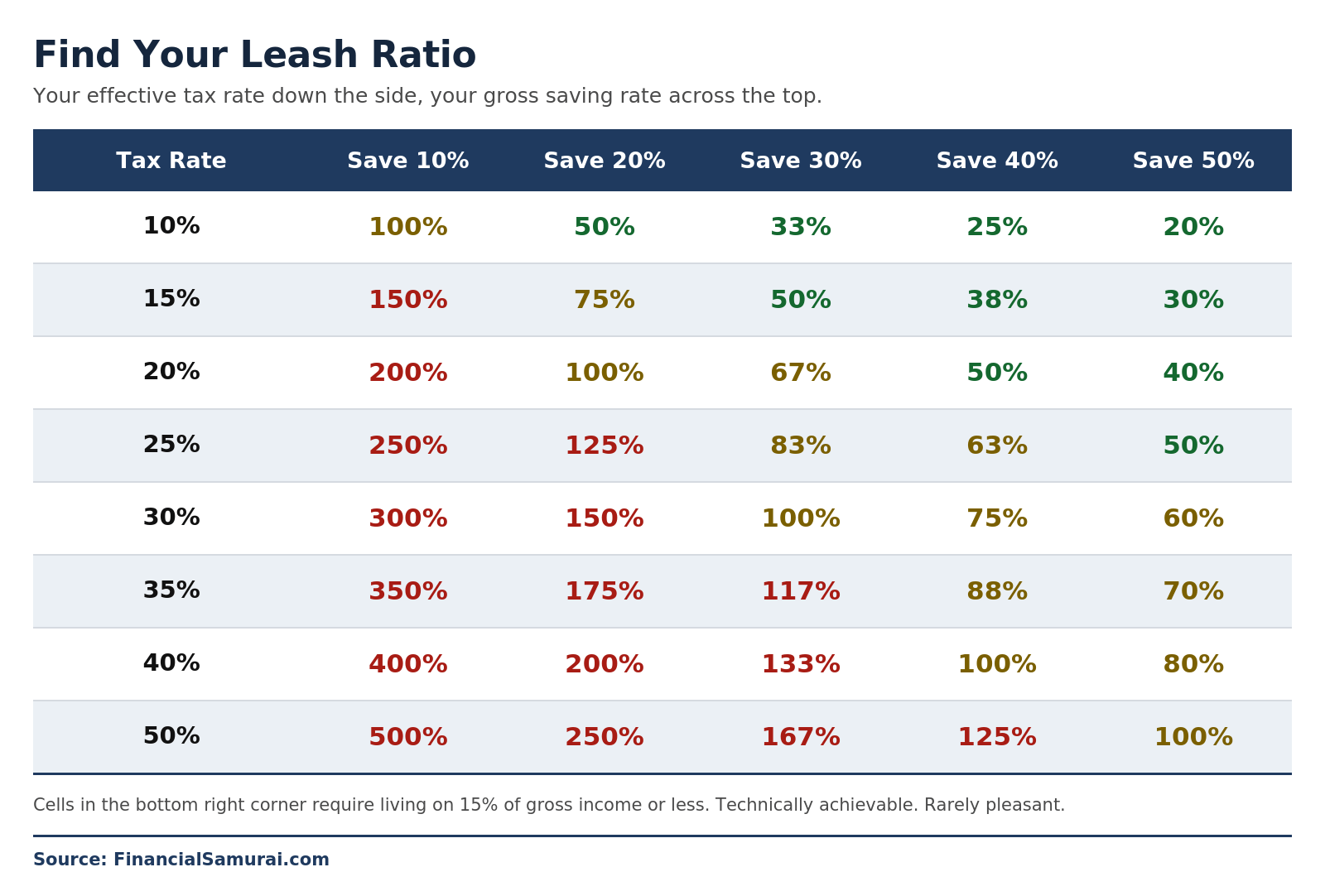
Source: FinancialSamurai.com. Cells in the bottom right corner require living on 15% of gross income or less. Technically achievable. Rarely pleasant.
What Your Score Means
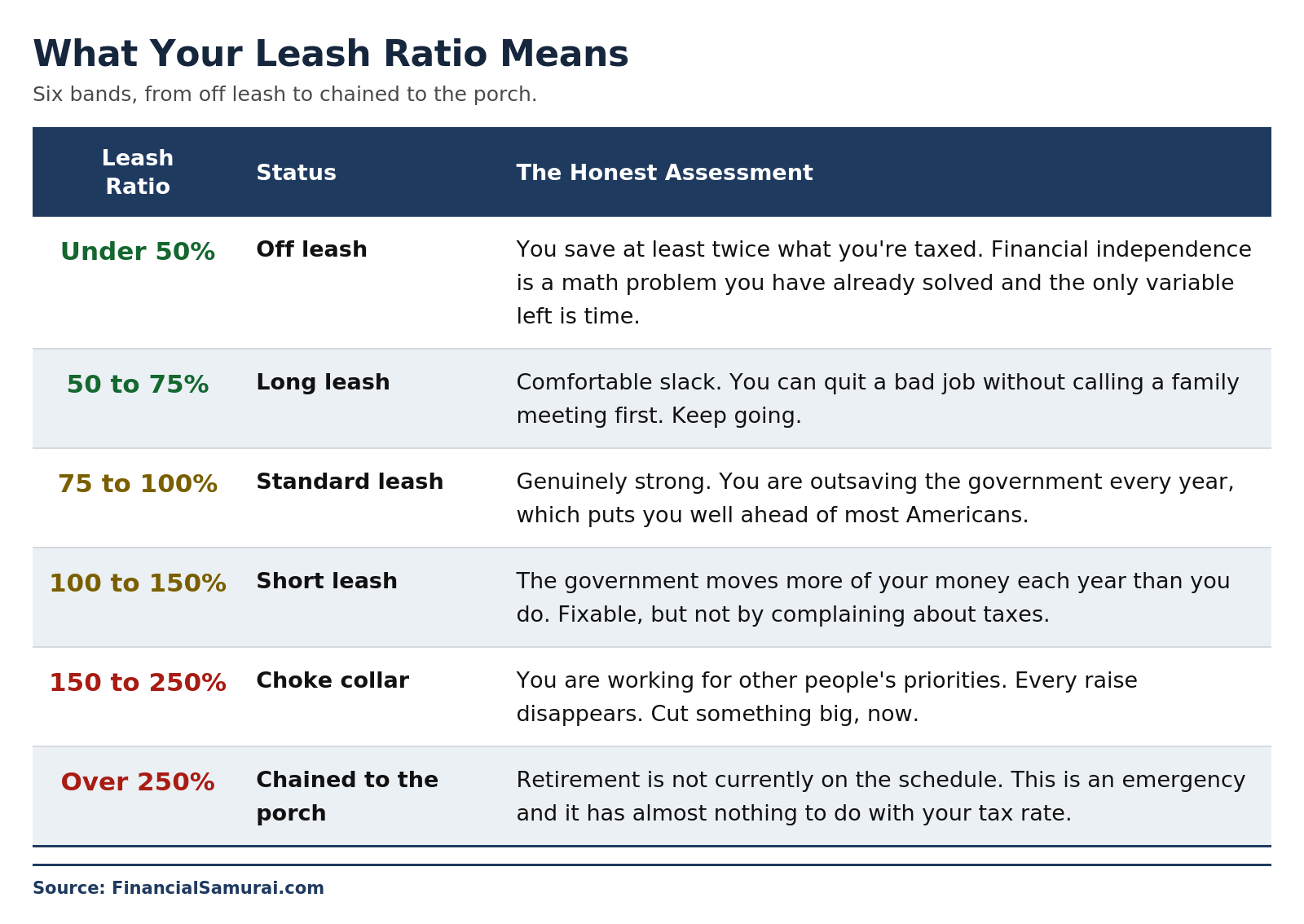
Fair warning: measured off gross, most Americans land in choke collar territory or worse. The typical household saves single digits of gross income against a mid-teens effective tax rate. If that’s you, don’t get defensive, get moving. The number is a starting line, not a verdict.
Under 50% is a stretch goal and most people won’t get there. The value is in the direction of travel. If your Leash Ratio drops every single year, you’re winning, and the leash gets longer whether or not Congress ever helps.
Running your Leash Ratio takes two numbers most people don’t have handy: what you actually paid in total taxes last year, and what you actually saved. I’ve used Empower’s free financial tools since 2012 for exactly this. Link your accounts and your saving rate and net worth update themselves, instead of living in a spreadsheet you refresh twice a year and then abandon.
Another great alternative is ProjectionLab, which enables you to create fantastic what if saving and taxation scenarios to help you better manage your financial future.
The Freedom You Can Actually Buy
I’m willing to work 60 hours a week for a total effective tax rate under about 28%. Above that, no thank you, I’ll take the time instead. I’m comfortable paying $100,000 a year in property taxes as San Francisco’s doom loop turns into a boom loop. Not much more.
Those are my numbers. Yours will be different. But you should have them, because if you don’t set the line, someone else sets it for you.
You will never be truly free so long as you own something or earn something. The government will always want a piece, and they’ll always have a form for it.
What you can do is decide how big that piece gets. Save more than you’re taxed. Convert active income into passive income. Own less of what gets assessed and more of what compounds quietly.
And if you see me on an empty court in a public park teaching a seven-year-old to hit a topspin backhand, please tell the rangers I have documentation.
Readers, what’s your Leash Ratio? Have you ever consciously reduced your income or restructured your assets to pay less in taxes, and did it actually make you happier? And has a government employee ever stopped you from doing something completely harmless on property your own taxes paid for?
If a friend forwarded you this post, join 60,000+ readers and get my free weekly newsletter. To get every new post the moment it publishes, and ad-free for the first few hours, subscribe here.
Read the full article here