




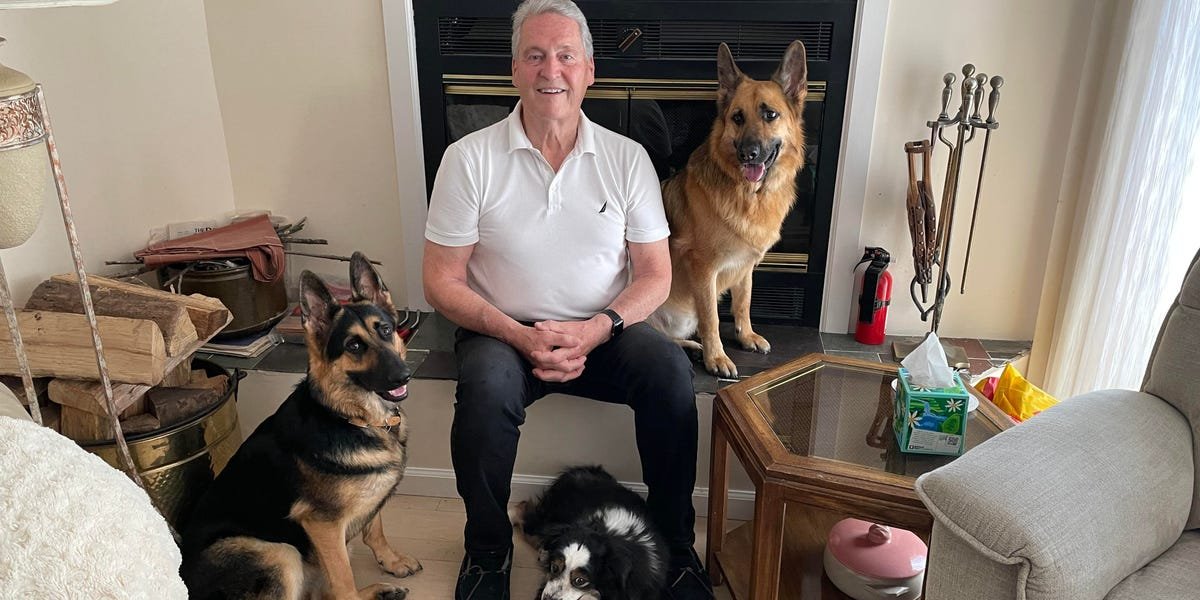

This as-told-to essay is based on a conversation with Jerry Burns, a puppy raiser with Guiding Eyes for the Blind. It has been edited for length and clarity.
I ran my own businesses for 53 years. First, I did wholesale sales of tobacco and candy. When I sold my partnership stake after more than three decades, I decided to focus on candy and snacks, avoiding the negativity of tobacco. We expanded into novelty goods and nostalgia items, which turned out to be a very good decision: It was a more enjoyable workday, and the margins were bigger.
I liked being an entrepreneur, but in my late 60s, I scaled back so I was only working about four hours a day. That’s when I first started thinking about volunteer work. I knew I wanted a sense of purpose in the next phase of my life.
I’ve always loved dogs, so I reached out to Guiding Eyes for the Blind, which has three puppy-raising facilities near me. I came for the dogs, but I stayed because the organization was so well-run. As a businessman, I appreciated that.
I was drawn to the German Shepherds in the program
I started volunteering regularly with Guiding Eyes for the Blind. I would help feed and walk dogs at the breeding kennel near my home. Often, I would bring a dog home with me in between my visits.
While most dogs in the program are Labrador retrievers, about 10% are German Shepherds. The Shepherds are amazingly smart dogs, but they often struggle in the kennel — they can become overwhelmed and act out by barking or jumping.
I had a German Shepherd in my 20s, and was immediately drawn to the breed again once I started volunteering. When I brought one home, the dog would immediately calm down and be able to fulfill its potential. I even hand-fed one dog, who was having a particularly difficult time with kennel life.
I started fostering a breeding dog, then raising his puppy
A little over a year ago, I sold my business and officially retired. I was fostering a shepherd who was a stud in the breeding program. That dog, Kohl, was supposed to be a long-term placement in my home, and I was thrilled at the idea. He was the perfect fit for my family.
Then Guiding Eyes decided to place Kohl in more formal training. I was a bit sad, but I thought if that’s the plan, that’s what we have to do. Kohl was meant to go on to bigger and better things.
Right around the same time, I was asked to become a puppy raiser for one of Kohl’s puppies. It seemed like the perfect timing. I was used to getting up at 7 a.m. every day and being out the door by 8. If I had a puppy to train, I could continue that schedule. I wanted to have structure in retirement and not find myself wondering, “What am I going to do today?”
I love the pup like my other dogs, but I know she’s not mine
That’s how I ended up with Geneva. About a month after she came home, we got a call that Kohl, her father, was being removed from the training program. I was thrilled to adopt him and have him join my mini Australian shepherd as a pet.
Over the past year, I’ve attended training with Geneva, and loved her like the other dogs in my house. Still, I know she’s not mine to keep: this summer, she’ll be moving on to formal service dog training. Puppy raisers typically have a dog for about 14-18 months. When I give her treats or pats, I remind her (and myself) that she’s going to do great things.
I’ve connected with a community through the program
The visually impaired people who use service dogs have had a tremendous impact on me. Hearing their stories showed me what a home run this program is, and I’m so glad to be part of it, even in a small way.
I’ve met great dogs through Guiding Eyes, but I’ve also met great people. I have a community of probably 25 puppy raisers, who go on walks and have dinner together to celebrate when a puppy is ready to move on to formal training.
Oftentimes, the puppy raiser already knows they’ll be getting another placement. I’m not sure my wife is ready for that, but Guiding Eyes has told me there will be another shepherd puppy ready for placement in the fall, soon after Geneva leaves. I might not be able to say no.
Read the full article here