





In what is perhaps Thomas Edison’s most famous quote, the inventor said, “Genius is one percent inspiration, 99 percent perspiration.”
For most of Edison’s career, this perspiration took place in his laboratory in West Orange, New Jersey.
When the laboratory opened in 1887, Edison had already been credited with inventing the light bulb and the phonograph, and he was a successful businessman. But in this new workspace about 15 miles from New York City, he’d continue to conduct experiments for the next 45 years until his death in 1931.
Edison previously worked out of a laboratory in Menlo Park, New Jersey, where he developed the light bulb and the phonograph, but it was in West Orange where he’d continue to experiment, creating the world’s first motion-picture camera, successful alkaline storage batteries, and other devices that would have far-reaching impacts on American innovation.
Edison registered a jaw-dropping 1,093 patents in his lifetime, though his work couldn’t have been achieved without models from his contemporaries, and his collaborators and engineers were crucial in the development of his fully in-house inventions.
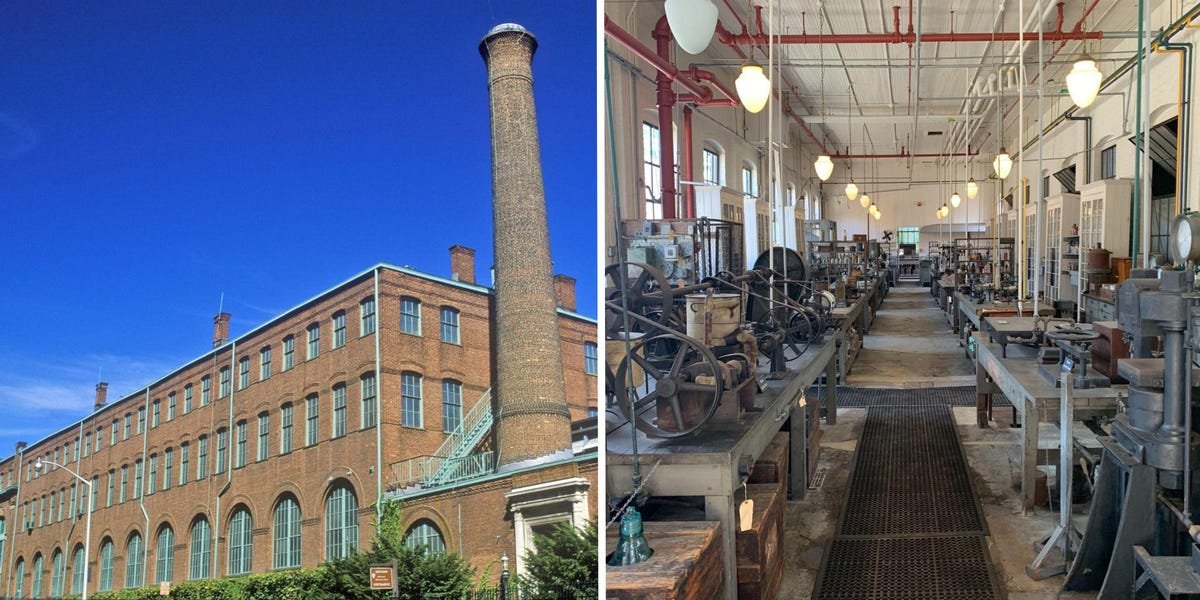
Today, the West Orange laboratory is known as Thomas Edison National Historical Park and is maintained by the National Park Service. Many rooms in the lab have been preserved to look exactly as they did when Edison died nearly 100 years ago.
See inside the 139-year-old laboratory.
Read the full article here