






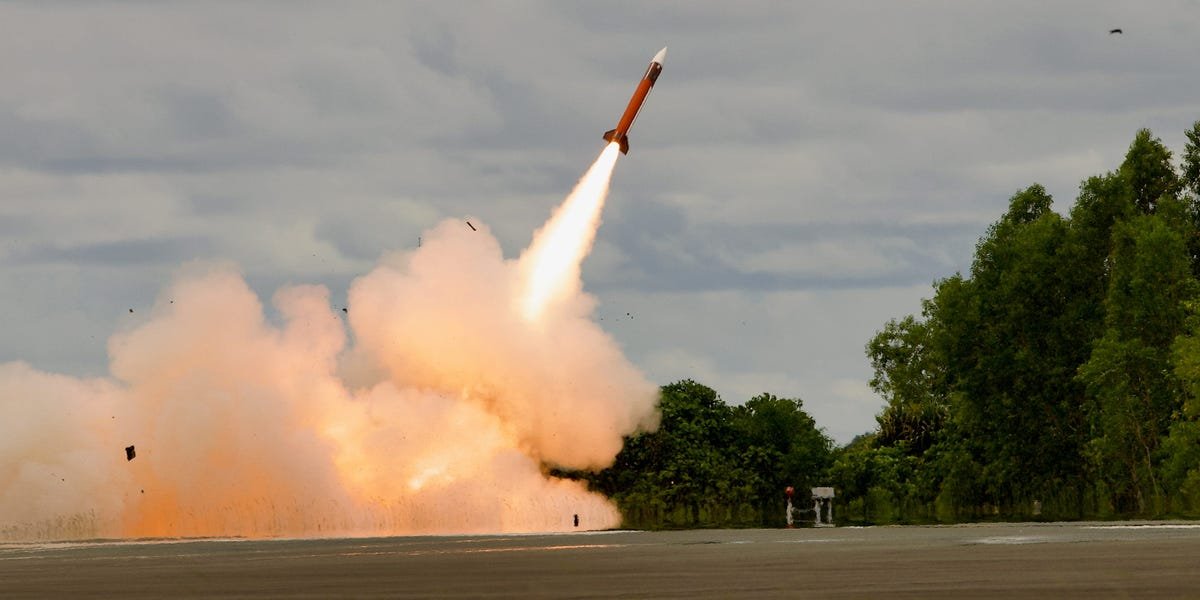

Ukraine didn’t shoot down a single Russian ballistic missile during a massive attack that began Sunday night and killed and wounded dozens of people.
Ukrainian officials said that the ballistic missiles were able to penetrate their country’s air defenses and strike their targets because Kyiv lacks critical interceptors, specifically the much-sought-after Patriot PAC-3 made by the US.
Russia launched 23 ballistic missiles, more than three dozen cruise missiles, and hundreds of drones in the attack, which mainly targeted the capital, Kyiv. Ukraine’s air force said defenders shot down most of the threats; however, they didn’t intercept any of the ballistic missiles.
“Our warriors performed well today in intercepting drones and cruise missiles, but unfortunately not Russian ballistic missiles,” said Ukrainian President Volodymyr Zelenskyy on Monday, a day after he warned that a large-scale attack was imminent. “The reason lies in the insufficient supply of interceptor missiles.”
Mykhailo Fedorov, Ukraine’s defense minister, said that Russian forces are ramping up their ballistic missile use, “launching them at a scale not previously seen while exploiting the critical shortage of interceptor missiles for Patriot air defense systems.”
Ukraine has multiple air defense layers to protect major cities such as Kyiv, and these rely heavily on Western-donated systems. The most high-profile of these is the MIM-104 Patriot battery — widely regarded as the country’s best defense against high-speed Russian ballistic missiles.
The US-made Patriot fires several different types of interceptors, including the Patriot Advanced Capability-3, or PAC-3, which has an estimated price tag of nearly $4 million. Ukrainian officials have repeatedly said that Kyiv doesn’t have enough of these in its arsenal and have pleaded with NATO countries to send more.
Ukrainian officials renewed these calls on Monday, arguing that there are plenty of Patriot interceptors in global stockpiles and that they would be of better use in Kyiv’s hands.
“Interceptor missiles belong in Ukraine’s air defense system now — not sitting in stockpiles,” the defense ministry said.
Zelenskyy is scheduled to meet with President Donald Trump this week on the sidelines of the NATO summit in Ankara, a White House spokesperson told reporters on Sunday. In previous meetings, air defense has been central.
Mark Rutte, the NATO secretary general, confirmed to reporters on Monday that interceptors are still flowing into Ukraine. However, he acknowledged that there’s a “limit to the amount of interceptors there are” in alliance territory and called on member states to ramp up production.
While industry is surging the production of Patriot interceptors, these defensive tools are in high demand globally. The US and its allies in the Middle East fired hundreds during the weekslong conflict with Iran earlier this year. Air defense doctrine typically calls for at least two interceptors for each incoming missile, so stockpiles can rapidly dwindle in a high-intensity conflict.
Global stockpiles were already under significant strain, and production has long struggled to keep pace with demand. To address its critical supply problem, Ukraine has been turning to its European partners for help with the long-term acquisition of interceptors.
“We have already signed contracts for Patriot interceptor missiles and continue to secure additional agreements, with deliveries scheduled to begin next year,” Fedorov said Monday.
“Our appeal to our partners is straightforward: transfer missiles from your stockpiles now, and replenish them later through our future deliveries,” he added.
Read the full article here