





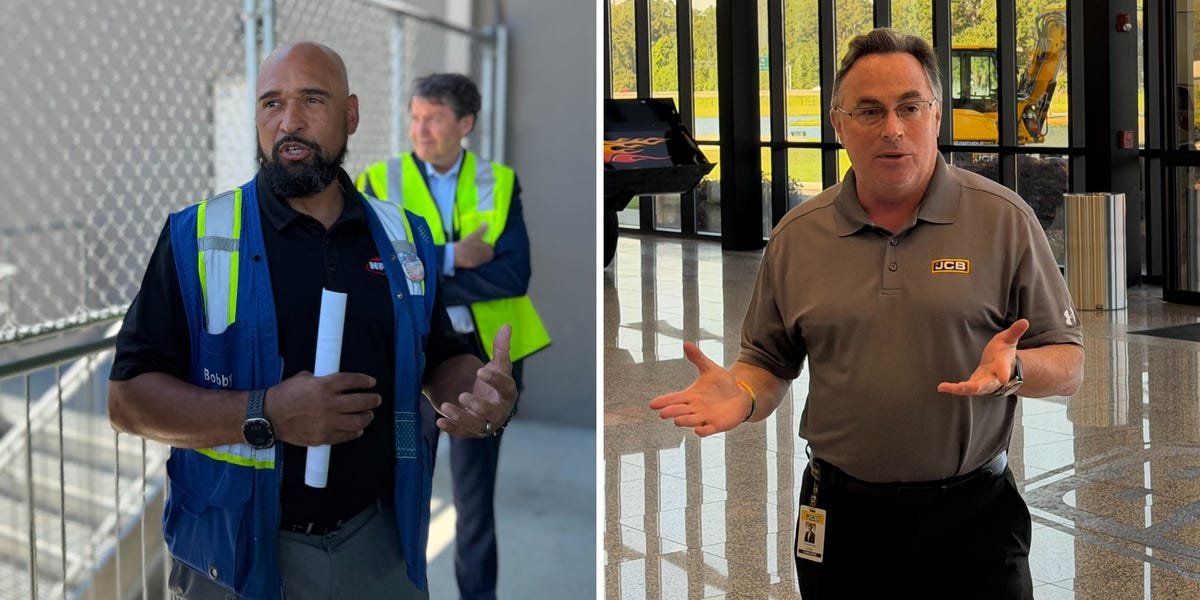

Ken Bianco lets out a brief laugh when he hears the question. Open a factory in California — where most of his customers are? “Absolutely not,” says JCB’s vice president of commercial operations, slicing the air with his hand as if swatting away a bothersome fly. “California has become too slow,” he says. “Everything takes too long there — it’s simply not business-friendly.”
Bianco is standing in the lobby of construction and industrial equipment manufacturer JCB. To his left sits a model of the world’s fastest diesel engine, to his right a backhoe loader painted with a flame motif. When the company, founded in Britain in 1945, planned its first US plant in 2001, one thing was clear: it would head south. “Georgia welcomed us with incredible incentives,” Bianco recalls. Today, the firm’s North American headquarters stands here, complete with 500,000 square feet of production space, and a second large plant is currently under construction in the “Lone Star State” of Texas.
That Republican-governed states in the American South are attracting so much investment is no coincidence. A look at the data reveals a pattern. Georgia, Florida, South Carolina, Utah, and Texas ranked among the country’s leaders in both economic and population growth in 2025.
While US GDP as a whole rose by 2.1% last year, Florida and South Carolina recorded gains of just over 3%, according to the Bureau of Economic Analysis — the highest rate of any state. Utah comes in just below that, with Texas also above the national average.
The trend of recent years is clear: While liberal metropolitan regions such as San Francisco, Boston, and New York remain the centers of finance, Big Tech, and research, industry is shifting ever more strongly into the Southern states. Manufacturing firms in particular are increasingly drawn to places where Republicans hold power. According to a report by CBRE, one of the nation’s largest real estate brokerage firms, 725 companies relocated their headquarters between 2018 and 2025. Increasingly, they left high-tax states like California or New York for Republican states like Florida or Texas.
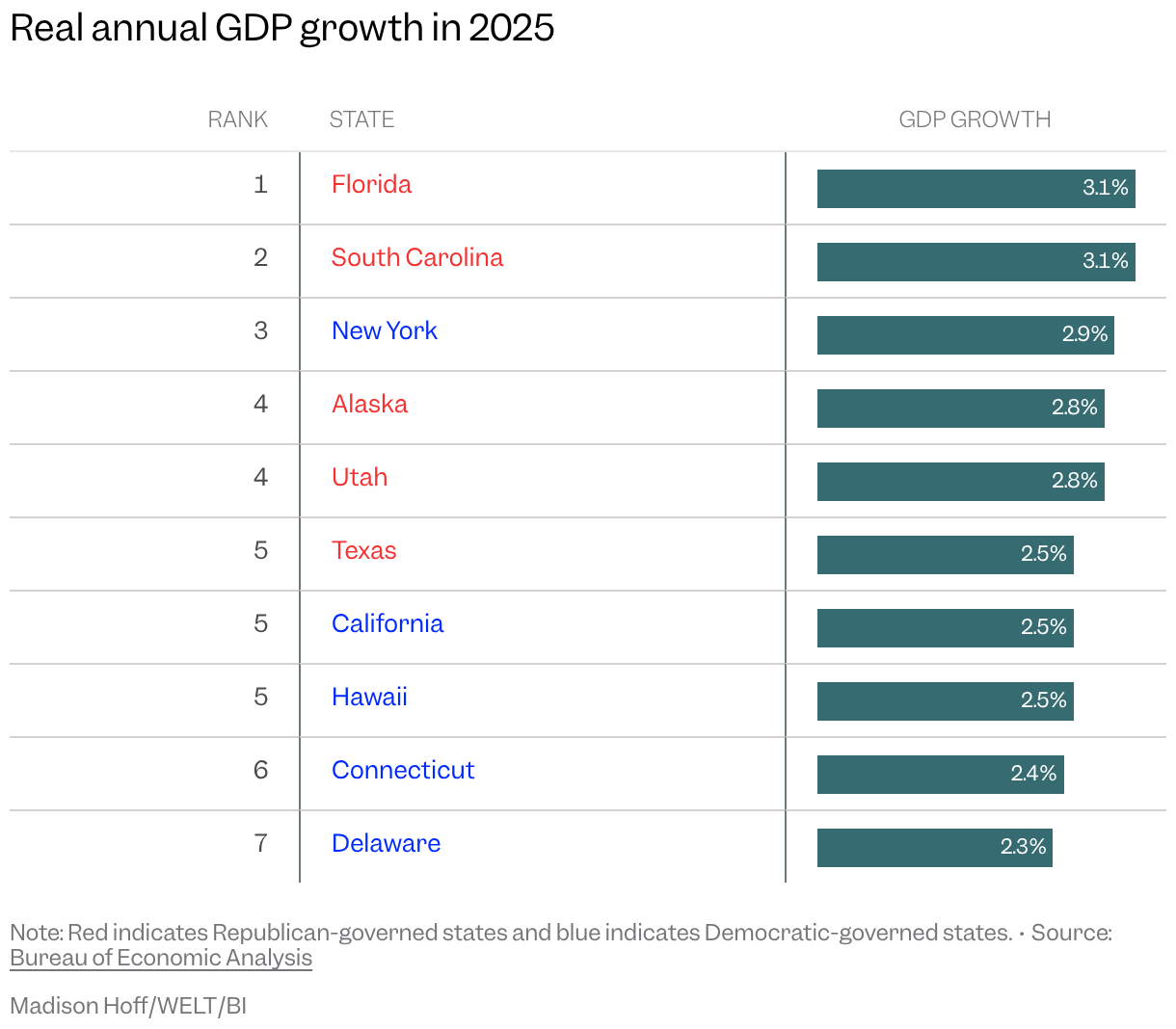
Economies of powerhouse states like New York and California are still growing too, driven above all by the tech boom. But the stronger momentum is currently elsewhere, as the population figures show. While New York’s headcount is stagnating, California has been losing residents for several years — and the list of big-name companies turning their backs on the “Golden State” is growing steadily longer.
South Carolina, by contrast, is currently the nation’s fastest-growing state in percentage terms. Texas, according to the US Census Bureau, is gaining the most residents in absolute numbers: In the past 15 years alone, nearly 7 million people have moved there. Often overlooked, Utah is also buoyed by a young, growing population, while Florida leads the field in immigration from abroad.
Behind these numbers lie millions of individual decisions. Taken together, however, they point to a clear conclusion: in the first year of “Trump 2.0”, it is above all Republican-governed states that are attracting industrial investment and people. There is no shortage of examples.
Take billionaire investor Kenneth Griffin, who — spooked by New York’s mayor Zohran Mamdani’s tax plans — has declared he would rather invest in Miami than in New York. Or the software engineers from Tesla or Oracle who have left overheated Silicon Valley for Austin, drawn by a mix of tech jobs, leafy suburbs, and low income taxes. Or the fast-growing cohort of retirees selling their homes in the Midwest to enjoy the Florida sun. It is the industrial sector in particular that is fueling the upswing in the South, while the former “workbench of America” — the so-called Rust Belt — continues to bleed out.
One of the companies on a growth track is JCB, which operates its largest US plant just outside the port city of Savannah. “Twenty-five years ago, this was just an acre,” Bianco recalls. Today, the factory alone turns out more than 20 excavators a day, and soon that number is expected to rise to 30 — the order books are full. The plant employs 560 workers in production and around 200 in administration.
Its success also has to do with America’s military build-up under Donald Trump. In its commercials, JCB presents itself as a problem-solver that makes heavy equipment for construction sites. But the company has long since moved into the booming military business, which people here euphemistically refer to as “defense”.
During the plant visit in Georgia, press officers monitor every step the visitors take and repeatedly urge them not to take photos — the highest level of security applies in the military area. In terms of the US Army, Georgia has another strategic advantage: the state is home to the country’s largest infantry presence, meaning the armed forces, a major client, are effectively on the doorstep.
Republican-governed states tend to have one thing in common: in most cases, they have been traditionally “red” for decades. Especially in Texas and Florida, some politicians see themselves, with pride, as the antithesis to the “blue” coastal metropolises; talk of “blue state bullshit” that they want to keep at arm’s length is commonplace. The relentless culture war that has been raging in the US for years has only intensified since Donald Trump returned to the White House.
In reality, though, the reasons why industrial companies prefer to invest in the Republican South are rather prosaic. Governors and local politicians promise to keep taxes low, limit the rules imposed on business, and fast-track infrastructure projects. In practice, that means fewer requirements, quicker permits, and more projects. Big-name developers who might wait years for a building permit in California or the Northeast encounter municipalities here that actively court investors.
Few examples show this as clearly as the corporate empire Elon Musk has moved from California to Texas. In the southwest of the Lone Star State, SpaceX rockets now shoot into the sky, and the company boasts the highest stock market valuation in history, while just outside the capital, Austin, the world’s richest man has, within a few short years, built an entire “corporate town” around his companies, Tesla, The Boring Company, and X.
Texas is, overall, a special case. The oil and gas business is benefiting from Trump’s policy of giving fossil fuels more room again; at the same time, tech clusters are springing up along the highways around Austin, Dallas, and Houston, where start-ups sit side by side with branch offices of corporations that have shifted activities from expensive coastal regions to the Sun Belt.
Cities like Austin are long past being the cheap alternative for hipsters from San Francisco; they have themselves become pricey metropolises plagued by traffic jams, housing shortages, and rising homelessness numbers. Yet compared with many coastal cities, a house with a garden remains within reach — and above all, the tax burden is lower.
Perhaps the most visible consequence of the investment boom is the construction spree. Around cities like Houston, Miami, or Atlanta, one new suburban development after another is going up. On the outskirts of hubs such as Savannah or Laredo, Texas — the largest freight gateway on the Mexican border — cranes are erecting new logistics centers almost weekly.
On top of this comes a second, hugely capital-intensive trend: the boom in data centers. With space at traditional locations such as the Bay Area or greater Seattle exhausted and expensive, investors have shifted their focus to places where land and energy are cheap, and politics are on their side. Alongside Democratic-run Virginia, that means above all rural regions in states like Texas and Georgia. One key reason: with power supplies tight, some operators are building their own gas plants right next to the data centers. Projects like these are approved far more quickly in Texas than in California.
And there is another reason companies are increasingly turning away from the “Golden State” when making new investment decisions — one that is often glossed over: risk management. What sounds like something out of a Western movie has, in fact, become a major factor in supply-chain planning. In recent years, train robberies on the West Coast have reached shocking levels. At the peak, around 90 containers a day were being looted in the Los Angeles area alone.
“Companies from South Korea, China, or Japan now prefer to send their containers to the Port of Savannah rather than Los Angeles,” says Arthur Hutton, who oversees operations at a recently opened logistics center near the Savannah docks. As Hutton walks through the halls, a major shipment has just arrived: pianos from Japanese manufacturer Yamaha and paper rolls from China. And indeed, evaluations by the US Department of Transportation show that California has lost market share to Atlantic ports — even though the route from Asia is longer and therefore more expensive.
One other reason for the shift in investment that companies don’t mention publicly: Workers are less often unionized in the Southern states. Take the logistics center, dominated by Amazon, in Savannah, for instance: None of the staff is part of any union, Hutton says.
California still boasts the largest economic output of any US state, thanks to Silicon Valley and Hollywood. But alongside Austin in Texas, other states are vying for tech supremacy. One is Utah, governed by Republicans continuously since 1985. The region around Salt Lake City has developed in recent years into a tech hub often referred to as the “Silicon Slopes”. Software firms, start-ups, and service providers leaving the pricey West Coast find here a blend of good pay, relatively modest living costs, and spectacular scenery.
South Carolina, Alabama, and Georgia, meanwhile, stand for the industrial South and have attracted major automotive plants and suppliers in recent years — from Europe, Asia, and other parts of the US. In addition to ports such as Savannah and Charleston, one reason is that unions are less powerful here than in the coastal metropolises — certainly a strong argument in the location decisions of German carmakers like Mercedes and BMW.
While these corporations in Germany are mainly making headlines for job cuts and the car industry at home is in crisis, the US is still seen as a growth market. Mercedes is investing $7 billion in the American market this year alone; BMW is putting in at least $1.7 billion. The “red South” continues to grow — helped along by money from Europe.
This story originally appeared on WELT and is courtesy of the Axel Springer Global Reporters Network, which harnesses the resources of the company’s newsrooms to publish ambitious scoops, investigations, interviews, opinion pieces, and analysis. It allows journalists — including those from POLITICO, Business Insider, WELT, BILD, Onet, and Fakt — to collaborate on major stories for an international audience of hundreds of millions across platforms.
Read the full article here