






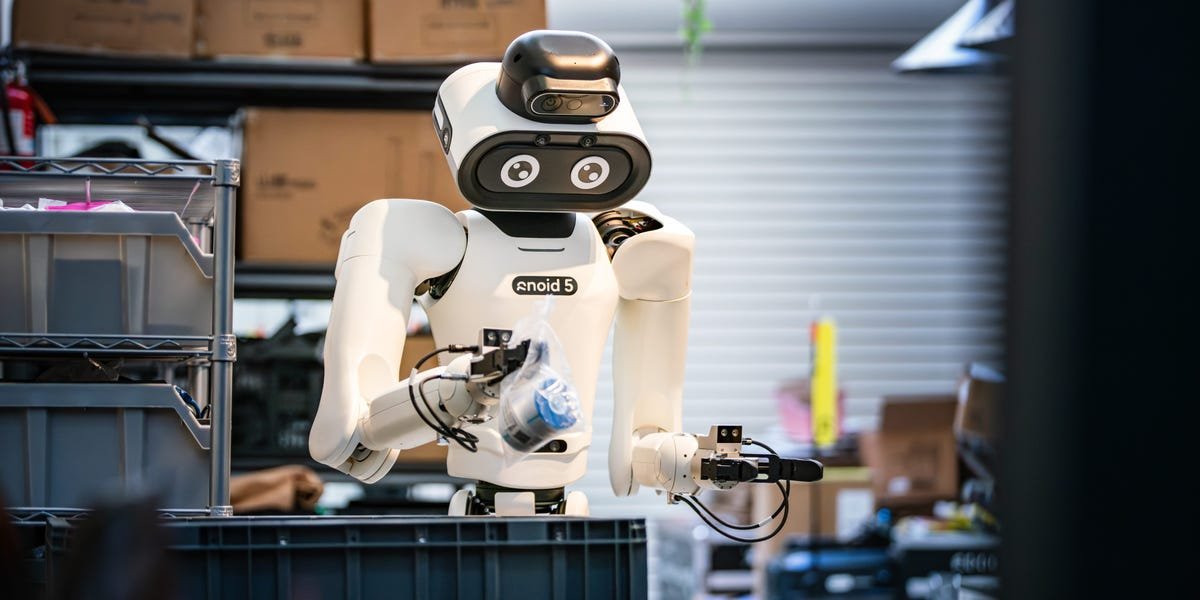

Delivery robot startup Robot.com is expanding into workplace humanoids, targeting industrial, food services, and logistics customers with a new robot designed to complete repetitive tasks.
The San Francisco-based startup, formerly known as Kiwibot, told Business Insider it will launch R-noid, a humanoid robot on wheels that can package orders, load and unload boxes, and prep workstations. The startup is working with Physical Intelligence, one of its AI lab partners, to develop custom foundation models for R-noid.
CEO Felipe Chavez said in an interview that the robot is part of a nearly two-year-long process to expand beyond campus-delivery robots and into commercial labor automation across multiple industries, from food service to logistics and healthcare.
“We already have a foot in the door with our delivery robots,” he said. “It made sense to also offer manipulation solutions.”
Chavez said that the company has commercially deployed fewer than 40 R-noids across about a dozen customers. One deployment the CEO disclosed was at Harbor Links Golf Course in New York, where Chavez said an R-noid is helping load food into delivery robots and supporting staff with order-packing.
The company is positioning the R-noid as a practical workplace robot rather than a do-it-all personal assistant aimed at factories, homes, and other environments.
Robot.com said the initial use-case categories will include: restaurant assistant, packer, picker, folder, and host. Chavez said the number of tasks the R-noid can complete will increase over time.
The CEO said his company has the operational know-how to deploy humanoids from its delivery robot business. He previously shared that Robot.com has 500 robots deployed, most of them delivery robots, and has completed more than 2.5 million tasks.
“We have built operations, maintenance, remote operations, remote service desk, data infrastructure, and business development infrastructure,” Chavez said. “We already know what it takes to deploy robots.”
The AI partnership behind R-noid
One key partnership Robot.com has secured is with Physical Intelligence, a closely-watched AI startup focused on building foundation models for robots of different form factors — in other words, the brain behind the robot.
“We have been working with them since last year, developing custom models for the robots that we’re deploying with customers,” Chavez said, adding that Physical Intelligence is one of the AI labs Robot.com has partnered with.
The startup is not alone in betting on wheeled robots: Diligent Robotics has deployed its wheeled Mix robot in hospitals, while newer companies such as Sunday Robotics and Genesis AI are now demonstrating wheeled bots.
Robot.com said that its robot can be deployed within eight to 12 weeks. Chavez said that weekslong process entails visiting a customer’s facility to identify what tasks could be automated. Then the company collects hours of robot data to fine-tune the model, or robot brain, before the R-noid can be deployed on-site.
The CEO said the amount of data can depend on the complexity of the tasks. Some tasks, he said, could entail collecting 50 hours of data before a robot is deployed.
Teleoperations and remote support are also key parts of the deployment strategy, Chavez said, adding that the startup expects about 70% autonomy during initial deployment.
Long-term, Chavez said customers can expect to save on labor costs with its robots, but the near-term goal is to prepare businesses for robotics to improve worker satisfaction.
“One of our motives is robots today, not someday,” he said.
Read the full article here