







IRPIN, Ukraine — The soldiers arrived in darkness. Pulling up to a field in a van, they began quietly setting up their ground control station on the side of the road. Headlamps cut through the night as they prepared to launch.
Before sending up the interceptor drone, they flew a small quadcopter out to scout the area and check for radar interference. Inside the van, the Ukrainians watched its progress on a computer screen.
Suddenly, the feed vanished into static.
Something had disrupted the scout drone’s signal, likely electronic interference. They couldn’t launch the interceptor, and the mission was grounded before it began.
In moments like these, it’s good to have a fallback.
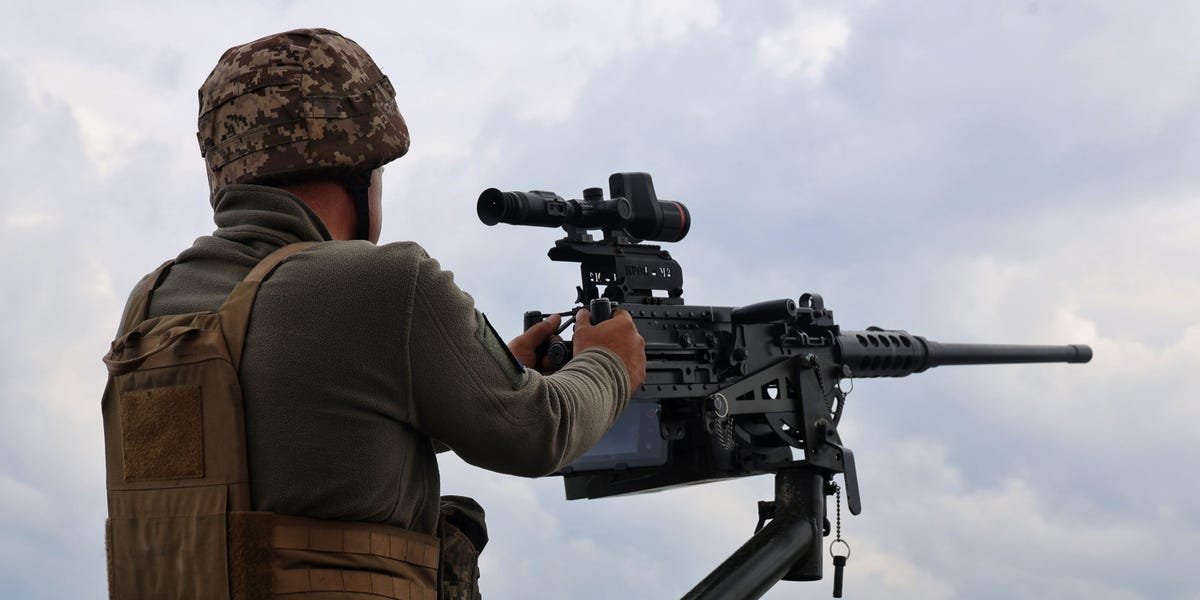
Ukrainian mobile air defense crews, such as this one in a Kyiv suburb, have long used .50 caliber M2 Browning machine guns mounted on the beds of pickup trucks to battle the Russian one-way attack drones regularly striking their cities.
But like other mobile defense units in Ukraine, they are learning to use high-tech interceptor drones alongside the Browning, a particularly versatile American-made heavy weapon designed at the end of World War I and fielded in the early 1930s.
Business Insider recently linked up with this unit to observe soldiers as they trained on the interceptors. Losing the scout drone to suspected electronic interference underscores how delicate these operations are at a time when electronic warfare is becoming more prominent not just on the battlefield but also in civilian areas.
Interceptor drones are playing an increasingly important role in Ukraine’s air defense network, making mastery essential for mobile fire groups. Last year, Russia modified its drones to fly faster and at higher altitudes, well beyond machine-gun range, leaving their effectiveness in question.
The interceptor drones, which can hunt targets at altitudes of up to 5,000 meters and at speeds of nearly 200 mph, help close that gap. The mobile unit near Kyiv is training with the P1-Sun and Bullet, two models made by Ukrainian companies Skyfall and General Cherry, respectively.
Despite their advantages, the interceptors are not without their limitations. They are hamstrung by poor weather and electronic interference, as demonstrated by the training incident. Russia has also upgraded some of its drone tactics to make them more maneuverable to avoid interception.
“There are different conditions where Browning machine guns are still really effective,” explained Oleksiy, commander of the mobile air defense unit. He could only be identified by his first name for security reasons.
The old machine guns are useful against Russian drones flying low enough to evade radar, at altitudes up to 100 meters. Video footage of an engagement earlier in the day showed one of the machine gunners in Oleksiy’s unit firing at Shaheds during a massive Russian bombardment across Ukraine.
“This is a deeply layered defense system that includes different types of weapons and means of engagement,” Oleksiy said.
A pilot with Oleksiy’s unit who is training on the relatively new interceptor drones said previous experience with first-person-view (FPV) drones helped prepare her for the interceptors.
The pilot, who spoke on condition of anonymity for security reasons, said one challenge in learning to use interceptor drones is getting comfortable controlling an aircraft at much higher altitudes than she is used to. She said she is eager to put those skills to use in combat.
“I want the war to end,” she said. “My children live here, and I want to do something.”
Ukrainian officials have described interceptor drones as a successful and growing part of the country’s wider air-defense network.
Oleksiy Vyskub, the country’s first deputy defense minister, told Business Insider in a recent interview that while these weapons are used alongside aviation assets, such as helicopters, and other antiaircraft systems, the interceptor drones account for “the majority” of drone kills.
The share of Russian Shahed drones shot down by low-cost interceptor drones has doubled since the start of the year, Mykhailo Fedorov, Ukraine’s defense minister, told reporters last month. Interceptor drone deliveries have also increased.
“This is a cheaper, faster, and more scalable response to Russia’s mass attacks,” Fedorov said.
Ukrainians have said that there is a definite learning curve to mastering the interceptor drones, although mobile air defense units like Oleksiy’s are more than ready to give it a go.
“We always try to master every new technology we get,” Oleksiy shared. “At first, it was regular FPV drones, then interceptor drones. We believe the more technologically advanced we are, the better our chances of victory.”
Read the full article here