






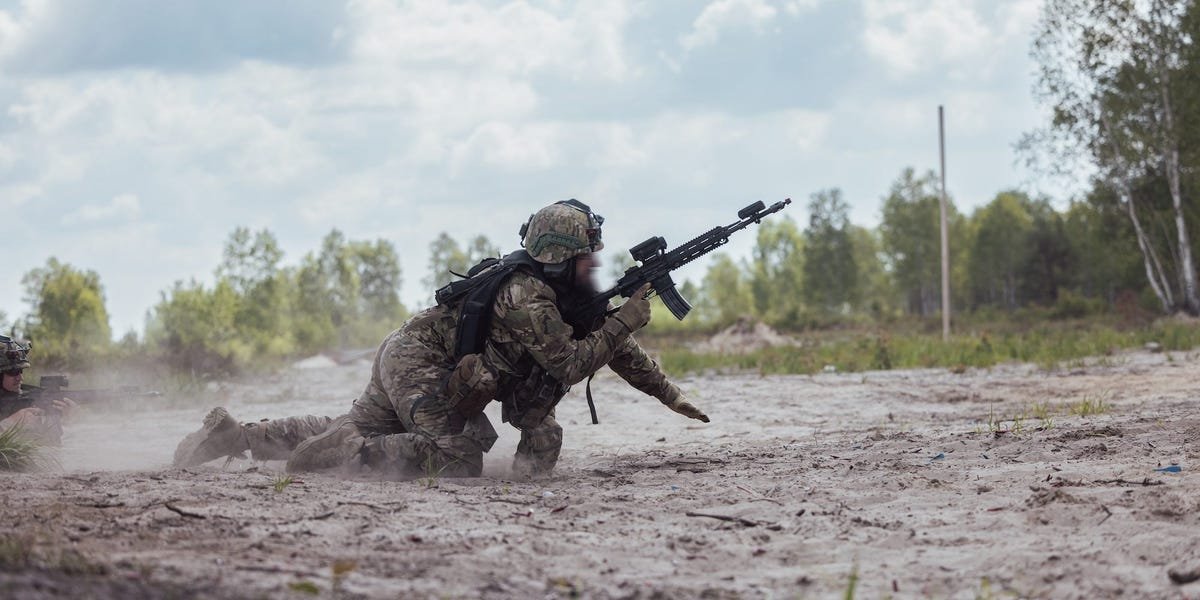

Western militaries training Ukrainian troops for war with Russia can’t rely on the usual cycle of periodically updated manuals because battlefield lessons are changing too quickly, a NATO commander told Business Insider.
Norway is leading multinational training for Ukrainian troops at Camp Jomsborg, a purpose-built camp in eastern Poland, as part of Operation Legio. The training needs constant updates about the tactics and weaponry that work on the rapidly changing battlefield, Brigadier Atle Molde, the commander of Task Force Legio, told Business Insider.
“You cannot do that based on bureaucratic training manuals issued once a year or stuff like that,” Molde said. “It’s just too slow.”
The work happening in Poland “all comes down to being relevant for the sake of saving lives and helping the Ukrainians win this war,” he said. That means making the training as accurate to the battlefield as possible, where weapons and tactics are evolving and becoming obsolete far faster than Western militaries are accustomed to.
Operation Legio strives to impart Western doctrine and best practices to Ukrainian soldiers, who can then combine them with their hard-won battlefield knowledge. To do that effectively, trainers try to recreate the realities of the fight as much as possible, including the terrain, tech, and tactics.
The challenge is that the battlefield changes quickly. Ukrainian soldiers say that tactics change every week, and cutting-edge battlefield tech can shift into obsolescence within a few weeks.
That makes Ukrainian experience, not training manuals, central to keeping the training current. Instructors listen to feedback from experienced Ukrainian soldiers and integrate it, and Ukrainian instructors and leaders are also present.
Maj. John, the S3 Operations Officer in charge of synchronizing the overall training operation, said Camp Jomsborg is defined “as a Ukrainian training center.”
If the Ukrainians tell their instructors that their armed forces don’t do something anymore, then the training changes, Molde said.
Molde said it’s critical that the training keep pace with the battlefield. “You have to adapt to the situation, or you become irrelevant,” he said.
If “the training is not relevant, then more Ukrainians will die,” Molde added. The war, as is, has already come with significant casualties on both sides.
Jørgen, a Norwegian Army instructor for Legio’s platoon leader course, told Business Insider that “we make a lot of changes, and we try to evaluate on a day-to-day basis, and we’re bringing the flexibility to be able to change tomorrow or tonight.”
The Ukrainians regularly update their own training on very tight timelines as well. Drone school leaders previously told Business Insider that they need to constantly update the lessons they teach, sometimes every other week.
Technology in the war is “moving forward at a very fast pace,” Tetyana, a Ukrainian veteran who goes by the call sign “Ruda” and the head of R&D for drone school Dronarium, said. This means the school has “to be very fast in our adaptability.”
The rapid battlefield changes mean the kind of tech that’s relevant shifts quickly too, complicating Operation Legio’s efforts to mirror the battlefield as closely as possible.
Ukrainian President Volodymyr Zelenskyy said in January that success in the war depends on who is “the fastest” at applying and adapting technology.
Ukraine’s tech companies work with this speed and the need for constant adaptation in mind.
Ukrainian drone and weapons maker Frontline Robotics, for example, told Business Insider that it makes up to 20 changes to its products a month, while the CEO of Ukrainian arms maker Ark Robotics said that the company gets continuous requests for updates from soldiers.
Companies stay up to date by messaging and FaceTiming soldiers, as well as by sending employees to dangerous positions near the fighting to test and make changes.
Ukraine’s experience has been a wake-up call for NATO, with the West worried that its militaries can’t adapt their tactics and technology as quickly as Ukraine does.
NATO in July said that “Russia’s war of aggression against Ukraine has highlighted how quickly warfare is evolving — with innovation cycles compressed from years into months.” The alliance said “innovation on the battlefield is moving faster than ever.”
Adm. Pierre Vandier, NATO’s supreme allied commander for transformation, said in May that “adaptation is maybe the most important lesson” from Ukraine.
Read the full article here