






Tokenmaxxing became the buzzy AI word du jour this spring; as summer begins the trend is already running on empty. Amazon pulled its AI leaderboard after some employees made useless AI work to game the rankings. Palantir CEO Alex Karp likened tokenmaxxing to a porn addiction, and Duolingo walked back a decision to weigh AI use in employee performance reviews. Meta and AT&T have reportedly started curbing AI use as costs skyrocket.
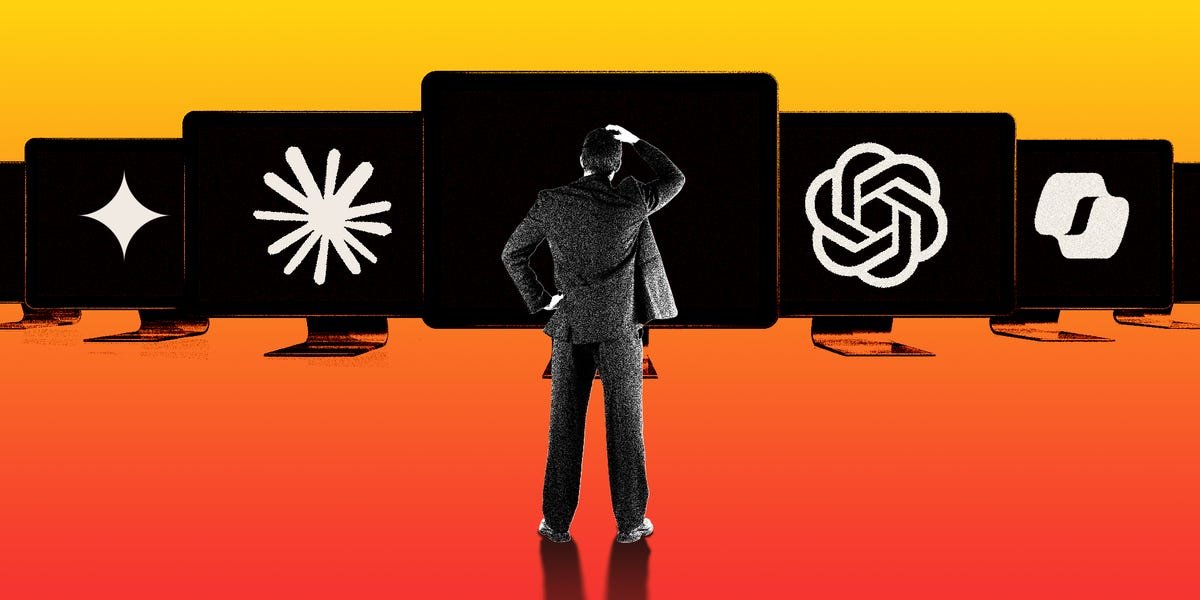
The pressure to use AI for the sake of using AI has created AI sprawl: Workers employ new agents or vibecode solutions with myriad AI tools that prove difficult for companies to wrap their arms around. That means burning through expensive AI budgets to create duplicate work, while often failing to pass on best tips and tricks to coworkers and wasting time “botsitting,” or, giving AI the necessary context and edits to make output usable. In a new survey of 6,000 digital workers in the US, UK, and Australia, from Glean’s Work AI Institute, researchers found that 77% of those who use AI engage with multiple programs weekly, a third use four or more tools, and 60% will shuffle the same prompts between multiple tools when they don’t find the first output sufficient. Individually, workers using AI say they save an average of 11 hours each week, but only 13% of those surveyed said these savings have “significantly improved” the company’s performance.
“The pressure to signal innovation by mere AI awareness, knowledge, appetite, is so strong, and it’s leading us astray,” says Kate Niederhoffer, head of BetterUp Labs, the behavioral research center at the coaching and workforce development company. Big shifts in the workforce require answering big questions, she says, such as, “Why are we adopting these tools? What are we trying to accomplish here? And how do we communicate that in a really clear and compelling way so that it impacts everybody in a way that they’ll use these tools to achieve those goals?” But few companies are answering “the big why” about AI.
Few companies are answering “the big why” about AI, says Kate Niederhoffer.
Unraveling the imperative to use AI means more than taking down leaderboards or adjusting reviews to focus on tangible worker impact. The rhetoric around adopting AI — that you must maximize and master it or it will replace you, or someone better at using AI will replace you — has reinforced the urgency to pursue individualism. AI has the potential to boost collaboration and decentralize some skills, like coding or editing images. But so far much of the evidence suggests that instead of thriving during a shortened work week, AI maxxers have burned out, lost faith in their coworkers, and marooned themselves, working alone on islands.
Proteinmaxxing, looksmaxxing, Ozempicmaxxing, 9-9-6maxxing — in a post-pandemic era that praises gains at any cost, workers were primed workers to engage with tokenmaxxing. But the lack of a cohesive AI user manual has also led tools to spread willy-nilly across organizations. Individual workers aren’t maxxing their way to efficiency. Companies need to tame the AI sprawl while guarding the chance for people to innovate.
Tech updates and new workflows typically come top-down: your company decides to use Zoom over Microsoft Teams, Microsoft 365 over Gmail. Employees receive logins for a suite of tools. But aside from some enterprise subscriptions to OpenAI or Anthropic, employees’ AI use often operates in the shadows. OpenAI took steps this year to unify ChatGPT and Codex. People want to use apps made specifically for their roles, like coding or marketing or human resources; two people working in sales want to use AI differently, and might repeat prompts or tasks, burning through tokens to create near-duplicate reports or decks when they once would have collaborated with a coworker to get the job done.
Lee Senderov, chief transformation officer at Travelport, a retail platform for travel agencies, tells me she’s seen AI sprawl take hold as people try to work the technology into their work. One worker burned through 160 times the amount of tokens that the next most prolific AI user did over a four-day period. When employees work in silos, pushed to use AI to do more, they might experiment with it alone, but end up duplicating the same work as a colleague. That’s not cheap. “You’ve got hard costs, you’re spending more money on tokens that you don’t need to be spending, duplicative costs there,” Senderov says. “But you also have duplicative soft costs of just, we’re wasting effort and then, who’s the expert that should be writing this?”
One worker burned through 160 times the amount of tokens that the next most prolific AI user.
When people work alone with AI, they can dilute the outcomes, flattening the rewards of collaboration in favor of a quick solution. Herbert Simon, a Nobel prize winning researcher, saw this behavior decades before AI arrived. Individuals will choose the good enough solution instead of interrogating every possible option, which Simon referred to as “satisficing.” “On an individual level we do that all the time,” says Emily DeJeu, professor in Carnegie Mellon University’s Tepper School of Business. “The purpose of organizations is to bring together all of these people who satisfice and to try and get them to coordinate and work towards shared goals in ways that are, at scale, productive.”
Layoffs of thousands of workers and pivots toward AI clash with this theory. Meta, which laid off 8,000 workers last month, plans to boost its spending on AI between 60% and 87% this year, following up on its “year of intensity,” in which it began slashing jobs to move its focus. Mark Zuckerberg has said single individuals can now do work that once required entire teams, but that threatens to erode the larger fabric of what makes an institution or company work.
Instead, AI at work is heading for the fate of past innovation: the tragedy of the commons, says Rebecca Hinds, head of Glean’s Work AI Institute. The theory goes like this: As individuals benefit from a shared resource, they use it near depletion, or, in AI’s case, use it to boost their own stature and credibility at the risk of downgrading a whole team or project. “If we can have a tool that is going to boost our individual productivity, that’s what we tend to reach for first,” Hinds says. “The problem is this coordination neglect that happens when we don’t consider the impact of our actions on the broader collective.”
Ill-intentioned AI use can degrade trust. Past research from BetterUp found that when people produced workslop — AI-generated documents and powerpoints that lacked proper oversight — their coworkers began to trust them less. An overreliance on AI can disintegrate the communal aspects of work; people rely increasingly on chatbots to answer their questions and on gen AI to spit out work that previously may have needed a coworker’s expertise.
But AI has also democratized innovation: marketers vibe code, agents can act like personal assistants, and startups do more with fewer hires. The trick becomes moving the benefits that individuals have eked out of AI and translating them into larger, team- and company-wide workflows. “How do you go from sprawl, which is unorganized and a little crazy, and how do you start to at least organize it a little bit so that we can get the most out of it?” Senderov says. She says her company is experimenting to try to centralize AI workflows. If they know two people are working on the same thing, they can encourage them to work together, and show the best use cases at the enterprise level. The larger a company is, the harder that centralization might be.
Senderov acknowledges everyone is still experimenting on the best ways to do this. But it’s becoming clear there’s no tokenmaxxing shortcut to get them there.
Amanda Hoover is a senior correspondent at Business Insider covering the tech industry. She writes about the biggest tech companies and trends.
Business Insider’s Discourse stories provide perspectives on the day’s most pressing issues, informed by analysis, reporting, and expertise.
Read the full article here