





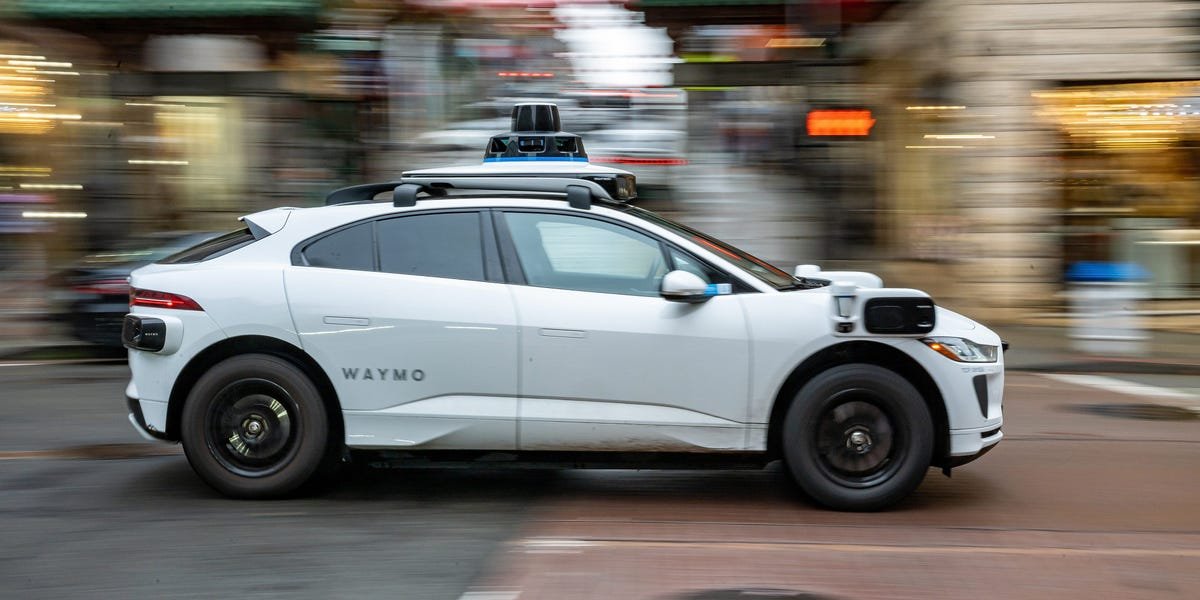

Waymo is a robotaxi service that began as a research project inside Google and has since scaled to be one of the leading fully autonomous ride-hailing companies in the world.
The company launched public rides in Phoenix in 2020. By April 2026, Waymo expanded to several US cities and said it provided more than 500,000 autonomous rides a week.
As the service has grown, Waymo has also faced public scrutiny over robotaxi mishaps. A massive power outage left Waymos stuck in the middle of intersections; they’ve failed to yield to school buses; and the death of a bodega cat after a Waymo ran over the animal has drawn criticism over the safety and responsiveness of autonomous cars.
Waymo regularly publishes data showing that its robotaxis are safer than human drivers.
New competitors have also entered the robotaxi race in just the past half-decade as the Alphabet company paves the way for adoption.
Who can take a Waymo?
Waymo is commercially available in 11 metropolitan regions as of April 2026.
Prospective riders within operating areas can download the Waymo One app and hail a robotaxi.
In a few cities, riders can only hail a Waymo through other ride-hailing apps. In Austin and Atlanta, riders have to toggle through the Uber app to request a Waymo robotaxi. Riders are quoted the fare while booking a ride on the app.
Waymo ride prices are based on trip distance and time, and a minimum fare is charged for all trips.
Waymo doesn’t disclose pricing data, but some studies have shown that the service is increasingly reaching price parity with Uber and Lyft.
How do Waymo’s robotaxis work?
Waymo’s robotaxis are electric and use a mixture of mapping technology, artificial intelligence, and sensors to drive autonomously.
Before Waymo launches a robotaxi service in a region, the company deploys a fleet of human-driven cars attached with sensors to create highly detailed maps of the environment. The company has said that this allows the driving system to drive better and more predictably.
“For example, when the Waymo Driver approaches an intersection, not only can it sense a car that might cut across its path, but because of our custom maps, it also knows that vehicle has a stop sign,” the company said in a blog post.
Waymo’s robotaxi also relies on a suite of sensors, including cameras, radar, and lidar. Lidar is a laser light that can measure distance and depth.
The company’s use of lidar has been the subject of much debate within the industry. Tesla CEO Elon Musk has said that lidar is a costly “crutch” and that cars should be able to drive themselves with cameras only.
Waymo’s co-CEO Dmitri Dolgov said the various sensors can allow a car to detect things that cameras can’t detect immediately, such as a pedestrian crossing blocked by a bus or a distant car in a dust storm.
Despite being autonomous, a dedicated human workforce exists entirely to support robotaxi operations outside the engineers working on the autonomous software.
Humans, for example, are responsible for charging and maintaining the cars at robotaxi depots, which are strategically located in the cities where the fleet operates.
Humans are also needed to man the remote support centers in case customers need help during a ride. This does not mean humans remotely drive the vehicles.
The company has said that the AI driver is fully in control of the driving functions and that remote support agents can only provide more information or context to the autonomous driver.
Waymo said it had about 70 “remote assistants” worldwide as of February 2026.
What does Waymo do?
Waymo makes the software and mobile app for its fully autonomous ride-hailing service.
The company itself doesn’t manufacture the vehicles. Instead, it buys vehicles from other automakers and retrofits them with Waymo’s proprietary sensor suite and software. Waymo has partnered with automakers like Jaguar, Hyundai, and Zeekr, a Chinese EV company.
The company built a 239,000-square-foot factory in Mesa to support the retrofitting operations.
Waymo has said that it plans to expand its business outside of ride-hailing to include delivery service, long-haul trucking, and putting its software in consumer cars.
In April 2025, the company said it was in early talks with legacy automaker Toyota to bring autonomous driving to personally owned vehicles.
In October 2025, Waymo announced a partnership with DoorDash to launch an autonomous delivery service in Phoenix.
Waymo’s expansion plans
Waymo said it has plans to expand to more than 20 cities, including London and Tokyo.
The company has begun testing in Tokyo and said it will start offering public rides in London by late 2026.
Other cities Waymo is targeting include Boston, Detroit, Sacramento, San Diego, and Washington, D.C.
To support its expansion plans, Waymo said in February 2025 that it raised $16 billion for a $126 billion valuation. Alphabet was the largest backer, with additional funding coming from major investment firms, including Dragoneer Investment Group, DST Global, and Sequoia Capital.
Who are Waymo’s competitors?
Several companies have announced plans to launch their own robotaxi services since Waymo began offering public rides.
In June 2025, Tesla started offering supervised, driverless rides with 10 to 20 cars operating within a geo-fenced area of Austin. Musk said the company can quickly expand its service and took multiple shots at Waymo, saying the Alphabet company’s robotaxis cost more to expand.
Amazon-backed Zoox uses a purpose-built robotaxi — meaning the car has no steering wheels or pedals — and began giving rides to the public in limited parts of Las Vegas and San Francisco. The company opened a 220,000 square-foot production facility in California to manufacture more robotaxis.
Hyundai’s Motional is another robotaxi player that plans to launch a driverless service by the end of 2026.
There are also software-oriented companies that develop autonomous driving technology and have partnered with ride-hailing platforms.
Uber, a Waymo partner, is launching a competing service through its partnerships with Nuro and Lucid Motors.
Lyft, another Waymo partner, is also taking the partnership route with May Mobility, an Ann Arbor-based company, and Tensor, an automaker.
Robotaxis also operate outside the US. In China, driverless taxis continue to expand with companies like Baidu’s Apollo Go and WeRide.
Waymo’s beginnings
Waymo was initially formed by Google and was known as the Google Self-Driving Car Project. After seven years of research and development, it eventually spun out into its own company in 2016. Alphabet remains Waymo’s majority owner.
Google began developing Waymo and its self-driving technology in 2009 at the Google X lab, led by Google cofounder Sergey Brin. Sebastian Thrun, a pioneer in the self-driving industry, was tapped to lead the project.
After almost two years of testing the technology, Google and The New York Times revealed its existence in late 2010.
US lawmakers raised concerns at the time about the lack of regulations for this new technological frontier. Google was a prominent supporter, lobbying for regulation. By 2012, Nevada’s Department of Motor Vehicles had licensed a self-driving Prius running Google’s software, marking the first time that a self-driving vehicle had been licensed in the United States.
In 2022, Alphabet CEO Sundar Pichai distanced Waymo and Alphabet’s other subsidiaries from Google by granting them more autonomy to design job structures and compensation outside Google’s job architecture.
Waymo was affected by Google’s 2023 layoffs, when the company cut roughly 8% of its staff.
Despite the restructuring, Waymo’s offices remain in Mountain View, California, a short drive from the Googleplex, Google’s global headquarters.
Is Waymo safe?
Waymo says its driverless vehicles are safer than human drivers, but as with any frontier technology, autonomous taxis are not perfect.
Data from Waymo provided to the California Public Utilities Commission showed that the company’s robotaxis were involved in at least 419 collisions between March 2022 and March 2025.
Still, an analysis by Business Insider found that Waymo significantly reduced the collision rate over those three years. Between March and May 2022, the collision rate was about 147 per 100,000 rides. Between January and March 2025, the rate reduced to about 7 collisions per 100,000 rides.
When comparing human drivers over the same distance within the company’s operating cities, Waymo says its autonomous driver experiences 93% fewer pedestrian crashes with injuries and 79% fewer crashes with airbag deployments.
Waymo’s robotaxis have been documented experiencing some technical issues, however. One rider told Business Insider that his Waymo ride was stuck driving in circles. A San Francisco resident recorded footage of the robotaxis honking at each other at a Waymo depot.
In December 2025, Waymo’s service in San Francisco stalled after a massive power outage struck the city. Footage on social media showed Waymo’s robotaxis stuck in the middle of intersections, further clogging roadways.
The company said at the time that the blackout triggered a backlog of requests from the autonomous cars seeking more guidance from human operators.
Kyle Wilson contributed to this article.
Read the full article here