






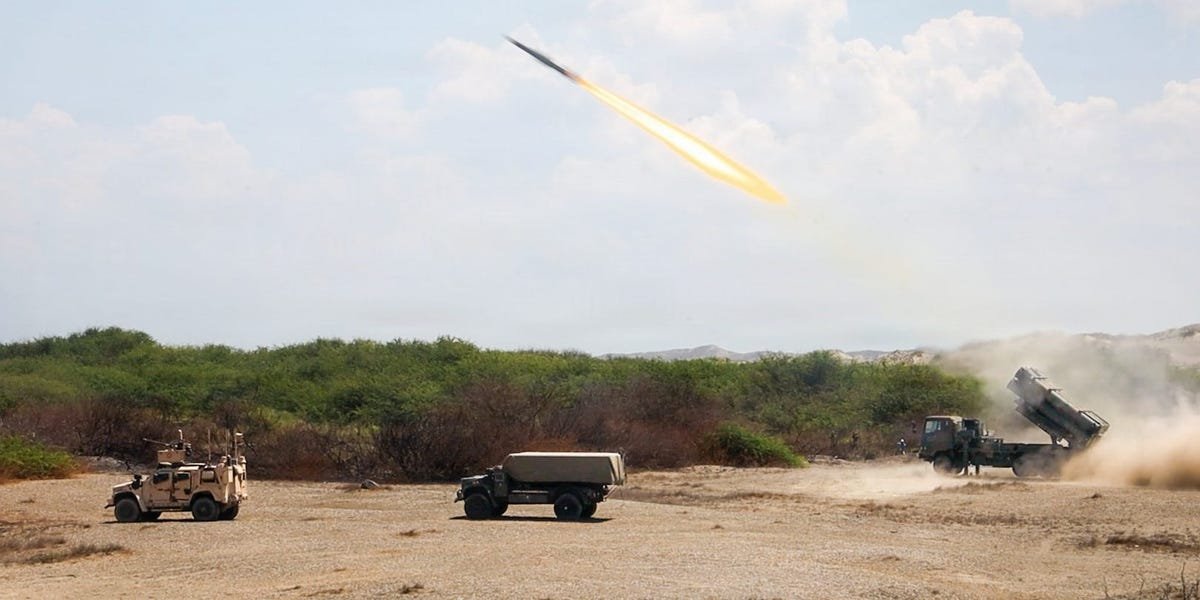

Missiles, rockets, artillery, drones, and other weapons flew across the Philippines earlier this month in a large-scale military exercise that a top US commander described as a rehearsal for a Pacific fight.
Adm. Samuel Paparo, head of US Indo-Pacific Command, said that Balikatan 2026, which brought over 17,000 US and allied troops together, served as a “full-scale multinational mission rehearsal for the defense of the Republic of the Philippines” in a “dangerous security environment.” The exercise featured clear demonstrations of how these forces would fight in the first island chain.
Balikatan was held from late April to early May in the Philippines. The annual US-Philippine exercise has grown into a broader multinational drill as Washington and its Pacific allies focus more heavily on regional threats and the risk of major conflict.
This year’s exercise centered on defending beaches, denying enemy ships access to key waters, connecting sensors to shooters, and leveraging missiles capabilities. It notably featured elements of the ongoing war in Ukraine, such as drones and electronic warfare.
Ahead of a live-fire counter-landing exercise, US soldiers operating on the northern coast of Luzon practiced using lightweight low-altitude reconnaissance drones, including first-person-view drones, to find targets. Heavier payload-capable drones were used to test aerial resupply concepts.
Soldiers trained in the shifting winds of the open coastal terrain. One American soldier said in an Army release that the training was meant to test how far the drones could go in those conditions and keep operators sharp on a “use-it or lose-it” skill.
During the training events focused on preparing troops to counter an invasion of the main island, the allied forces wargamed an enemy amphibious assault scenario. Nominal enemy forces, including uncrewed vehicles designed and painted to closely resemble Chinese Type 05 amphibious fighting vehicles, attempted to storm the beaches at the La Paz Sand Dunes. Hostile drones also came into play during the mock invasion.
US and allied forces used drones to detect simulated landing targets and then layered in rocket artillery, infantry, heavy machine guns, mortars, howitzers, attack helicopters, loitering munitions, unmanned surface vessels, and Stinger teams to stop threats from the sea and air, according to the US military and press reports.
Citing displayed infographics, USNI News reported that the Army calls the counter-invasion concept the “Littoral Deep Battle,” drawing partly on Ukraine’s use of drones, missiles, and coastal defenses against Russia’s Black Sea Fleet.
US Indo-Pacific Command said that electronic warfare architecture “operating behind the scenes ensured the massive show of coalition force culminated in pinpoint, synchronized strikes.”
“While explosions in the air and sea were clearly audible and visible,” it explained, “the exercise’s decisive actions took place in an invisible battlespace: the electromagnetic spectrum.” The spectrum is an unseen battlespace of growing importance in modern warfare.
Paparo said that one of the highlights of this year’s exercise was the inclusion of a specially designed command-and-control network that all US, allied, and partnered forces could use to fight and communicate together.
This year’s Balikatan drill was heavy on long-range strike, including Tomahawk cruise missiles launched from the new Mid-Range Capability, or Typhon, as well as Precision Strike Missiles. Balikatan marked the first Typhon launch from the Philippines, with a Tomahawk hitting a target about 390 miles away from its launch point in Leyte. During the drills, US forces also employed the Marine Corps’ NMESIS anti-ship missile system.
Manila used its BrahMos shore-based anti-ship missiles, while Japan fired Type-88 coastal anti-ship missiles outside its territory for the first time, sinking a decommissioned Philippine vessel in a maritime strike drill. American air assets were involved in the strike as well, including a US P-8 Poseidon maritime patrol aircraft and an MQ-9 drone.
Further south, US Marines and allied forces ran another counter-beach landing live-fire event.
At Aporawan Beach in Palawan, the Marines and allied military forces practiced breaking up an enemy landing force before it reached shore, combining rockets, mortars, wire-guided and Javelin anti-armor missiles, machine-gun fire, artillery, and low-altitude air defenses. The exercise also saw the Marines release live payloads from first-person-view drones.
In the Philippines, US forces practiced implementing drones into jungle warfare, including both using them and also defending against hostile drones. And like previous drills in the Pacific, the US also focused on 3D-printing drones and drone parts in remote areas, skills that could be needed in a future conflict to keep uncrewed technologies working when supply lines are strained.
Amid the Balikatan exercises, China executed a major deployment of naval assets. Conflict experts at the Institute for the Study of War assessed that these moves were intended to signal Beijing’s ability to mobilize its forces in response to the actions of the US and its allies.
Read the full article here