






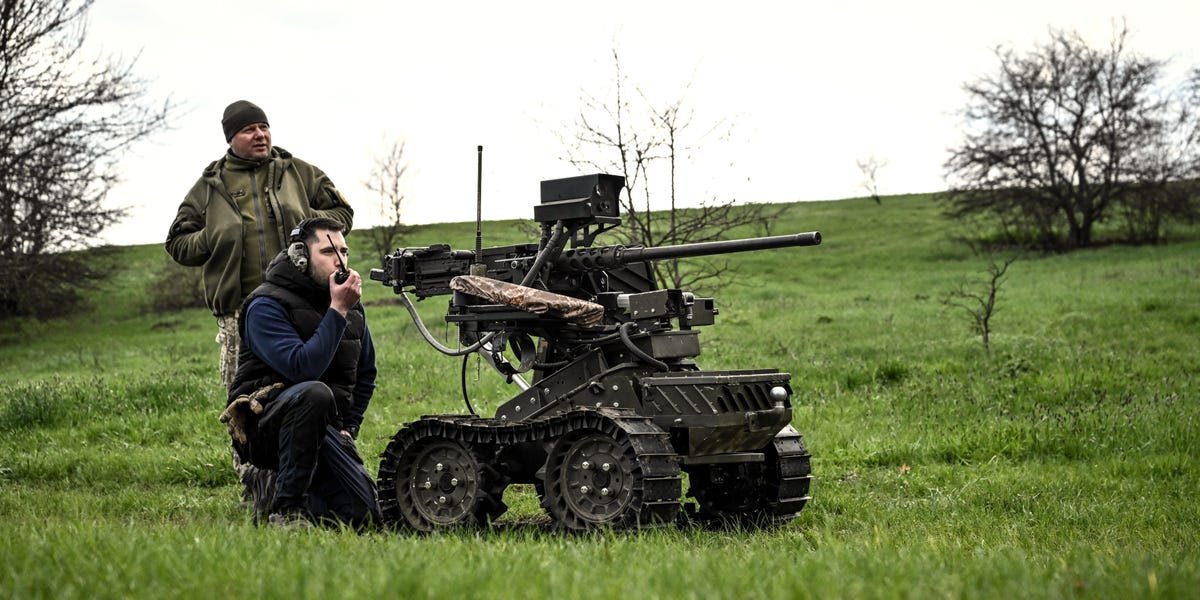

Ukraine’s experience shows Western militaries how major yearslong conflicts can deplete tanks and armored vehicles and why warfighting robots might matter more in the long run, a Ukrainian ground robot maker told Business Insider.
In a long, high-cost conflict, the number of vehicles needed for tasks ranging from combat to logistics could make relying on expensive armored vehicles like tanks unsustainable, Oleg Fedoryshyn, the director of R&D at Ukrainian robotic systems maker DevDroid, said.
These systems are expensive and slower to produce, making it difficult to replace heavy losses, Fedoryshyn said. However, robots, he said, are “quite cheap” and significantly easier to produce and replace if they’re destroyed.
Officials in the US and allied militaries have raised concerns that in a prolonged war — particularly against a near-peer adversary like Russia or China — stockpiles of key munitions, including air defense and precision weapons, could be strained. Likewise, vehicle inventories, especially in the age of cheap drone strikes, could suffer heavy attrition in a protracted conflict.
Fedoryshyn’s comments align with broader warnings from Western officials that Ukraine’s war has highlighted the need for large volumes of cheaper, attritable systems, essentially inexpensive and expendable mass that militaries can fall back on when more traditional assets are damaged or destroyed.
Ukraine has underscored how a war like its fight against Russia’s invasion can demand both sophisticated systems and large numbers of expendable ones.
Ukraine fields masses of cheap weaponry. Many of its low-cost drones fail to reach their targets or have a significant impact, but they are deployed at such a scale that they can still eliminate far more expensive systems. High losses are expected — and generally acceptable — because they are cheap and quick to replace.
Ukraine has a growing fleet of ground robots that are used to evacuate injured soldiers, carry weaponry and heavy goods, lay and remove mines, and attack Russian positions with weaponry. These are also expendable. As Defense Minister Mykhailo Fedorov said this month, the focus is on making cheap and effective systems that Ukraine can scale quickly.
Some Western military leaders have also argued the need to manage costs. US Army Secretary Dan Driscoll said last year, as the service reevaluated the Robotic Combat Vehicle program, that “we can’t sustain a couple-million-dollar piece of equipment that can be taken out with an $800 drone and munition.”
The war has highlighted how vulnerable tanks and armored vehicles can be to artillery and cheap drones. Drones costing hundreds of dollars destroyed tanks worth millions. Tanks have adapted with new armor and tactics but remain at risk.
Ground robots are not a perfect replacement for tanks and armored vehicles, and Western militaries likely wouldn’t want to entirely replace those traditional assets. Those vehicles have more power to get over tough terrain, provide far more protection for important assets that need to be brought across the battlefield, and can conduct far larger and more impactful attacks.
But ground robots can take over some roles and keep humans safer in the process. They can attack positions with explosives or mounted weapons such as machine guns and grenade launchers. They can also deliver to the front lines.
The latter use is one in which Ukraine is investing heavily. Fedorov said recently that Ukraine’s goal is to use ground robots for 100% of front-line logistics missions.
Tanks have seen mixed performance in Ukraine and reduced use after heavy losses. Ukraine is still making and getting some armored vehicles from partner countries and has requested more tanks, but it is increasingly placing far more emphasis on other types of weaponry.
Constant drone surveillance, limited air cover, and limited numbers of tanks have made Ukraine’s armored operations more difficult. The more advanced Western militaries might struggle less, but these factors could still pose a challenge, especially if they find themselves in a protracted slog.
Ukraine is betting big on its robots. Fedorov announced last week that Ukraine will contract 25,000 new robots in the first half of this year, which is double what it contracted for all of last year.
Fedoryshyn said that his company is able to quickly make updates and repairs to its robots, including by having teams that stay near the front lines to quickly fix damaged systems or make rapid upgrades to them. That allows for same-day repairs and even recovery of damaged robots from the battlefield.
Read the full article here