






Close Menu
Fin Street NewsFin Street News
  • Home
  • Business
  • Finance
    • Banking
    • Stocks
    • Commodities & Futures
    • ETFs & Mutual Funds
    • Funds
    • Currencies
    • Crypto
  • Markets
  • Investing
  • Personal Finance
    • Loans
    • Credit Cards
    • Dept Management
    • Retirement
    • Mortgages
    • Saving
    • Taxes
  • Fintech
  • More Articles

Subscribe to Updates

Get the latest finance and business news and updates directly to your inbox.

Trending
Can You Put a Case on Apple’s New Foldable iPhone? See the Options

Can You Put a Case on Apple’s New Foldable iPhone? See the Options

September 10, 2026
How hard is it to get into the nation’s most selective universities? See the 25 lowest acceptance rates in the US.

How hard is it to get into the nation’s most selective universities? See the 25 lowest acceptance rates in the US.

September 10, 2026
The top 15 party schools in the US, ranked

The top 15 party schools in the US, ranked

September 10, 2026
Retiring Before 65? Your 2027 Obamacare Premium Is Headed up Another 15% — and  of Income Decides Whether You Get Help

Retiring Before 65? Your 2027 Obamacare Premium Is Headed up Another 15% — and $1 of Income Decides Whether You Get Help

September 10, 2026
Gas prices are climbing again. See the states where it is the most and least expensive.

Gas prices are climbing again. See the states where it is the most and least expensive.

September 10, 2026
Facebook X (Twitter) Instagram
  • Privacy Policy
  • Terms of use
  • Press Release
  • Advertise
  • Contact
September 10, 2026 3:02 pm EDT
|
Facebook X (Twitter) Instagram
  Market Data
Fin Street NewsFin Street News
Newsletter Login
  • Home
  • Business
  • Finance
    • Banking
    • Stocks
    • Commodities & Futures
    • ETFs & Mutual Funds
    • Funds
    • Currencies
    • Crypto
  • Markets
  • Investing
  • Personal Finance
    • Loans
    • Credit Cards
    • Dept Management
    • Retirement
    • Mortgages
    • Saving
    • Taxes
  • Fintech
  • More Articles
Fin Street NewsFin Street News
Home » The war in Ukraine is exposing the dangers of prolonged tourniquet use. US special operations medics are adapting.
The war in Ukraine is exposing the dangers of prolonged tourniquet use. US special operations medics are adapting.
Markets

The war in Ukraine is exposing the dangers of prolonged tourniquet use. US special operations medics are adapting.

News RoomBy News RoomJuly 19, 20266 ViewsNo Comments

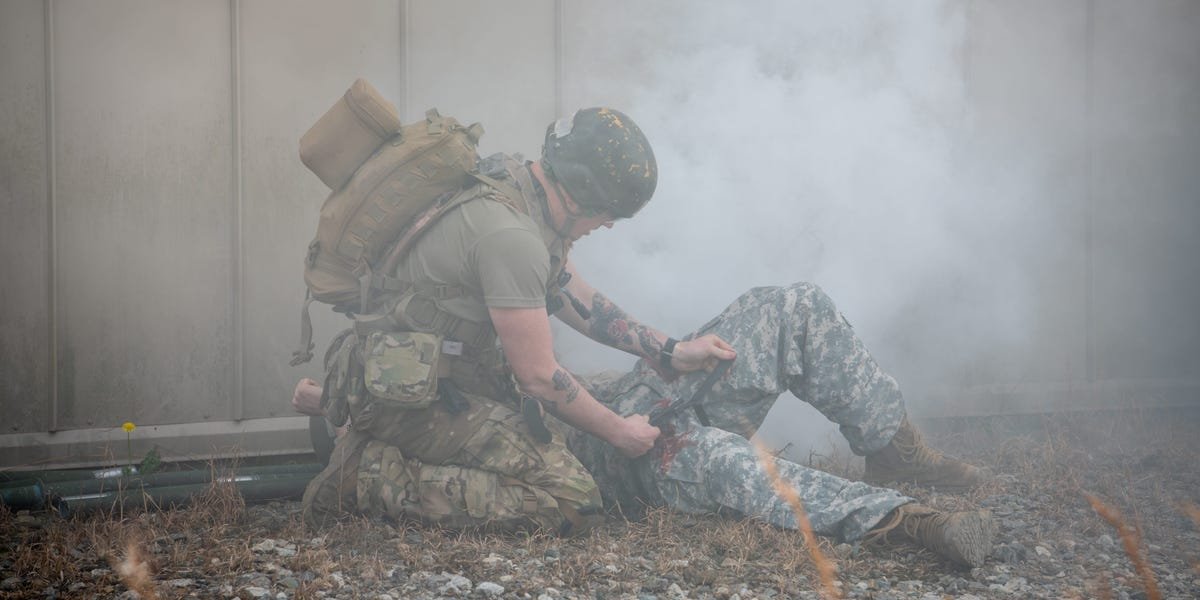
As the US military prepares for high-intensity, mass-casualty future wars, its medics are training to do something they almost never did during the Global War on Terror — remove a tourniquet from a wounded soldier.

Not long ago, tourniquet training for most American service members followed simple, strict guidance: apply one high and tight to limbs to stop life-threatening bleeding, and leave removal to advanced medical care personnel.

A modern military tourniquet is a heavy-duty nylon strap that’s tightly secured around an injured limb with Velcro, then cinched down further by twisting a small rod until blood flow stops.

In the GWOT era, stopping a service member from bleeding out in the field was the top priority, and the possibility of rapid medical evacuation required few further considerations. But in large-scale combat operations, where air control is contested, medics and non-medical troops alike may have to find alternative solutions to prolonged tourniquet use to prevent the kind of catastrophic damage that can result in organ dysfunction or limb loss.

US Army Special Forces training personnel told Business Insider that students in their medical pipeline are increasingly expected to know how to remove them, not just apply them. Troops are graded on those removals, known as tourniquet conversions, and on their ability to teach others to do the same.

“As we’re seeing more battlefield data from modern conflicts without that golden hour, now medics are forced to make a decision themselves as to when and if they reverse that tourniquet,” said the Army’s special operations medical course chief, a trauma expert who spoke to Business Insider on condition of anonymity. “If you don’t, you lose that limb.”

Tourniquets are among the most important lifesaving tools in a medic’s kit, according to the military’s Tactical Combat Casualty Care guidelines, and hemorrhage is the leading cause of preventable death on the battlefield. When in doubt, putting on a tourniquet on a wounded patient remains a safe decision, the chief said.

But the complexity of Ukraine’s battlefields, where pervasive surveillance and attack drones have often made timely casualty evacuation impossible, has shown that isn’t always a hard-and-fast rule.

There, medics are being forced to manage combat casualties for longer, requiring them to find other ways to control bleeding to avoid damage that can come with leaving tourniquets on for too long. Troops in Ukraine have previously told Business Insider that prolonged use has turned injuries that should have been an “easy fix” into life-altering amputations.

When blood flow is restored after prolonged tourniquet use, toxins from the damaged tissue can be released into the bloodstream, potentially injuring the kidneys. Ukraine has reported an increase in demand for dialysis among wounded troops who’ve had tourniquets on for too long. Permanent nerve damage is also a concern.

One of the clearest lessons emerging from Ukraine is the need for more troops to understand tourniquet conversions, said Col. Ken Dwyer, commander of the Army’s Special Warfare Center and School, which oversees the students’ training.

“I put on a tourniquet to save this guy’s life. But at some point, I need to figure out a less destructive way to control that bleeding,” Dwyer said. “I have to remove that tourniquet and see if a pressure dressing will work or something else will work, and to try to save that limb.”

The students, including Navy corpsmen headed to Marine reconnaissance and special operations units and Army medics assigned to the Rangers and Green Berets, are also expected to teach tourniquet conversion to other service members and allied forces, the course chief said. (Navy SEAL and Air Force special operations medics attend separate training pipelines.)

Troops who fought in Iraq and Afghanistan were taught to apply tourniquets, but rarely to remove them — loosening one too soon can restart massive bleeding.

That approach reflected the nature of the wars the US was fighting and its overwhelming air superiority — casualties were often evacuated by helicopter within the military’s “golden hour” to well-staffed trauma centers where surgeons and trauma specialists could safely remove the tourniquet.

Now, casualty evacuation in Ukraine is so difficult and dangerous that ground robots are increasingly being used to evacuate troops, with varying degrees of success. Deploying medical crews for rescue is risky, and helicopter evacuations are usually impossible.

“The duration of a pre-hospital tourniquet has long been a concern,” said John Holcomb, a trauma professor at the University of Alabama who formerly led the Army’s Institute of Surgical Research, and served as a trauma consultant for the Army Surgeon General.

But “it was less of a concern in Iraq and Afghanistan because we had such rapid evacuation, right? We controlled the air.”

After the chaos of combat, he said, casualties arrived at well-lit, robustly staffed medical facilities where providers had the time and resources to reassess tourniquets. Even those that might not have been necessary could be removed quickly enough to avoid complications.

Ukraine has forced military trauma experts to rethink the assumption that casualties will quickly reach advanced care.

“When you don’t control the air, when you have denied, prolonged evacuation, then you put a tourniquet on, if you leave it on for longer than two hours, it can cause more problems than the wound,” Holcomb said.

Stacy Shackelford, an emergency medicine professor and former director of the military’s Joint Trauma System, called the shift a “180” driven by lessons from Ukraine. “Every single person who’s trained to put on a tourniquet needs to also be trained to take off a tourniquet,” she said.


Read the full article here

Share. Facebook Twitter LinkedIn Telegram WhatsApp Email

Keep Reading

The top 15 party schools in the US, ranked

The top 15 party schools in the US, ranked

The NFL is about to test the best way to survive a brutal work trip

The NFL is about to test the best way to survive a brutal work trip

Jimmy Kimmel is fighting with Donald Trump’s FCC again

Jimmy Kimmel is fighting with Donald Trump’s FCC again

I live in Paris and love traveling around Europe. Here are 4 cities I’ll definitely go back to — and 2 I’ll skip next time.

I live in Paris and love traveling around Europe. Here are 4 cities I’ll definitely go back to — and 2 I’ll skip next time.

I’ve lived in the Carolinas for years. There’s one small town I swear by visiting every fall.

I’ve lived in the Carolinas for years. There’s one small town I swear by visiting every fall.

Ukraine says AI is moving beyond drones and into strike missiles for the first time

Ukraine says AI is moving beyond drones and into strike missiles for the first time

The US Army is betting on new AI navigation for its vehicles when GPS is jammed

The US Army is betting on new AI navigation for its vehicles when GPS is jammed

The Boring Company raises  billion as demand for Musk Inc booms

The Boring Company raises $3 billion as demand for Musk Inc booms

One of McKinsey’s top AI leaders explains how it’s stopping staff from overspending on tokens

One of McKinsey’s top AI leaders explains how it’s stopping staff from overspending on tokens

Add A Comment
Leave A Reply Cancel Reply

Editors Picks

How hard is it to get into the nation’s most selective universities? See the 25 lowest acceptance rates in the US.

How hard is it to get into the nation’s most selective universities? See the 25 lowest acceptance rates in the US.

September 10, 2026
The top 15 party schools in the US, ranked

The top 15 party schools in the US, ranked

September 10, 2026
Retiring Before 65? Your 2027 Obamacare Premium Is Headed up Another 15% — and  of Income Decides Whether You Get Help

Retiring Before 65? Your 2027 Obamacare Premium Is Headed up Another 15% — and $1 of Income Decides Whether You Get Help

September 10, 2026
Gas prices are climbing again. See the states where it is the most and least expensive.

Gas prices are climbing again. See the states where it is the most and least expensive.

September 10, 2026
The NFL is about to test the best way to survive a brutal work trip

The NFL is about to test the best way to survive a brutal work trip

September 10, 2026

Latest News

Used Car Prices Are Finally Falling Again — Here Are the 20 Models Dropping the Fastest

Used Car Prices Are Finally Falling Again — Here Are the 20 Models Dropping the Fastest

September 10, 2026
The State of Women’s Finances: How Homeownership Is Becoming The Great Equalizer

The State of Women’s Finances: How Homeownership Is Becoming The Great Equalizer

September 10, 2026
We asked AI how it could kill humanity. Here’s what it told us.

We asked AI how it could kill humanity. Here’s what it told us.

September 10, 2026

Subscribe to News

Get the latest finance and business news and updates directly to your inbox.

Advertisement
Demo
Facebook X (Twitter) Pinterest TikTok Instagram
2026 © Prices.com LLC. All Rights Reserved.
  • Privacy Policy
  • Terms
  • For Advertisers
  • Contact

Type above and press Enter to search. Press Esc to cancel.