




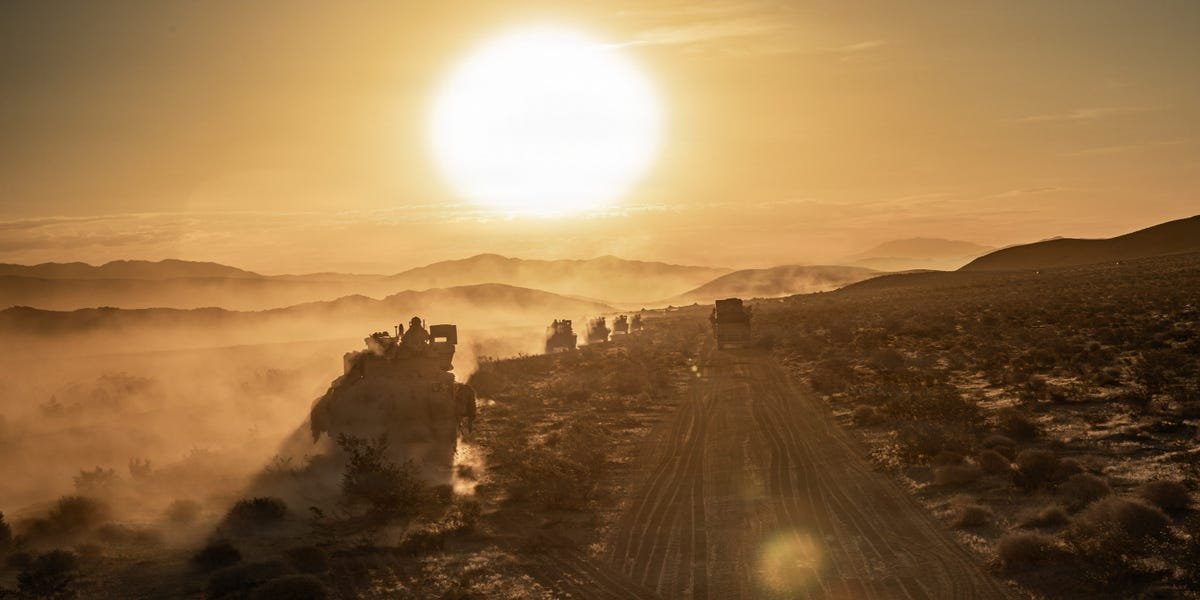

The US Army put its prototype command-and-control system to the test in the desert. Now, it’s sorting out what performed well enough to be scaled across the service — and what should be cut.
The Army has been developing Next Generation Command and Control, or NGC2, alongside industry partners like Anduril and Palantir, and at a recent exercise at Fort Irwin, California, the service put it to work in a large-scale desert combat scenario.
Project Convergence Capstone brought together nearly 10,000 Army soldiers, close to 100 new technologies, and forces from several allied and partner nations. It was the largest demonstration yet of NGC2, building on 10 months of testing at events like Ivy Sting and a broader trial, Ivy Mass, at Fort Carson, Colorado.
For the Army, this exercise offered critical insight into what’s working with NGC2. “As we move NGC2 into additional units, we’re going to be bringing the data layer, the applications, as well as the infrastructure, the transport,” said Joe Welch, an Army senior civilian executive overseeing NGC2’s development.
Those parts make up the core of NGC2, which is designed to streamline the flow of battlefield data and communications and use artificial intelligence to assist with information processing and battlefield planning.
This command-and-control system is intended to help the Army track and stay connected with distributed assets, be they soldiers or weapons, and use apps for functions such as calling in fires or tracking levels of fuel, water, and ammunition.
Army officials expect the NGC2 testing and training for additional units will be shorter because of the lessons that have been learned during its development. They say test data and feedback from soldiers should help future units adopt the system more quickly.
At the same time, the Army acknowledged that parts of NGC2 did not perform as expected during the exercise.
“We’re gonna have some failures out here in the desert, and that’s good,” said Gen. Christopher LaNeve, the Army vice chief of staff. “If there is something out here that’s not living up to what has been advertised, we’re going to walk away from that.”
The Army cited examples like applications that fulfilled duplicative functions, as well as pieces of hardware that didn’t perform well. Specifically, the heat of the Mojave Desert proved to be a challenge, causing some pieces of commercial technology to overheat. Soldiers sometimes improvised their own fixes.
“Soldiers figured out that by soaking a T-shirt in ice water, you could put it on top of some of the antennas and cool them off enough for them to function,” said Maj. Gen. Patrick Ellis, commander of the 4th Infantry Division.
There were other lessons learned from the exercise, including which apps were most useful for specific personnel and operational missions, and how NGC2’s user interface could be modified to better fit an individual user’s needs.
The Army is asking for nearly $4 billion to continue developing NGC2 in its latest budget request. Army officials have said the system, together with the service’s approach to bringing in vendors and using commercial technology, marks a shift in how it does business with the defense industry.
Brent Ingraham, assistant secretary of the Army for acquisitions, logistics, and technology and the Army’s acquisition executive, said the effort shows “how the Army is changing” the way it acquires and fields new technology while making better use of systems already in its formations.
Read the full article here