





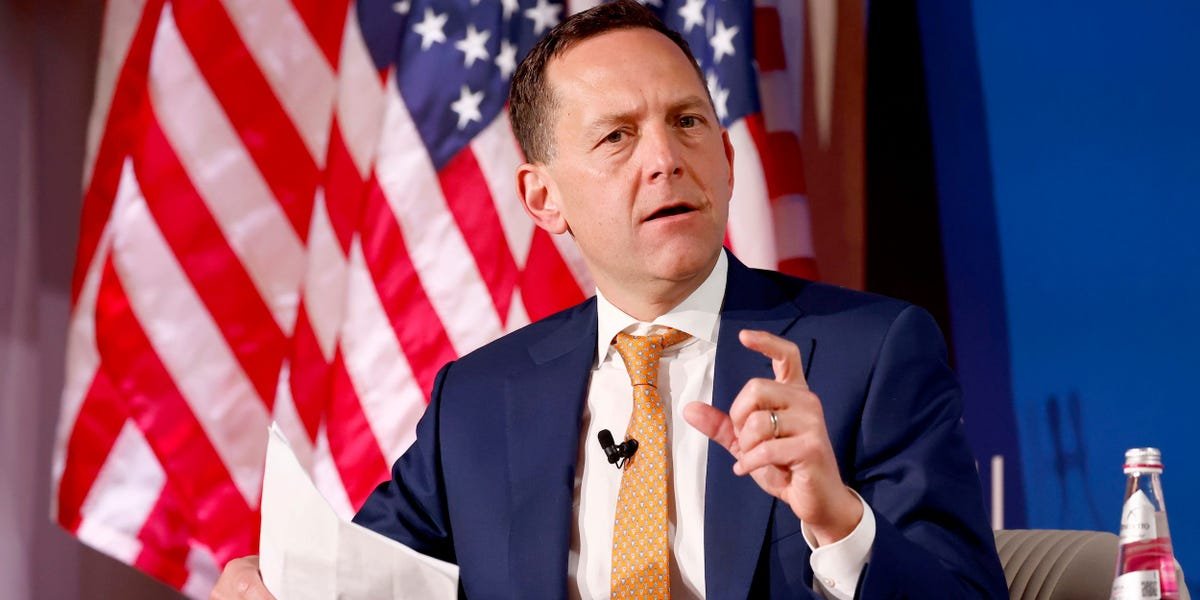

Venture capitalist David Friedberg says critics shouldn’t write off New York Mayor Zohran Mamdani’s city-run grocery stores.
“Everyone’s got it a little bit wrong in assuming that this thing is going to radically fail,” Friedberg said during a recent episode of “The All-In” Podcast, which he cohosts.
Friedberg said, “It’s a sad state” that the government-subsidized grocery stores, one of Mamdani’s core campaign promises, will likely come to fruition and spur similar efforts elsewhere when people see the stores in action.
“I think that these things are going to create a radical spectacle, an exuberance for socialist policies that’s going to kind of light a fire for socialism around the country, unfortunately,” he said. “Because at the end of the day, no one has to pay the bill, because the bill doesn’t come due for some time.”
Mamdani’s grocery plan has been heavily criticized. Red Apple Group CEO John Catsimatidis, an area grocery store magnate and longtime friend of President Donald Trump, recently told Fox Business that Mamdani’s plan was “trying to create something that’s not viable.”
The stores, Friedberg said, will “create a spiral where you need to offer more stuff for free to come up with a way to cover the cost of the inflation for people that can’t afford things anymore.” But in the immediate future, Friedberg expects them to be quite popular.
“They’re going to outperform Whole Foods. They’re going to outperform Safeway. They’re going to outperform Albertsons,” he said. “They’re going to be so in demand that what will end up happening is that over the next 24 months, every other city in America will look to these grocery stores and say, ‘We want the same. Why does only New York get these grocery stores?'”
Under the plan, New York will open five grocery stores, one in each of the city’s boroughs. Mamdani previously said the stores will offer a 30% discount on the “most common and most critical groceries for families,” like fresh produce, meat, and dairy. The city has set aside $70 million to launch the stores, with additional funding to come once they are operational. The Bronx location will open in 2027, the first one set to open.
Friedberg and his “All-In Podcast” cohosts have lamented the rise of socialism broadly. Recently, a handful of Democratic Socialists of America-backed candidates have won congressional primaries in New York, Colorado, and Pennsylvania. Not all candidates agree with the DSA’s entire platform, which, in addition to supporting policies like Medicare for All, also calls for abolishing the US Senate.
“A big part of the multi-level marketing scheme of socialism is to create spectacle,” Friedberg said. “And it will create more spectacle that will help to fuel the multi-level marketing scheme of socialism. And remember, the problem with all multi-level marketing schemes at the end of the day is someone has to pay the bill.”
Polls show that American adults remain broadly skeptical of socialism.
Last fall, Gallup found that 54% of Americans had a positive view of capitalism, the lowest since the firm began tracking such opinions in 2010. At the same time, only 39% of Americans had a positive view of socialism.
The story is different when you look at specific groups. In the same poll, more than 6 in 10 Democrats had a positive view of socialism, compared to just 14% of Republicans and 38% of independent voters.
On the heels of the recent electoral success of democratic socialist candidates, a Washington Post-Ipsos poll found that 3 in 4 Democrats would consider supporting a candidate with that ideology for president. In contrast, a majority (55%) of Americans would not consider supporting a democratic socialist for president.
Sen. Bernie Sanders, an independent from Vermont, who considers himself a democratic socialist but is not a member of the DSA, ran unsuccessfully for the Democratic presidential nomination in 2016 and 2020.
Read the full article here