







Washington’s war with Iran has cast a spotlight on a new American one-way attack drone, and Russia’s military bloggers are not liking what they see.
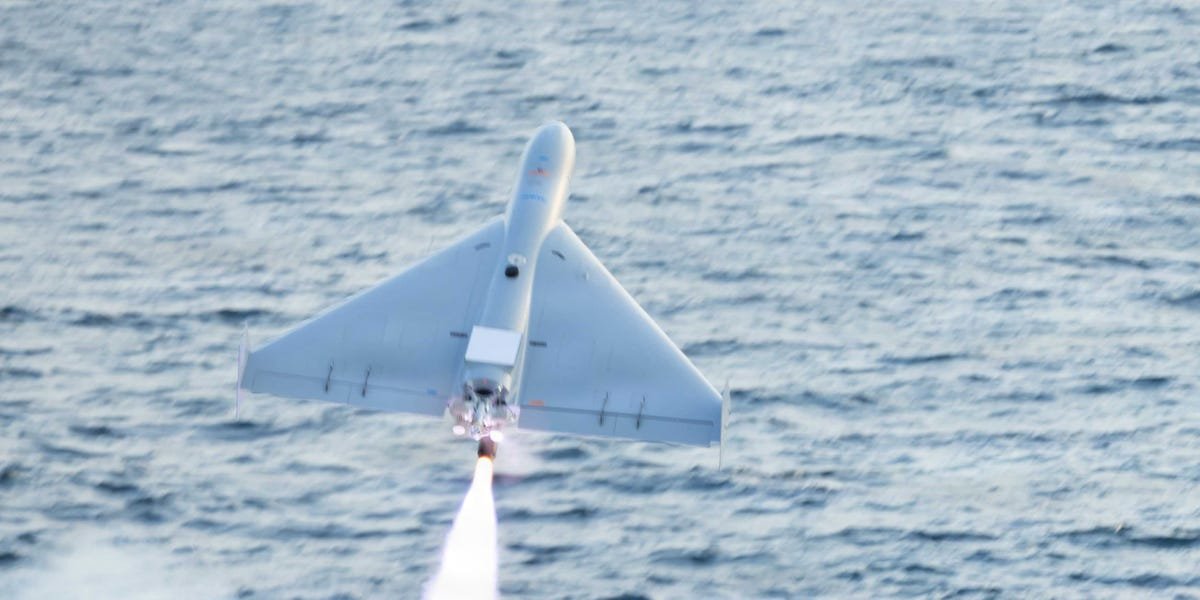
The US military deployed the Low-Cost Unmanned Combat Attack System, or LUCAS, for the first time in combat as part of major operations against Iran this weekend.
After the news broke on Saturday, several of Russia’s prominent war observers, some of whom have close ties to the Kremlin’s forces, began resharing footage released in December by the Pentagon of a LUCAS sea-based test launch.
The military bloggers — influential pro-war commentators with insider ties who shape domestic war narratives and pressure Russia’s military leadership from nationalist positions — zoomed in on one detail of the video: The drone’s apparent satellite terminal.
“What was inevitable has happened: Starlink terminals have been installed on American ‘Geran-like’ LUCAS drones, allowing jam-resistant communication anywhere in the world where Elon Musk’s network operates,” wrote Rybar, a prominent but irregular Russian military media organization that has 1.5 million followers on Telegram, on Monday.
“The effectiveness of enemy drone strikes will increase by an order of magnitude,” it said.
Another blogger, under the Telegram channel name “Obsessed with War,” raised concerns about the LUCAS separately on Sunday.
“What do we see?” they wrote. “A Starlink receiving antenna, which will allow the drone, if it is not shot down, to be guided precisely to its target while remaining connected until the very last split second.”
The LUCAS, built by US engineering company SpektreWorks, is believed to connect to military networks via Starshield, SpaceX’s government version of Starlink.
Neither SpaceX nor SpektreWorks responded to requests for comment from Business Insider.
Both the drone and its satellite service strongly parallel the capabilities that Russia has been trying to use against Ukraine. The LUCAS draws inspiration from the Iranian Shahed, a delta-wing loitering munition that also serves as the basis for the Russian Geran, the Kremlin’s main drone for long-range bombardment of Ukrainian cities.
Starlink, in particular, was widely used by Russian forces until SpaceX recently cut off access to the service in Ukraine. Kyiv’s forces had repeatedly said that Russia was arming its Gerans with Starlink terminals for jam-resistant guidance.
Starlink or Starshield terminals would allow attack drones to continuously receive and transmit data via SpaceX’s vast network of low-earth-orbit satellites, making the aircraft harder to spoof or jam while allowing operators to send real-time instructions until the point of impact.
The technology has proven more operationally resilient to electronic warfare than traditional satellite systems on which weapons have long relied.
Tech tested by Russia, reaped by the US
Since they were blocked from Starlink last month, Russian troops have been hard-pressed to find an alternative. The milbloggers, meanwhile, appeared distressed that the US has learned to integrate the technology on its drones after watching Russia’s fight.
Dmitry Konanykhin, a war blogger who runs a pro-Kremlin war podcast distributed by Russian state media, lamented on Sunday the possibility that the apparent terminal-equipped LUCAS was the result of Russia and Ukraine testing the concept prior to US adoption.
“Here are the results of laboratory work, conducted under ideal conditions by the US on the territory of Ukraine: a Starlink module on a Shahed-type drone,” he wrote.
Konanykhin expressed concern that the US and its allies could eventually expand the use of Starshield terminals to “any drone where aerodynamics allow” and that SpaceX’s thousands of satellites might potentially be difficult for Russia to take down.
“Forget the Soviet tales about nails scattered in orbit sweeping away satellite constellations,” they wrote, referring to anti-satellite weaponry that uses debris clouds. “That might have worked against hundreds, but not tens of thousands of satellites.”
Similarly, the military blogger “Russian Engineer” expressed worry on Sunday that the US might one day attach Starshield terminals to its cruise and ballistic missiles, such as the Tomahawk or Joint Air-to-Surface Standoff Missile.
Throughout the war in Ukraine, various munitions dependent on stable satellite guidance have seen reduced effectiveness, but capabilities like Starlink, if paired with these weapons, might limit the impact of electronic interference.
“In other words, all these long-range strike systems will be able to be controlled anywhere on the planet and achieve the same precision as FPV drones, literally through a window,” read the post from “Russian Engineer.”
“This isn’t just an evolution in military affairs; it’s a genuine revolution,” they added.
‘Things will go very badly for us’
Russia’s milbloggers, though the name may sound insignificant, are unofficial military voices and online opinion leaders who can wield significant influence over the national discussion of war and military affairs.
Several have had roundtable discussions with Russia’s president, Vladimir Putin, and are often regarded as Moscow’s allies in framing public war information.
Now, the LUCAS’ appearance has them calling for Russian authorities to invest in anti-satellite capabilities.
In a post on Monday, Rybar wrote that the Kremlin “needs to start developing means to destroy thousands of Starlink satellites now.”
“This must be funded as the highest priority,” they added.
Rybar wrote that Russian milbloggers had suggested using Starlink to control drones two years ago but were frustrated by authorities who did “not take this threat into account.”
“Obsessed with War” urged the same, posting a photo of what they called “Geran-like LUCAS drones.” They said in their post that “if within a year we do not find a solution against this satellite constellation, then things will go very badly for us.”
Read the full article here