






Hollywood workers, take note.
An AI-made feature film headed to the Tribeca Film Festival on Wednesday offers a glimpse of what filmmaking jobs could look like in the future.
Ash Koosha, the creative force behind “Dreams of Violets,” said he brought it to life almost entirely alone from his London flat using Anthropic’s Claude and other AI tools in lieu of a traditional cast and crew. It is the first fully AI-generated feature film to screen at Tribeca, one of the most competitive stages in independent cinema.
An Iranian exile, Koosha said he relied on AI out of necessity to create the film, which he described as a memorial to the victims of the Iranian government’s January crackdown on protesters. He said he would’ve preferred a full production, but he couldn’t safely erect a set in Iran or put real actors’ lives at risk of retaliation.
“I’ve been subject to the prosecution, the brutality in Iran,” he told Business Insider. His goal, he explained, was to create a visualization of events that the world would likely never fully witness through traditional journalism or filmmaking.
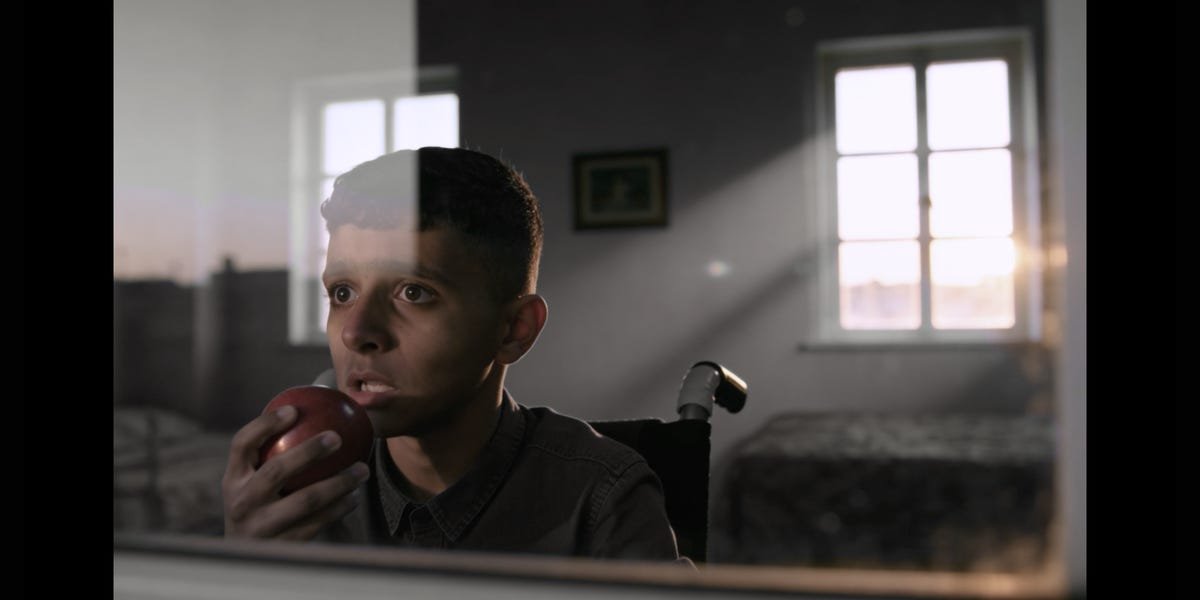
“Dreams of Violets” follows five strangers hiding from a violent soldier during a protest crackdown, while a child in a wheelchair witnesses their plight and decides to intervene. It is set in Tehran and was inspired by real events from 47 years of civilian resistance.
AI’s role in filmmaking first became a point of tension during the 2023 writers’ and actors’ strikes. Koosha’s experiment provides a real-world example of how the technology could dramatically alter employment across cinema, from pre-production to the silver screen.
His film’s place on the Tribeca slate also raises a thorny question: If one person can make a festival-caliber film with AI, what happens to Hollywood jobs?
“I didn’t need anyone to do this,” said Koosha, 40. “Not a single employee.”
Koosha doesn’t see AI replacing conventional filmmaking altogether. Though he said some stories are impossible to tell through traditional filmmaking, he added that “others are impossible to make with AI.”
He credits AI for giving him more than just independence. He said it also allowed him to work at “the speed of news.” He produced “Dreams of Violets” in roughly two months and said he could’ve gotten it done in just three weeks if he didn’t have a day job as the CEO of a tech-infrastructure startup.
The 75-minute production cost only about $2,000, according to Koosha, which is significantly less than most microbudget independent films. He said the budget consisted largely of subscription fees for AI tools he normally pays for, plus some additional usage credits.
Koosha said he wrote the script himself and used AI primarily to generate video elements that would otherwise have required a team of people, such as actors, costume designers, location scouts, and camera operators. He stressed that he was in control the entire time.
“I am the pure 100% decider of the output,” he said. “I’m only using AI models to render, almost print, the output that I desire.”
Koosha’s background is mainly in music production and technology. He said he doesn’t consider himself a filmmaker, though he played the lead role in “No One Knows About Persian Cats,” a 2009 film about his life that won a Cannes award and forced him into exile. He said he also unsuccessfully attempted to direct a feature film in 2015 because it required more than he could afford or technically execute at the time.
Still, Koosha said AI isn’t a substitute for filmmaking expertise, and he doesn’t want “Dreams of Violets” to leave people with the impression that anyone can suddenly produce a movie by typing prompts into an AI app.
“This is the false advertisement of the current AI model sellers,” he said. “It’s an absolute joke.”
Besides, he added, the AI tools he used were available to others at the same time, so technology alone doesn’t explain the film’s success in getting accepted into a major festival.
“The models themselves did not do this film,” he said. “You have to be a cinema-affiliated person.”
What “Dreams of Violets” shows, said Koosha, is that AI isn’t eliminating filmmaking expertise so much as it is changing how that expertise is applied. He said the future belongs to people who already understand the industry’s fundamentals and can translate those instincts into AI workflows.
This means some film jobs could evolve rather than disappear. Workers who once handled physical production tasks may instead spend more time on research, world-building, image generation, and creative decision-making, he said, and experts in areas such as lighting and sound might apply their techniques through AI tools rather than on a set.
“They know so much about positioning of light and reflections and the camera and the cinematographer’s needs,” he said. “If they learn how to store lighting in image generation in AI, that by itself is a specialist job.”
To be sure, there is at least one area where AI comes up short, Koosha said: Voice acting. With “Dreams of Violets,” Koosha said he voiced six characters, including a woman and a child. He said AI voice models lack realism and that he used a basic voice changer to adjust for gender and age.
For his next film, Koosha is looking to hire five individuals who will use AI just as he did, so together they can accomplish more and in less time than he did with “Dreams of Violets.”
“Those are new jobs, and they require cinema experience,” he said. “I can’t just get anyone from any industry and bring them in.”
Read the full article here