






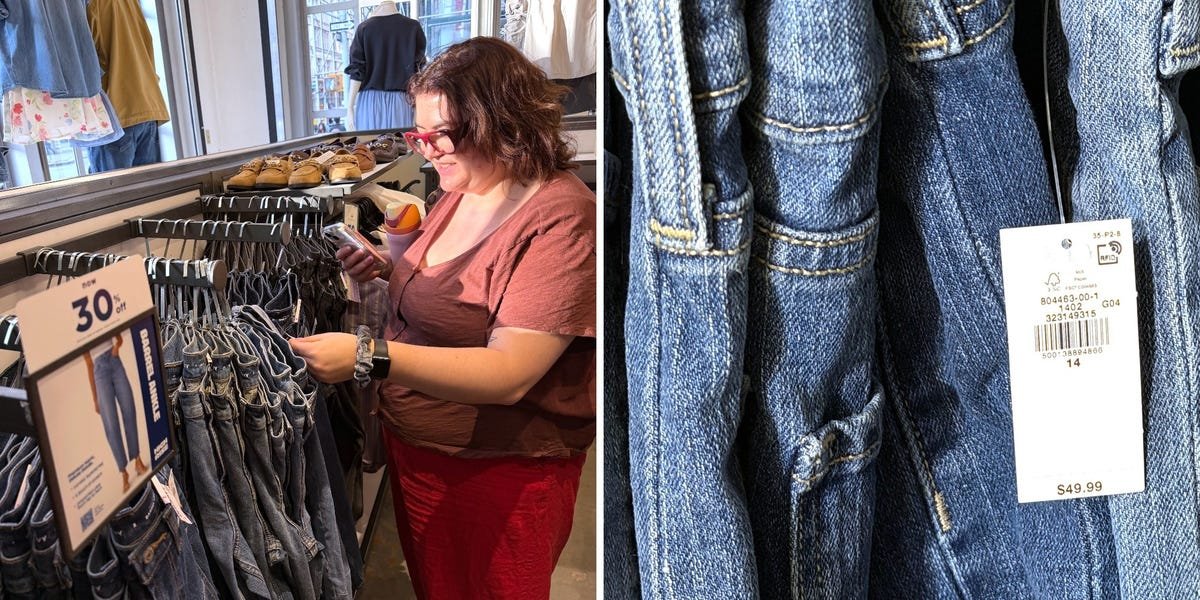

For the last week, I’ve been watching the dip and trying to figure out the optimal time to buy. I’m talking, of course, about my Old Navy shopping cart.
A few months ago, I noticed that items I’d added to my cart on the Old Navy app changed day to day. Typically, prices would increase after a day or two, and go back down the next day. Often, I’d hit “checkout” to avoid more price hikes. It was annoying, and I would often blame myself if I let a deal slip by.
So I decided to try an experiment. For the past two weeks, I’ve been tracking an Old Navy cart filled with a few basics:
- Socks
- Leggings
- A T-shirt
- Jeans
The price of my cart has changed three times already. I also went to two different Old Navy locations in person, and each time, the prices were higher than those in my app cart.
The rules of shopping have changed under our noses. While we expect some price fluctuations across the economy — plane tickets, concert tickets, and rideshares, for example — there’s something that feels different about gamifying my denim purchases.
Dynamic pricing has become more common across the economy, with digital price tags shifting costs for consumers at retailers from Walmart to Kroger. I did try to ask Old Navy about the logic of their pricing and the fluctuations in my cart; the company told me twice that they “aren’t able to participate at this time.”
A pair of jeans may seem like a drop in the bucket for an economy contending with a worsening labor market, looming stagflation, and worker despondency, but this approach to pricing is spreading across everyday purchases, turning all of us into day traders of everyday goods. Just like in trading, there are winners and losers — even when it comes to acquiring a new pair of leggings.
How pricing has changed
The practice of charging different prices for different buyers is nothing new. In economics, that’s part of what’s called price discrimination. Take a discounted student movie ticket, for example, says Mark Tremblay, an assistant economics professor at the University of Nevada, Las Vegas, who studies the digital economy. Both the non-student and student are getting the same product — a movie ticket — but the student is paying less.
That’s a straightforward example of effective price discrimination. Students generally have less money. Offering a discount attracts students who might not see the movie otherwise, and the theater makes money.
Once upon a time, grocery and clothing prices followed the same reasoning. If something wasn’t selling, firms would stick a big sale tag on it or send it to the clearance corner. Those who bought it on clearance received the same product, but at a slashed price they were willing to pay. In retail, that type of pricing is used to manage inventory. Halloween candy getting marked down on November 1 is a classic example, says Peggy Stover, the director of the University of Iowa’s marketing institute.
But now, as both Tremblay and Stover said, companies have a lot more information about how and when consumers are spending. Rather than Halloween candy or tickets being one price and then getting marked down to a far reduced one, they might become a real-time pricing experiment.
“You just have these constant price fluctuations, and that’s how things will be moving forward,” Tremblay said. Indeed, Gap Inc. CEO Richard Dickson has said that the company is trying to dial back on a bombardment of promotions and discounts, shifting so that “how we promote is a much more refined and directed narrative.”
That’s changed the shopping calculus many of us grew up with. No longer are there solely sweeping clearance sales or special promotional days; although those still exist, shoppers are also likely to encounter gradual decreases through pricing shifts and rolling sales.
“I think that’s more the direction that we’re going — just less of this ‘there’s a retail price, there’s a sales rack,'” Tremblay said. “It’s more of everything’s kind of in between.”
As the National Retail Federation notes, the outcome of this digital pricing means consumers could see lower prices during off-peak periods, and more tailored discounts. It’s an accelerant of decisions retailers have always made, NRF writes.
“This ain’t your momma’s home economics, right? Everything we learned about shopping as a kiddo or everything that you’ve understood about shopping for decades has shifted into your feed,” said Lindsay Owens, the executive director of the Groundwork Collaborative and the author of an upcoming book on price gouging. “And comparison shopping is really difficult now because there often isn’t a posted price, or the posted price is varying minute by minute, or day by day.”
Of course, there are still deals to be found; I learned that firsthand when my Old Navy cart total dropped $11, nearly 17% below its starting price, during my experiment. But this set off a new spiral for me: When do I actually take the plunge and hit buy? Would there be a mythical day when my cart would hit a new low? It was almost madness-inducing; I now knew that every day could mean a tantalizing price decrease, or a hike that erased any of the cart “gains” I had made. When I asked Tremblay when I should finally stop watching and buy, he laughed.
“If I knew that, I wouldn’t be talking to you, and I’d be investing in stocks, right?” Tremblay said.
Who wins and loses
Tremblay had a point: I am now a leggings day trader. Didn’t he think that’s a little bizarre, I asked.
He did, but said this is the direction that pricing is going across the board. If retailers see that I’m willing to wait and don’t have leggings urgency, they’re willing to drop my price a bit. Stover said she’s experienced that firsthand — in some instances, ever-changing prices can benefit consumers. I’m now getting a better deal than I started out with. That’s a point in favor of shifting prices: I waited to decide whether a purchase was worth it, and that waiting period worked.
“You see this explicitly in your case, right? If you’re willing to wait, you save 11 bucks,” Tremblay said.
That doesn’t always extend to the in-person shopping experience. I visited two brick-and-mortar Old Navy stores in New York on different days and located the exact items in my virtual cart. If I had purchased those items in-person, I would’ve spent nearly $24 more. However, I knew a secret: If I scanned the price tags in the app, it would show a different price. If you show Old Navy workers that an item is cheaper on the app, they’ll price-match it in-store. That’s exactly what I did with the one item I purchased (an extremely cute three-pack of socks). I paid half of what the in-store price scanner said the socks would cost.
Looking around, I noticed a lot of older shoppers who didn’t have smartphones out and weren’t scanning the tags as obsessively as I was. That made sense: Gen Xers and especially boomers primarily shop in-store, per an analysis of retail data by Capital One. Walking through the aisles, I realized I might end up paying less than my fellow shoppers simply by knowing the right way to use the app.
Jason Straczewski, the National Retail Federation’s vice president of government relations and political affairs, said to me that, broadly, we just don’t know what higher costs are associated with brick-and-mortar stores. There might be onerous regulatory requirements in the areas where they’re built, or higher labor and energy costs; it could be cheaper for a firm to market and ship a product to you online, rather than stocking it in a physical store.
The higher in-store prices, Tremblay said, also reflect different market forces. In-person shoppers can’t just open a tab and transport themselves to a different store; there’s less immediate competition, and so consumers will tolerate higher prices. If they’re price-matching in the moment, like I was, they can still get the more competitive online prices — they just have to know that they can do that.
That’s where we enter a pricing Wild West. Retailers can price how they want, and consumers can find ways to deal with it. But I did think about my other shoppers — folks who might have less time or smartphone savvy, or not speak English as a first language, or be nervous about asking to price match — and what this all means for them. I was an obsessive reporter with a spreadsheet. They were just trying to find a pair of pants.
“It’s definitely a disadvantage to those consumers who either don’t have the technology to help them do price comparison, or don’t have the resources or the knowledge to do it,” Stover said.
Ultimately, I walked away from this experiment with a three-pack of morally ambiguous socks. As I price-matched them in store, I knew other unsuspecting shoppers would likely be paying the $12.99 on the in-store price checker versus the $6.49 I shelled out. And yet, I felt a slight thrill at my discount conquest. The next time someone complimented my socks, I bragged: Yes, I had gotten them for half off. No wonder the day traders keep going back for more.
Read the full article here