






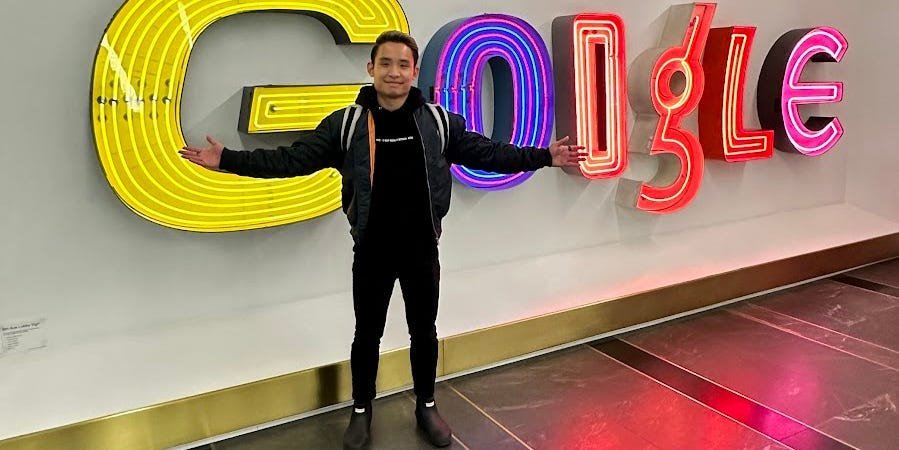

Throughout university, Google was always my dream job. I watched “The Internship” and dreamt of the day that I would get to work there.
Eventually, after a few years, I made my way in and landed a role at Google as a global product lead. Prior to that, I was at Meta as the business operations and planning lead for North America. Now I’ve left Big Tech to build multiple businesses, including one that is doing seven figures a year, and invest in over 20 companies.
None of that was a straight line. The first time I interviewed at Google, I was one of three finalists after a 12-month process, but I walked out knowing I had lost the moment I opened my mouth.
I bombed the final round so badly that it took three years before I interviewed there again. Here’s what happened, and the four lessons I’ve carried into every interview and career decision since.
I interviewed for a sales account manager role on Google’s ad team
I had never interviewed at a Big Tech company before, and the process was unlike anything I’d experienced.
I spent months preparing. I did hundreds of practice interviews. I was still so painfully nervous I could feel my hands shaking in the waiting room.
Somehow, I made it to the final interview. During the interview, the interviewer asked the most deceptively simple question imaginable: “What do you do for fun outside of work?”
I froze.
Here’s the truth: I was a nerd. A genuine, unashamed nerd who spent his evenings building websites, obsessively testing productivity tools, and writing about everything he learned. I had started a tiny tech newsletter I shared with a handful of friends (and my mom).
I had this image in my head of what a “Google person” looked like. Cool hobbies. Cool parties. Cool music. I was convinced that if I told her who I really was, she’d disqualify me on the spot.
So I lied.
I tried to change my personality for the job, and it didn’t work
I told the interviewer, “I go to a lot of parties and music festivals and watch a lot of TV.”
The color drained from her eyes. I could feel it happening in real time. She followed up: “What kind of music festivals? What was the best show you watched?”
I doubled down.
“I like Drake and Taylor Swift. And I’ve basically watched every show on Netflix. Literally every single one.”
I never got a callback. She thanked me for my time, said they decided to go with another candidate, and that was that. It took three years before Google interviewed me again.
What I’ve learned since
A year after that failure, I interviewed at another tech company — a better role, higher pay, and in my dream city. This time, I told them everything.
I talked about the tech newsletter I was building. I walked them through the websites I’d built for fun. I rambled about my obsession with productivity software in a way that — in hindsight — must have seemed slightly unhinged.
I got the job. Honestly, it changed my life.
Those two experiences taught me four things I now share with every early-career professional I coach.
1. The version of yourself you perform in an interview has to survive the job
Here’s the practical problem with lying in an interview: if it works, you’ve created a prison for yourself.
If I had gotten that Google role by pretending to love music festivals and Taylor Swift, I would’ve had to sustain that fiction with a manager I saw every single day. The relationship starts on a false foundation. The version of you that got hired isn’t the version that shows up on Monday morning.
When you’re authentic in an interview, you’re not just trying to impress them — you’re also evaluating whether this is a place where the real version of you can actually thrive. That calculus matters.
2. Generic answers are a death sentence
“I like Drake and Taylor Swift” is the résumé equivalent of “I’m a hard worker who loves a challenge.” It says nothing. It connects with no one. It helps no one.
“I run a tech newsletter about productivity tools — mostly friends, and my mom read it” is memorable, specific, and real. Even if the hiring manager has zero interest in productivity software, they now have a picture of who you are.
The goal isn’t to guarantee they’ll love your hobbies. The goal is to give them something real to react to.
3. Your niche obsessions are your competitive advantage
At the time, I was embarrassed by my interests. I thought they made me less hireable.
The opposite turned out to be true.
My obsession with building things, writing about what I learned, and exploring new tools were exactly the signals a company like Google was looking for. Someone who builds things in their spare time because they simply can’t help it.
Ask yourself: What are the interests you’re most tempted to hide in an interview? Chances are, those are exactly the ones that make you most distinctive.
4. Culture fit is a two-way interview
After failing that Google interview, I was devastated. I spent months replaying every answer.
What I understand now is that culture fit isn’t just something that happens to you — it’s something you also get to assess. A company that would pass on me for being a nerd who builds websites and runs newsletters was probably not a company where I would have thrived.
The right fit wants the real you. If it doesn’t, you’ve learned something valuable — for free, before you’re three years into the wrong job.
Andrew Yeung is a former Meta and Google employee who now throws tech parties through Andrew’s Mixers, runs a tech events company called Fibe, and invests at Next Wave NYC.
Read the full article here