







Cruise ship jobs are hard work, but there are some unique perks to the gigs.
Most notably, perhaps, crew members can travel while getting paid. However, jobs aboard the vessels are as wide-ranging as the services they provide, and wages can vary significantly based on an employee’s responsibilities. The many groups of employees “have different wage structures,” said Larry Pimentel, Cruise Executive-in-Residence at Florida International University’s Chaplin School of Hospitality & Tourism Management.
The terms of their employment also differ from many jobs on land. Pimentel, former president and CEO of Azamara and Cunard Line, among others, as well as co-founder of SeaDream Yacht Club, walked USA TODAY through what pay for cruise line crew members typically looks like.
How Much Do Cruise Ship Crew Members Make?
Cruise ship crew earnings can vary widely.
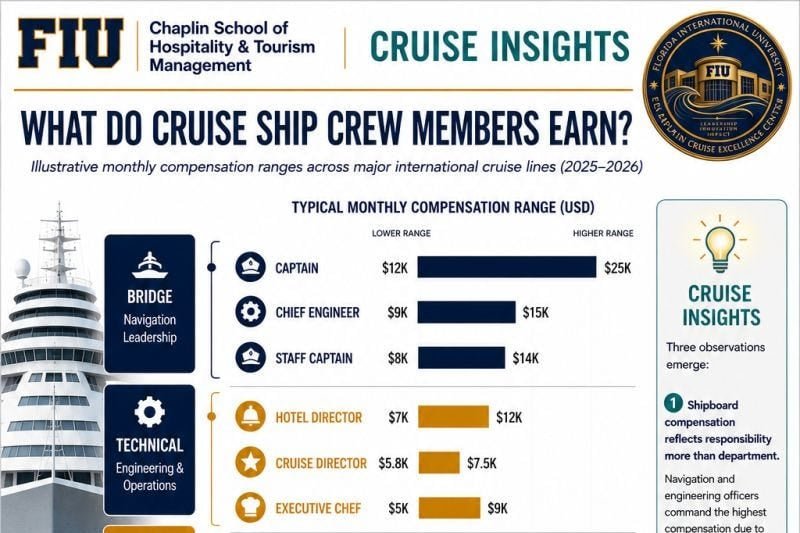
Cruise captains, the highest-ranking officials onboard, can commonly make between $12,000 and $25,000 a month, according to an FIU chart prepared by Pimentel based on an analysis of information from maritime recruiting firms and employment listings, industry compensation surveys, cruise employment agencies and more.
Galley or housekeeping utility roles – which could include washing dishes, for example – sit at the lower end of the chart, typically making between $1,200 and $2,500 a month for the former and between $1,200 and $2,200 for the latter. Toward the middle, chief housekeepers can earn between $4,000 and $7,000 monthly, while executive chefs can make $5,000 to $9,000.
Typical monthly compensation ranges across major international cruise lines (2025-2026)
Bridge (Navigation Leadership)
- Captain $12K – $25K
- Chief Engineer $9K – $15K
- Staff Captain $8K – $14K
Technical (Engineering & Operations)
- Hotel Director $7K – $12K
- Cruise Director $5.8K – $7.5K
- Executive Chef $5K – $9K
Hotel Leadership (Guest Experience Leadership)
- Casino Manager $4K – $8K
- Chief Housekeeper $4K – $7K
- Restaurant Manager $3.5K – $6.5K
- Shore Excursion Manager $3.5K – $6K
Department Management (Department Leadership)
- Nurse $3.5K – $6.5K
- Guest Services Manager $3K – $5.5K
- Security Officer $2.5K – $5K
Frontline Crew (Guest-Facing Service)
- Cabin Steward* $1.8K – $4K
- Waiter* $1.5K – $4K
- Bartender* $1.5K – $4K
Support Crew (Essential Support Operations)
- Galley Utility $1.2K – $2.5K
- Housekeeping Utility $1.2K – $2.2K
Pimentel stressed that those figures are “illustrative.” Many crew members are hired through third-party agencies with varying practices, and actual earnings can vary depending on the cruise line, the individual employee’s experience level and other factors. Most cruise ships are also flagged – or registered – in foreign countries such as the Bahamas or Panama, and there is no comprehensive U.S. public wage database for crew (though ships are still subject to international maritime labor standards).
“There’s no one uniform easy way to get your arms around it, because you have manning agencies, you have flag state requirements and you have the contract terms,” he said. There are other forms of compensation, too.
“Wage comparison alone underestimates the opportunity, because crew also receive food and accommodation at zero cost while they’re on board. … They receive medical coverage for the contract duration,” Pimentel said. “They obviously have no commuting, housing or utility costs – they’re on a ship. And in some cases it’s a bonanza, because many source nations exempt overseas maritime earnings from income tax entirely.”
Wages must also be viewed through the lens of the workers’ home countries, he added, with established source markets including the Philippines, India and Eastern Europe. There can be 50 or more nationalities represented among crews on large ships, Pimentel said, where they can often earn more than in hospitality jobs back home.
“The ship, for many of these international crew, are a multiplier effect of two to eight times what they could normally get in their own country,” he said. There’s also sizable future income potential, since crew members can advance through the ranks.
Pimentel said to “consider the fact that many of these staff members, they’re being given training, they’re being given opportunity for education, and the upward mobility, given all these new ships, for some of these people is amazing.”
How Long Are Cruise Ship Crew Contracts?
Contract lengths vary by role and cruise line.
Princess Cruises contracts, for example, range between three and nine months. “After each assignment, you will receive approximately two months of vacation before your next assignment,” the cruise line said on its website.
The schedules are often demanding while on board, however. “Your daily work schedule while on board is in accordance with ILO Convention guidelines and will depend on your position, but you must expect to work seven days a week and anywhere between 10-13 hours per day.”
How Are Cruise Ship Gratuities Distributed?
Pimentel’s analysis does factor in gratuities which are paid to roles that support guest services, such as cabin stewards, waiters in the dining room and others.
Holland America Line’s Crew Appreciation charge, for example, is “designed to recognize the many team members who support your journey, including those you see every day and those working behind the scenes,” according to its website. The company charges $20 per guest, per day for those in suites, and $18 for all other passengers.
Many cruise lines automatically add those gratuities to guests’ onboard accounts – though they can usually be adjusted up or down before disembarking – to be distributed among designated teams. Other brands, such as luxury lines, generally bundle gratuities into their fares and allocate them internally to crew.
Pimentel noted, however, that gratuity practices and structures vary “enormously across the industry.”
“And the more that the guest understands that it’s a part of their wage structure – in particular the frontline crew area – the more I’ve found that they’re inclined to be a participant.”
Nathan Diller is a consumer travel reporter for USA TODAY based in Nashville.
Read the full article here