





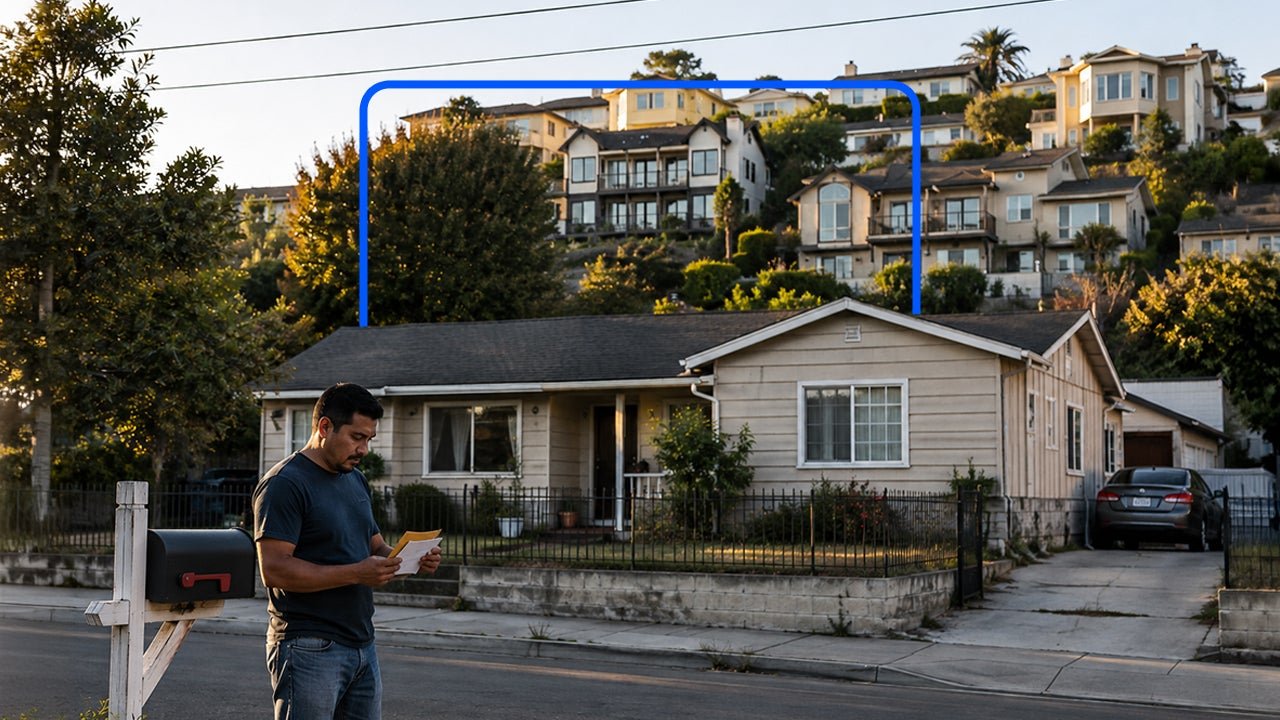

The moment Runbo Li’s parents bought his childhood home is something he hasn’t forgotten.
In 1998, his parents emigrated from China to build a better life for him and his younger sister. For nearly a decade, they lived carefully, saving whatever they could while working jobs at Penn State University.
In 2006, their persistence paid off. With each parent earning roughly $30,000, they bought a newly built home in State College, Pennsylvania, for $180,000.
Their incomes didn’t grow much over time. They weathered two market downturns and endured times when they owed more than their home was worth. They took side jobs to make ends meet and even tapped into their home equity along the way. But his parents kept pushing forward, and by 2020, they had paid off their mortgage in full.
For many low-income families, stories like this capture what homeownership is supposed to mean: stability, security and a path toward something better. Homeownership rates among low-income households (people earning less than $30,961) have climbed since 2015, with gains even outpacing those of higher-income groups, according to the Federal Reserve Bank of Minneapolis.
The house is an embodiment of all the sacrifices they went through. It’s almost like they bottled up all the struggles — financial, life and social — accumulated all of that and then exchanged it for something physical.
— Runbo Li
But Li’s family story is more of the exception than the rule. What happens after many low-income homeowners buy is far more complicated. While home equity is the largest asset among low-income households, they are often running behind on the equity treadmill — building wealth more slowly and with less stability than higher-income owners. For many families, the challenge becomes holding onto and building that wealth in a system mostly shaped by factors beyond their control.
Lower-valued homes, slower equity growth
Homeownership is often considered one of the most reliable paths to wealth building. But, the reality isn’t the same for everyone.
Between 2012 and 2022, the median value of homes owned by low-income households rose by 75% to $98,910, according to the National Association of Realtors (NAR). It’s impressive percentage growth, but the resulting dollar value is still $23,000 less than the value of middle-income homes ($122,100) and nearly $52,000 less than homes of upper-income households ($150,800).
The median value of homes owned by low-income households grew at a higher percentage change than those of middle- and upper-income households, but their dollar values trail significantly behind. It’s a basic math problem.
| Starting home value | % growth | Growth in dollars | Ending home value |
| $100,000 | 60% growth | $60,000 | $160,000 |
| $125,000 | 55% growth | $68,750 | $193,750 |
| $150,000 | 50% growth | $75,000 | $225,000 |
“The main reason for that is that they [low-income homeowners] tend to own lower-valued homes,” says Nadia Evangelou, senior economist and director of real estate research at NAR. “After they enter the market, they are not able to accumulate the same wealth as other income groups. Upper-income levels tend to own homes in high-cost areas, so they are able to build equity faster. Unfortunately, they [low-income homeowners] are not able to buy homes in these areas. So location matters.”
While low-income and high-income homes are facing the same rising costs for everyday expenses — gas, groceries, medical care and more — their largest assets aren’t returning comparable dollar values. Therefore, the already wealthier households grow their wealth more quickly while the lower-income households fall further behind, even with impressive percentage growth.
The tenure penalty for low-income households
Low-income homeowners find themselves on the wrong side of the time as well. Common advice says that the longer you stay in a home, the more you stand to make in equity as home values generally increase over time. And while that’s true for both low-income and high-income homeowners, the numbers once again don’t favor lower-income households.
Lower-income homeowners stay an average of 19 years in their homes, the longest of any income group, but they walk away with about $100,000 less in appreciation than upper-income owners who stay just 14 years.
| Income group | Homeownership rate | Median property value | Median household income | Estimated wealth gains from price appreciation | Avg. years in house |
| Low income (less than 80% of the median) | 48.1% | $272,736 | $35,168 | $156,856 | 19 |
| Middle income (80%-200% of the median) | 70.1% | $356,318 | $102,734 | $169,956 | 16 |
| Upper Income (200% and over) | 86.9% | $537,752 | $229,467 | $254,625 | 14 |
Source: National Association of Realtors/2024 American Community Survey Public Use Microdata Sample
The uphill entry to homeownership
Building equity begins even before a homeowner receives the keys. It begins with how much money you bring to the table, i.e., the down payment. Therein lies another challenge to building equity for many low-income homeowners: coming up with even a small amount for that down payment. Not only can this limit the price of the home and the type of neighborhood they can access, but it also impacts how much equity they’re able to build.
And if these families are able to attain homeownership, the challenges to building equity don’t disappear. Housing downturns can quickly wipe out gains, something Li’s parents experienced firsthand.
Just two years after they bought their home, the 2008 financial crisis hit. His parents’ home value dropped sharply, and they spent some time underwater. Li says there was even another small downturn after that. He says his parents’ home price has almost doubled in the past 20 years, but “It hasn’t grown at the rate it could have if the timing were a bit better.”
Stephen Ross, an economics professor at the University of Connecticut, says that the financial losses homeowners faced after the Great Recession largely came down to two factors: the loss of the down payment and the slower-than-expected growth in home values over time.
“We might be concerned about encouraging more financially vulnerable individuals to move into homeownership because of these long-run risks,” he says. “The idea is that they never would have had access to those capital gains in housing if they hadn’t moved into homeownership anyway.”
Putting their equity to work
When equity grows slowly, it can leave low-income homeowners in a precarious position. They have less cushion if they want to sell and trade up to a larger home. Accessing home equity for emergencies like medical bills or job loss hits harder since the home can’t easily provide a financial buffer. Refinancing may also be challenging, locking them in not just with high rates but also low equity.
Even so, some low-income homeowners are finding ways to navigate these challenges.
Evangelou points to the 2024 Home Mortgage Disclosure Act (HMDA) data, which shows 33% of mortgage originations among households earning $30,000–$40,000 were refinances. That’s higher than the 22%-23% refinance rate among middle- and upper-income homeowners.
“This suggests lower-income homeowners are more likely to tap into their home equity or adjust their loans, often to manage financial hurdles,” she says.
Home equity often functions as a forced savings account for low-income households. While their stake will slowly accumulate over time, it will eventually become a critical source of financial mobility when they access it.
“In the past 60-70 years, wealth within a home is what people have been able to pass down to their children to help give them a step up economically,” says Anneliese Lederer, senior policy counsel at the Center for Responsible Lending, a nonprofit research and policy advocacy organization. If someone is locked out of homeownership, they’re cut off from a major source of wealth that can grow over time, she explains.
In the late 2000s and into the 2010s, Li remembers his parents working constantly. There were long stretches of time when he barely saw them. His mother worked a nonstop schedule at Penn State in the morning and at a restaurant in the evening. Their efforts eventually paid off. Around 2020, his parents were able to tap into their home equity to invest in apartments and even buy a small hot pot business.
“Starting a business was something that they had always dreamed about and trying to do something bigger,” Li says. “After the home was mostly paid off, that gave them that sense of security to go for it.”
Homeowners usually tap into their equity in one of three ways: HELOCs (home equity lines of credit), cash-out refinances or home equity loans.
There isn’t always a strict income requirement for these, but lenders do look closely at your debt-to-income ratio (DTI). Your DTI shows how much of your income is left over after covering your monthly debts. Aim for a DTI no greater than 43%.
The median DTI for HELOC borrowers was 41.02% in Q3 2024, according to HMDA data. With many borrowers just below the DTI cutoff, that can make accessing equity difficult, especially for low-income homeowners with tighter budgets.
A harder path for the next generation
Homeownership remains one of the most powerful tools for building wealth in America. For low-income households, it’s even more critical.
“Low-income households are more reliant on homeownership as a wealth-building tool because they don’t usually have access to other assets like stocks or retirement accounts at the same scale as the other income groups,” Evangelou says.
For low-income households, turning the idea of long-term financial stability into reality can be difficult.
Bankrate analysis found that anyone earning the median U.S. income ($80,000) will find themselves priced out of 3 out of 4 U.S. homes on the market. As of March 2026, the median home sales price in the United States was more than $408,000. This has left many people with limited income locked out of homeownership and the ability to build wealth through equity.
“The mortgage cost is up and the price is still elevated. That’s really putting the squeeze on people who weren’t already in homeownership,” says Erik Hembre, senior economist at the Federal Reserve Bank of Minneapolis. “In particular, we’re seeing a pretty big drop in people being able to enter homeownership, especially lower-income groups.”
This reality is sobering for Li as he reflects on his parents’ accomplishments.
“It’s just very impressive that they were able to do it in 2006, on not a lot of income,” Li says. “You are speaking to something where their incomes afterward didn’t grow basically that much. I think it would have been much, much harder for them to try to do that today.”
For Li’s parents, the purchase ultimately paid off. He says the fully paid-off house will eventually be passed down to him and his sister as an inheritance. Watching their experience taught him a lot about homeownership: the challenges of building equity, the ups and downs in home values and the pressures of keeping up with mortgage payments. Li’s been happily renting for 13 years and isn’t in a rush to buy a home.
“It feels very far out to me,” he says. “I think the likely scenario in which I would even consider that is when I kind of want to settle down; maybe I’m married, thinking about children and know the place that I want to live. But those are all really big things that I’m far away from.”
Why we ask for feedback
Your feedback helps us improve our content and services. It takes less than a minute to
complete.
Your responses are anonymous and will only be used for improving our website.
Help us improve our content
Read the full article here