





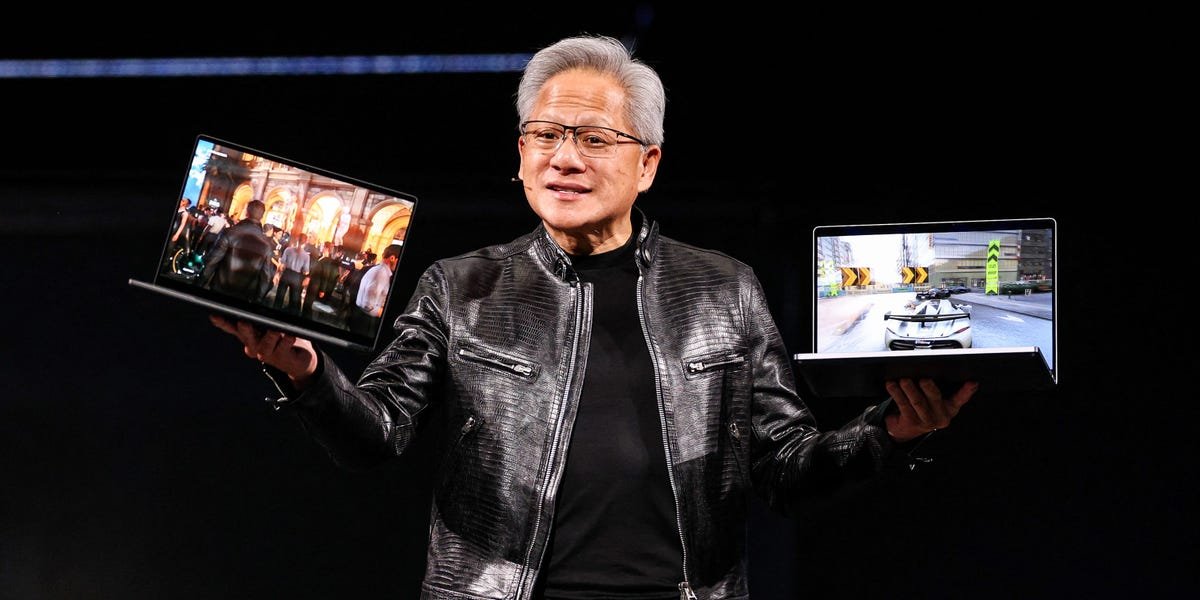

Nvidia CEO Jensen Huang delivered his hotly anticipated keynote speech at Computex on Monday.
It was jam-packed with new releases, including a chip aimed at reinventing the personal computer as we know it. Huang also had some words of optimism for software engineers, who are seeing their industry transformed by AI.
Computex, which is held annually in Taipei, Taiwan, is Asia’s largest tech trade show — and Huang is one of its main draws.
The “Jensanity” around Huang has grown since last year’s Computex, when crowds flocked to see him in Taipei. At this year’s event, his onstage dance moves with colleagues went viral.
Here are the key takeaways from his keynote speech.
1. Nvidia’s new chip brings AI to laptops
Nvidia became the most valuable company in the world by selling chips for data centers to power the AI boom. Now it wants to power AI directly on personal computers.
Huang unveiled the RTX Spark — a chip designed to enable AI agents to run natively on personal computers. Nvidia has collaborated with Microsoft for Windows PCs purpose-built for running personal agents.
He gave the example of designing a house to demonstrate what an AI chip for a personal computer could do.
You could select the build site, share concept sketches, and a style moodboard, then prompt a chatbot with requirements. Then the agent gets to work, turning your idea into a plan, complete with renderings and materials — all while running on the device itself rather than in the cloud.
“This reinvention of the computer is as big of a deal as the reinvention of the phone into what we now know as the smartphone,” Huang added.
2. Nvidia is doubling down as an ‘infrastructure company’
Huang said it’s not enough for Nvidia to just design AI chips, known as graphics processing units, or GPUs. He wants to build the entire stack.
“Nvidia has really become an infrastructure company. Not just a GPU company. Not just a systems company,” Huang said.
At Computex, he unveiled the Nvidia DSX, a framework for designing, deploying, and operating AI factories at scale.
An AI factory is the combination of data centers, power, cooling, networking, compute, software, and data that enables AI to be trained and operated at scale.
“Becoming incredibly good at helping customers build AI factories and deploy AI factories is incredibly important, and the reason for that is this: compute is revenue now. Compute is profit,” Huang added.
Nvidia also announced on Sunday that the Vera Rubin, a microprocessor designed to power AI agents, is now in full production. The company previously announced that Anthropic, SpaceX, and OpenAI are among its first customers.
3. Huang says AI will need more software engineers, not less
Huang reiterated his optimistic view on AI’s impact on jobs.
He said he believes that the productivity gains AI provides to software engineers will instead make the profession more valuable.
“People talk about AI reducing jobs — complete nonsense,” Huang said.
“It’s causing more software engineers to be hired, and the reason for that is very simple. If you can hire a software engineer and you can generate $9 trillion worth of productive work, why wouldn’t you want to hire more software engineers?”
AI has transformed the role of software engineers. For some of them, it has created an identity crisis, while others worry that they’ll be automated out of a job.
However, data from tech-hiring analytics firm TrueUp showed that software engineering job openings have actually increased this year.
Similarly, Huang said onstage at Computex that AI means it’s actually an “incredible time” to be a software company, following concerns that the technology would cause a “SaaSpocalypse.”
Read the full article here