






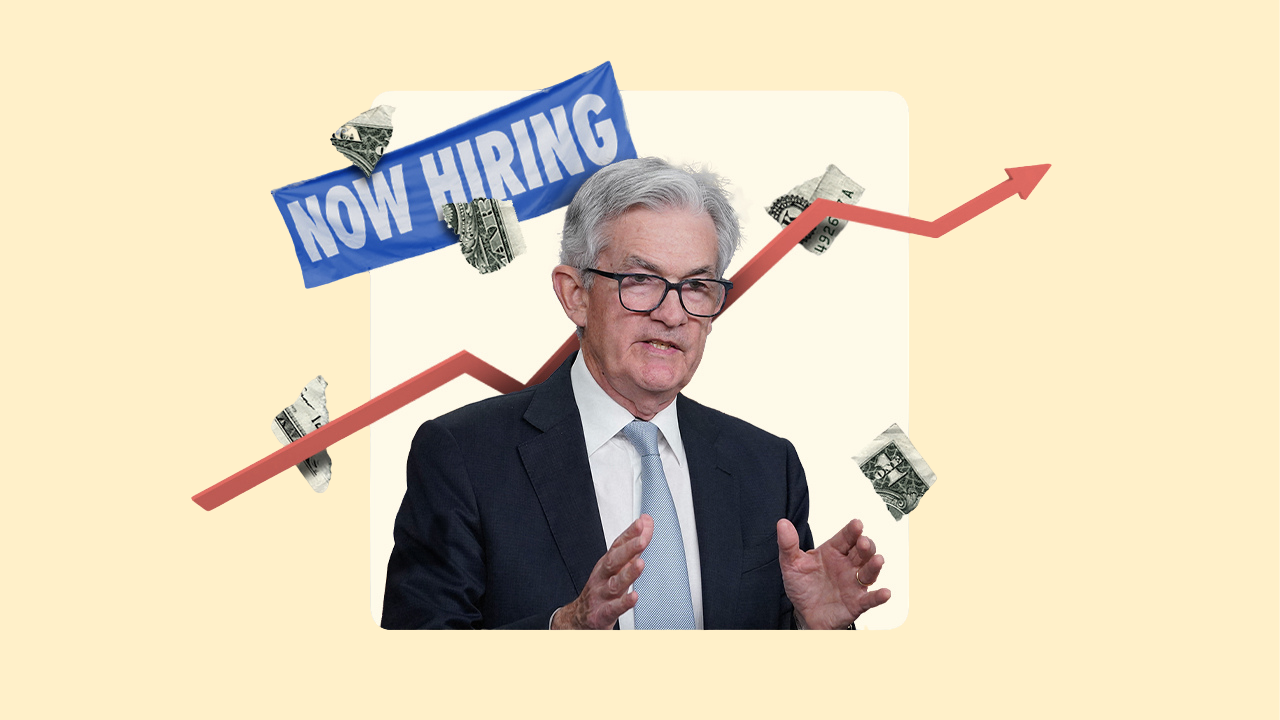

If strong economic headlines aren’t lining up with the way the economy feels to you, take it from the nation’s top economists: This is one of the strangest economic moments in recent memory (at least since an unforeseen global pandemic brought the gears of commerce to a sudden halt in 2020).
On paper, growth is going gangbusters. The U.S. economy expanded at a robust 4.3% annual pace in the third quarter of 2025, the fastest pace in two years. Forecasters expect another solid showing in the final months of the year, and Federal Reserve officials believe the economy will hang onto that momentum in 2026.
Typically, booming growth goes hand in hand with rapid hiring and big raises. Instead, wage gains are slowing, hiring has largely flatlined since the summer of 2025 and unemployment is the highest in more than four years.
Job growth has cooled into more of a ‘low-hire, low-fire’ market, which means fewer fresh opportunities and less bargaining power. In total, the numbers might look fine, while lived experiences are something else.
— Mark Hamrick, Bankrate senior economic analyst
For a decade, Bankrate has been conducting quarterly polling with the nation’s top economists on their expectations for the job market, inflation, the Federal Reserve and economic growth. Read on to learn what 20 of these economic leaders had to say about the year ahead.
1. Will the job market get better in 2026?
Probably not by much.
Most economists surveyed (79%) think unemployment will increase in the year ahead. The average forecast among economists calls for a 4.5% unemployment rate by December 2026, up slightly from its current level of 4.4%.
Economists also expect employers to add 64,500 jobs a month, on average, over the next 12 months. That’s up slightly from the previous 12-month pace of 49,000 jobs, according to the latest Department of Labor data. Yet, hiring is nowhere near as robust as it was when the economy was roaring back from the pandemic. Only two economists pencil in a solid year for job growth with 100,000 positions or more a month.
In plain English
Economists’ forecasts point to a cooling — not crashing — job market. Layoffs aren’t widespread, but hiring is slow. Job searches may take longer, more workers are competing for fewer positions and Americans don’t have as much bargaining power as they did a few years ago.
Hiring could improve in the second half of the year as higher tax refunds make their way through the economy and trade uncertainty eases, economists told us. By historic standards, though, job growth may keep looking tepid, as supply-depressing factors like an aging population and a slowdown in immigration constrain hiring.
The likely economic turndown in the first half of the year should reverse in the second half. Regardless, don’t expect job gains to resemble what we were used to for the past 30 years.
— Joel Naroff, president of Naroff Economics
Just one predicts that unemployment will edge back toward a half-century low of 3.8% in the year ahead. The rest (95%) think unemployment will stay at 4% or higher.
These expectations come as the Federal Reserve cuts interest rates to cushion the job market. Those cuts may be helping prevent deeper damage, according to economists’ forecasts, but they’re not reigniting hiring.
There is no denial that the labor market is slowing. There are short-term factors like tariffs and policy uncertainty, yet there are also long-term factors like immigration, demographic changes and AI that will alter the labor market for years to come.
— Tuan Nguyen, economist at RSM
2. Will the U.S. economy avoid a recession this year?
Despite their cautious outlook on the job market, economists say the U.S. economy has a solid chance of sidestepping a recession again in 2026 — at least for now.
The average odds of the U.S. economy entering a downturn this year stand at a little more than 1 in 4 (28%), according to the economists featured in Bankrate’s survey.
The U.S. economy has been defying economists’ expectations for years now. During the Fed’s aggressive rate hikes to tame decades-high inflation, economists’ perceived probability of a downturn soared as high as 65%, on average. A recession, however, never came to fruition.
The odds of a recession in Bankrate’s Q4 survey are the lowest in a year — economists in the prior-quarter survey gave the U.S. economy a near 2 in 5 chance (39%) of contracting.
In plain English
Not all recessions are created equal, but they’re usually characterized by layoffs, slumping consumer spending, weak economic growth and slow wage gains. Even if the job market isn’t broadly expected to improve, lower prospects of a recession at least mean economists don’t expect it to get much worse.
Last year’s tax cuts from the Trump administration, lower interest rates from the Fed and big investments in artificial intelligence (AI) are propping up the economy right now, according to experts.
Recession risks over the coming year have eased modestly as tariff rates have dropped and the Fed has resumed their rate cuts to stabilize the U.S. labor market.
— Tuan Nguyen, economist at RSM
But the risks haven’t vanished. A stock-market correction, renewed trade frictions and deepening consumer stress are all threats that could alter this outlook.
At an individual level, economists’ responses ranged from as low as 10% to as high as 60%. Most economists (95%) said the chance of a downturn was below 50%, up from 81% in Q3. Meanwhile, 35% put the odds at less than one in four, up from 13% last quarter.
Consumer spending has become more dependent on the stock market, making the broader economy more vulnerable to any correction. Any durable signs that firms are turning to outright layoffs, not just weak hiring, would be a signal of greater weakness ahead.
— Michael Pearce, chief economist at Oxford Economics
3. How long will inflation stay hot?
Economists say the fight against inflation could stretch on for at least another year, with experts growing less optimistic that inflation will return to the Fed’s 2% target anytime soon.
Just one economist believes inflation will return to 2% by the end of this year. That share has steadily shrunk over time, down from 13% in Bankrate’s Q3 2025 survey and 29% in Q2 2025. Instead, nearly half of economists (45%) now expect inflation to stay elevated through 2027. Another 25% don’t see inflation returning to target until 2028, while an additional 25% believe it could take even longer.
To be sure, prices aren’t rising nearly as fast as they once were — or even as much as many economists feared after President Donald Trump lifted tariffs to their highest levels in nearly a century. Inflation, however, has definitively been drifting in the wrong direction. Prices have risen 2.7% from a year ago, up from a 2.3% pace in April 2025 and still about a percentage point above the Fed’s target.
In plain English
Americans are likely to see affordability woes continue in the year ahead, especially in the face of a weaker job market that makes it tougher for workers to find better-paying jobs.
Looking ahead, economists say several forces are likely to keep inflation hotter than the Fed would prefer. Businesses could still pass along tariff-related price hikes, while Fed rate cuts and higher tax refunds in 2026 could keep demand strong.
Above-target inflation is the downside of a resilient economy. We expect the economy to maintain positive growth momentum into 2026 and thus it will take time for the Fed to achieve its inflation goal.
— Oren Klachkin, financial market economist at Nationwide
4. How much is AI propping up the economy?
Half of economists surveyed (50%) expect “above-trend” economic growth in 2026, according to Bankrate’s poll. Almost all of them had one thing in common: They cited AI as a factor juicing up the economy.
The AI and data center boom will lift business fixed investment and headline GDP growth over the coming years.
— Bernard Markstein, president and chief economist at Markstein Advisors
Businesses are spending big on data center construction and AI developments. Investments in software and information processing equipment accounted for half of all growth in the first half of 2025, versus just 10% in the first half of 2019, according to data from the Department of Commerce.
That growing reliance has raised concerns about whether the economy is becoming too dependent on AI. Analysts at Deutsche Bank have even gone as far as suggesting that the U.S. economy might already be close to a recession if not for tech spending.
The stock market has been in its own world with very high valuations by any metrics, in the hope that the AI-led investment will pay off big time for future economic growth.
— Lawrence Yun, chief economist at the National Association of Realtors
Comparisons to the early 2000s dot-com era have grown louder as a handful of tech-heavy stocks power the broader market. Over the past three years, the so-called “Magnificent 7” technology stocks — including companies like Apple, Microsoft, Meta and Nvidia — have accounted for more than 40% of the S&P 500’s gains, according to research from Carson Group.
To be sure, not all economists see an AI “bubble burst” as a probable outcome.
While there are useful comparisons being made between the ‘dotcom’ bubble and the current ‘near bubble’ of the AI ‘mania,’ we do not anticipate this outcome. Adoption is as important as the innovation itself.
— Hugh Johnson, chairman and chief economist at Hugh Johnson Economics
In plain English
Instead of investing in payrolls and head count, companies are pouring money into tech. That dynamic explains why the economy can look strong on paper while leaving many Americans — who measure economic prosperity by their opportunities and how much they can afford — behind.
As for the rest of economists’ forecasts, another 30% say growth will be consistent with recent trends, while 20% say growth will be below trend.
Data centers are great, but what do they produce? Chips are great, but how many do we really need? Can they build houses? That sector is doing well, while the rest of us watch AI stocks soar and wonder what the benefit will really be.
— Bill Dunkelberg, chief economist at NFIB
3 steps to protect your money in an uncertain economy
Usually, the economy avoiding a recession should mean more employment, faster wage gains and better job prospects. Instead, Americans barely seem to be reaping the benefits of a strong economy. About 1 in 3 adults (32%) believe their finances will get worse in 2026,
the highest level since 2018, according to a Bankrate survey from December 2025.
Trying to get ahead in a lopsided economy can feel like playing a real-life game of dodgeball, where you’re constantly ducking obstacles and unsure if you’ll be able to remain standing.
“[Everyday consumers] live in the economy of monthly payments,” says Hamrick. “Prices jumped in the post-pandemic period, and then higher interest rates piled on, making housing, cars, and credit a lot more expensive.”
Still, even small, practical steps can help you stay on your feet. Here are three moves to focus on next.
1. Reevaluate your cash flow, and try to free up money for your emergency fund
Making progress in an uneven economy starts with taking stock of your finances. Most experts recommend keeping at least six months’ worth of expenses in an emergency fund as a crucial buffer for covering unexpected bills or bridging a stretch of unemployment without turning to high-interest credit cards. But that goal can feel daunting, especially when wage gains are slowing and inflation is still running hot.
Remember: Building a safety net doesn’t have to happen all at once. If you’re just getting started, begin by identifying discretionary expenses you can cut back on temporarily. Setting aside an extra $50 to $100 a month can add up faster than you might expect.
Another way to free up cash is by tackling high-interest debt. If you have credit card debt, a balance-transfer card with a 0% annual percentage rate (APR) can help you chip away at your debts as long as you make a plan to pay off your balance before the introductory rate expires.
Any money earmarked for emergencies should be set aside in a liquid and accessible account, ideally in a high-yield savings account, where it can earn a competitive return while remaining available when you need it most.
2. Stay the course with your investmentsn preparedness
Market volatility can feel unsettling, especially when fears of an AI-driven correction or economic slowdown dominate headlines. But for investors saving for long-term goals like retirement, short-term volatility will mean little to your portfolio years, if not decades, down the line. If recent selloffs have shown anything, it’s that market downturns can fade quickly, leaving those who panic and sell locked out of the recovery.
Volatility is the price investors pay for inflation-beating returns over time. A diversified portfolio and a long-term mindset remain your best defenses against market downturns.
3. Think differently about how you market yourself in a job hunt
Slower job markets often mean more workers are competing for fewer positions. Finding a new position is still possible, but you might have to think about it differently today than you did a few years ago.
If you’re job hunting, focus on what sets you apart. Identify specific skills you bring to the table and have measurable results at the ready. Updating your resume, brushing up on in-demand skills or expanding your professional network can help your application stand out from others in the pile, too.
“With hiring slowing, job seekers may want to upskill or strengthen their resumes to stand out in a more competitive market.,” Hamrick says.
Why we ask for feedback
Your feedback helps us improve our content and services. It takes less than a minute to
complete.
Your responses are anonymous and will only be used for improving our website.
Help us improve our content
Read the full article here