






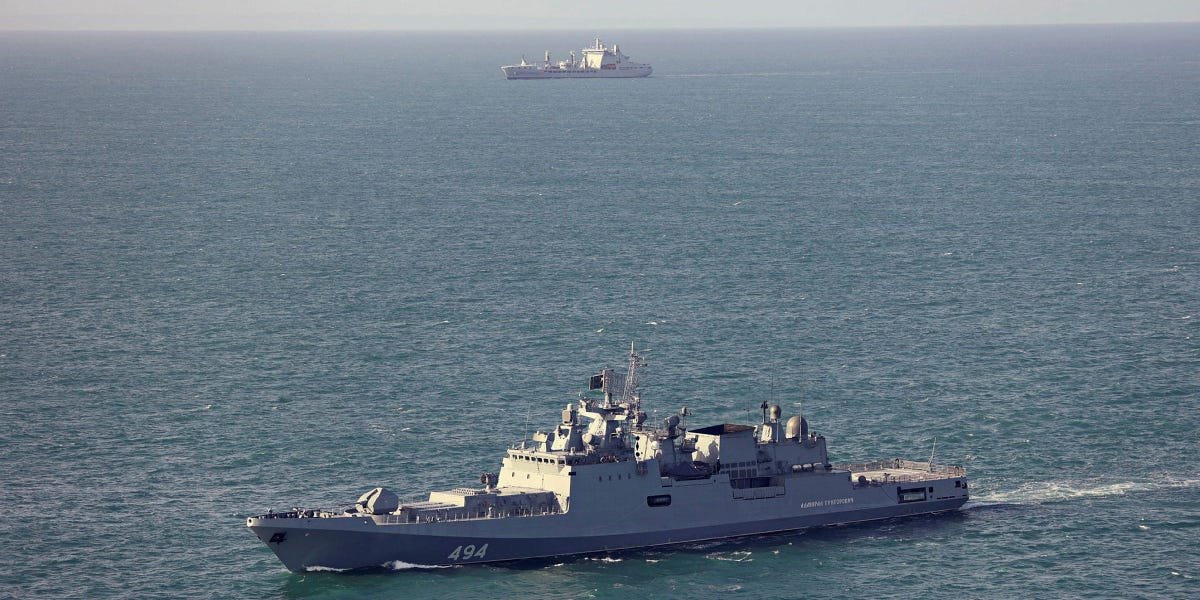

Russia’s warships are being tasked with escorting merchant tankers around Europe, further straining its surface fleet and worsening an already “serious” force-generation problem, a NATO military official told Business Insider.
The Russian Navy is facing a mix of different challenges, including sustainment, maintenance, and overall fleet readiness issues. Ukraine has targeted a number of its warships in the Black Sea, and Moscow no longer enjoys what was once a significant military presence at a strategic port in Syria.
Escort missions are exacerbating Russia’s struggles, the NATO official said, speaking on the condition of anonymity to discuss sensitive military developments.
The official said that allied navies have, over the past year, boarded roughly a dozen ships linked to the so-called Russian “shadow fleet,” a collection of hundreds of vessels used to move oil and circumvent sanctions on Moscow’s energy exports.
Russia has sent warships to escort shadow fleet tankers through the English Channel, in the Baltic Sea, and around Africa, stretching its surface fleet thin, the official said, adding that some ships have been deployed beyond their typical areas of operation.
The tanker escorts have strained Russia’s sustainment capacity, forcing warships to replenish or receive support at sea from repair vessels rather than dedicated oilers, the official said. They described these maneuvers, in which ships not purpose-built for this task may be only a few feet apart, as very dangerous.
The official said that, for the first time in years, there are no Russian warships in the Mediterranean, an indication of Moscow’s struggles. There is a lone Russian-flagged commercial dredge in Egypt’s Port of Alexandria.
US Lt. Cdr. Tim Pietrack, a spokesperson for NATO’s Allied Maritime Command, told Business Insider that the command “continues to see a trend of Russian Navy ships escorting merchant vessels” around Europe, including through the Mediterranean, Baltic, and North seas.
Pietrack said the “escort activities take up valuable days at sea for the Russian Navy” and place a “strain on their ability to generate naval forces for other missions.”
“I would also note,” he added, “that there’s no area around the Euro-Atlantic region where the Russian Navy operates that allies are not closely monitoring their activities.”
Neither Russia’s defense ministry nor its US embassy responded to a request for comment on the force-generation issues.
Russia’s navy has historically been under strain due to its limitations in shipbuilding, modernization, redeployment, and maintenance, as well as operational overstretch.
But setbacks in recent years have put further pressure on the surface fleet.
Since 2022, Ukraine has used naval drones and anti-ship missiles to damage or destroy dozens of Russian n warships and naval vessels in the Black Sea, an innovative campaign that has forced Moscow to relocate much of its fleet across the region.
And in late 2024, after Syrian rebels toppled the Assad government, Russia lost its ability to maintain a strong naval presence at the Tartus port on the country’s Mediterranean coast.
Western officials told Business Insider last year that these incidents have stretched the Russian Navy. The latest NATO assessment suggests the situation has worsened in the months since.
Russia has long prioritized its submarines over its surface warships, though. It boasts one of the world’s largest submarine fleets, with an estimated 64 active boats.
Western military officials have increasingly called attention to the Russian submarine presence in the Arctic and North Atlantic, and NATO has been expanding its footprint in the High North to better track these boats.
Read the full article here