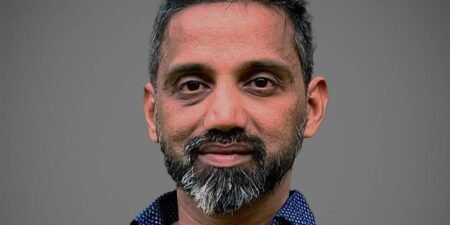






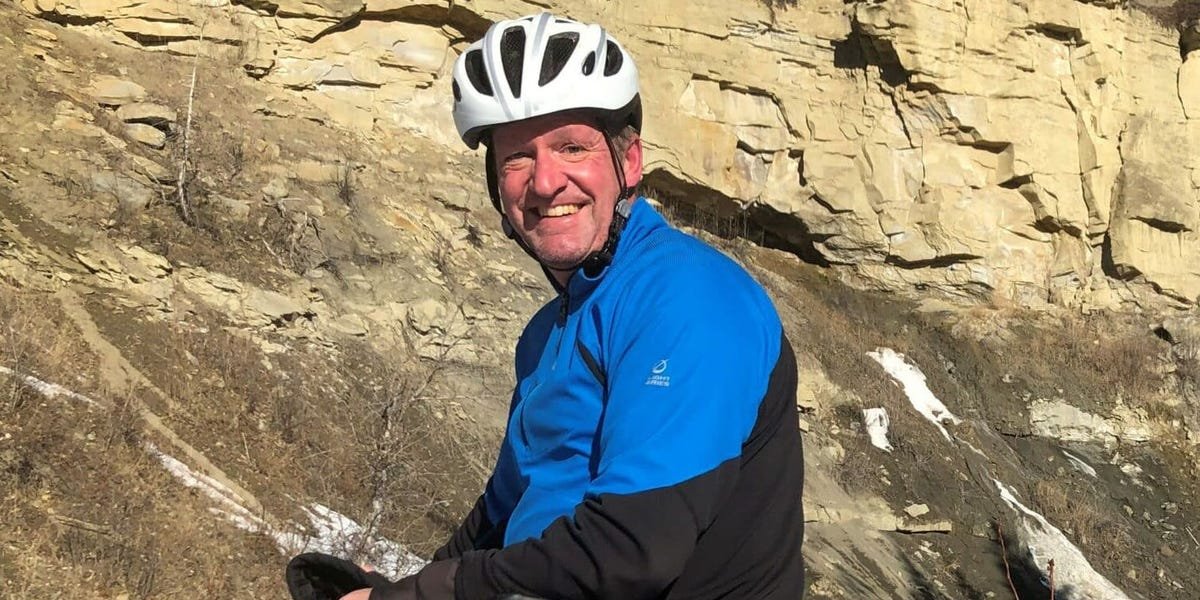

At 49, Dave Nitsche was the picture of great health.
A project manager for a Toyota subsidiary, he spent his free time competing in ultra-running and triathlon events, such as Ironmans, and hiking in Calgary, Alberta.
“It was just a very active lifestyle — nothing unusual,” Nitsche, 57, told Business Insider. Then, a few days before his 50th birthday, “everything changed — the engine light turned on.”
Nitsche’s vision suddenly became blurry in late 2019. Straight, vertical objects like telephone poles appeared wavy. He contacted his optometrist and was scheduled for an appointment a few days later. By the time he showed up, he had fully lost vision in the eye.
Three weeks later, he would learn that he had stage 4 lung cancer, which had metastasized to his eye, bones, liver, kidneys, and brain.
The optometrist, thinking Nitsche had a detached retina, had sent him to the hospital for ultrasounds. Nitsche had so much fluid buildup and pressure behind his eye that he would never regain his vision. His eye was removed and replaced with a prosthetic, and the fluid was biopsied.
Nitsche was sent to the hospital nearly every day to get bone scans and, eventually, to a lung specialist. That was when he was diagnosed.
“It was definitely a shock,” Nitsche said, as he had never smoked a day in his life and had no family history of lung cancer.
Even more shocking was his doctor’s prognosis: a 1- to 2-year life expectancy, despite Nitsche otherwise feeling normal.
To this day, “it’s always in the back of my mind,” Nitsche said. “‘What do you do with the rest of your life in 1 or 2 years?'”
‘No chance’ with traditional treatments
Upon hearing the news, Nitsche’s ex-wife, who came to the appointment with him, suggested he move back in with her. He started to get his finances and will in order.
Because his cancer had spread so far into his lungs, Nitsche was told he had “no chance” with traditional treatments such as chemotherapy or radiation at that point.
He could, however, try targeted therapies, which block specific molecules, genes, or cellular pathways that drive cancer growth, based on the specific EGFR mutation in his form of lung cancer.
First, he went on Gilotrif (afatinib), an oral medication that inhibits cell growth signaling in tumors. He went on another medication, Tagrisso (osimertinib), which targeted tumors in his brain. It works by binding to mutated proteins to stop them from signaling cancer cell division.
Nitsche remained on Tagrisso far longer than his expected survival date — six years. He’s since had radiation to treat a small cancer area in his brain, and is now on Rybrevant (amivantamab), a targeted antibody therapy that blocks cancer growth signals and helps the immune system attack cancer cells. Because he lives in Canada, all of his treatments have been covered by national health insurance.
“The timing of all these drugs was great,” he said. “As it turns out, I’m seven years in, so it’s been a ride, that’s for sure.”
The most common form of lung cancer is often diagnosed late
In 2024, Susan Wojcicki, the former CEO of YouTube, died at the age of 56.
Like Nitsche, she had non-small cell lung cancer (NSCLC). She, too, had never smoked tobacco in her life and was super active — running, eating well, and getting good sleep. Wojcicki had no obvious symptoms and was ultimately diagnosed at 54 when she started experiencing hip pain.
NSCLC is the most common category of lung cancers, accounting for 85% of all cases.
Unlike in small cell lung cancer (SCLC), the cancer cells in NSCLC generally appear larger. Because common symptoms, like coughing, chest pain, or fatigue, can be mild, this form of lung cancer can be missed until it progresses to stage 3 or 4, when it’s harder to treat.
While smoking still remains the biggest risk factor, other risks include exposure to radon, asbestos, metal and mineral dust, air pollution, and radiation therapy, as well as some infections and diseases, like HIV/AIDS and chronic obstructive pulmonary disease.
There are currently no annual lung cancer screening recommendations for non-smokers, as low-dose CT scans involve a small amount of radiation. In the US, the CDC recommends annual screenings for asymptomatic adults ages 50—80 who have a 20-pack-year history and either currently smoke or quit within the past 15 years.
He’s stayed very active throughout treatment
Nitsche said the medications he’s been on have been working very well. A recent CT scan showed that the tumors have shrunk significantly, with some nodules resolving and being replaced by scar tissue.
So far, the side effects have been manageable compared to those associated with chemotherapy, Nitsche said. Mostly, he’s experienced skin issues such as acne and fingernail infections.
It’s made it easier for him to keep up his active lifestyle. Nitsche, who is now retired, bikes 20 minutes each way to his appointments. “A lot of people meditate,” he said. “A lot of people meditate. I go out on my bike and ride.”
Nitsche believes physical activity helped in his recovery process. From the very beginning, his oncologist told him that he had higher than average VO2 max levels, or the amount of oxygen the body can use during aerobic exercise. While a high VO2 max can’t prevent or reverse lung cancer, some research shows it can signify stronger heart, lung, and muscle function, potentially making it easier to endure cancer treatments.
“It’s definitely helped me in this journey, for sure,” he said.
To Nitsche, who lives with his ex-wife and their dog, his cancer experience shows the importance of perseverance and taking things day by day. He’s currently training for his second BC Epic 1000, a bike race that spans nearly 700 miles across British Columbia.
“I joke that I live three months at a time, between scans and MRIs and CTs, but three months is better than no months,” he said.
In the long run, those months have added up. “It’s kind of surreal: You get past that first year and go, ‘Oh, well, prove them wrong,'” he said. “Then you get past the two years and go, ‘Oh, I’ll prove them wrong again.'”
Read the full article here