






More than a year after being laid off as a software engineer, Jesse Jashinsky still couldn’t find work. He was supporting his family on a patchwork of unemployment and SNAP benefits, help from their church, and increasing amounts of credit card debt.
Then their car broke down. Replacing the transmission was an emergency expense they couldn’t afford.
So Jashinsky made a crowdfunding campaign on GoFundMe and put it on Facebook. A few days later, he shared it on another social network, writing: “I don’t know if this is the right thing to do on LinkedIn, but I’m kind of desperate.”
Jashinsky said the post helped his fundraiser collect more than $3,800.
“I had no idea if it would get us anything, but I had nothing to lose,” said Jashinsky, who is 40 and lives in Utah.
Amid the slowing job market and high inflation of recent years, LinkedIn — once a buttoned-up professional networking site reserved for polished resumes and career updates — has become a place where workers post candidly about layoffs, job searches, and now, direct requests for mutual aid.
Business Insider reviewed 50 LinkedIn posts from the past year containing GoFundMe links and found repeated themes of prolonged unemployment, mounting bills, and financial emergencies. Many users framed the decision to crowdfund on LinkedIn as awkward, uncomfortable, or driven by necessity. About half of the posts were from people raising money after layoffs or extended job searches, while others sought help with medical bills or hardships affecting family and friends.
The posts come as the job market has grown more challenging. In February, the hiring rate fell to a level last seen during the early pandemic and the aftermath of the Great Recession. As of March, more than a quarter of unemployed Americans had been looking for work for 27 weeks or more, up from about 18% three years earlier.
While seeking financial support through LinkedIn can be effective, it also carries risks of stigma, scams, and unwanted scrutiny online.
The new openness on LinkedIn
The first signal of a vibe shift on LinkedIn may have been the “open to work” banners, which the platform introduced in 2020 amid soaring pandemic unemployment. The banners helped users signal availability to recruiters and their network, though some worried they were symbols of desperation that would turn off potential employers.
Norms around “self-presentation” online have changed rapidly, said Brooke Erin Duffy, an associate professor of communication at Cornell University who studies social media platforms. Growing uncertainty about the labor market and highly public conversations about work culture, including the “quiet quitting” trend, have encouraged more open discussions about career struggles, she said.
“People aren’t just sharing more of their personal lives — they are more likely to express vulnerability in professional contexts, from layoffs to demoralizing experiences at work,” she said.
Andrew Selepak, a social media professor at the University of Florida, said seeing others get traction on LinkedIn may help people to launch their own asks. He added that people may also be taking lessons from social media influencers, many of whom have drawn attention and support by sharing personal experiences online.
“I think many people understand on a very basic level that people will connect to me more the more transparent I am — the more I reveal about myself,” he said.
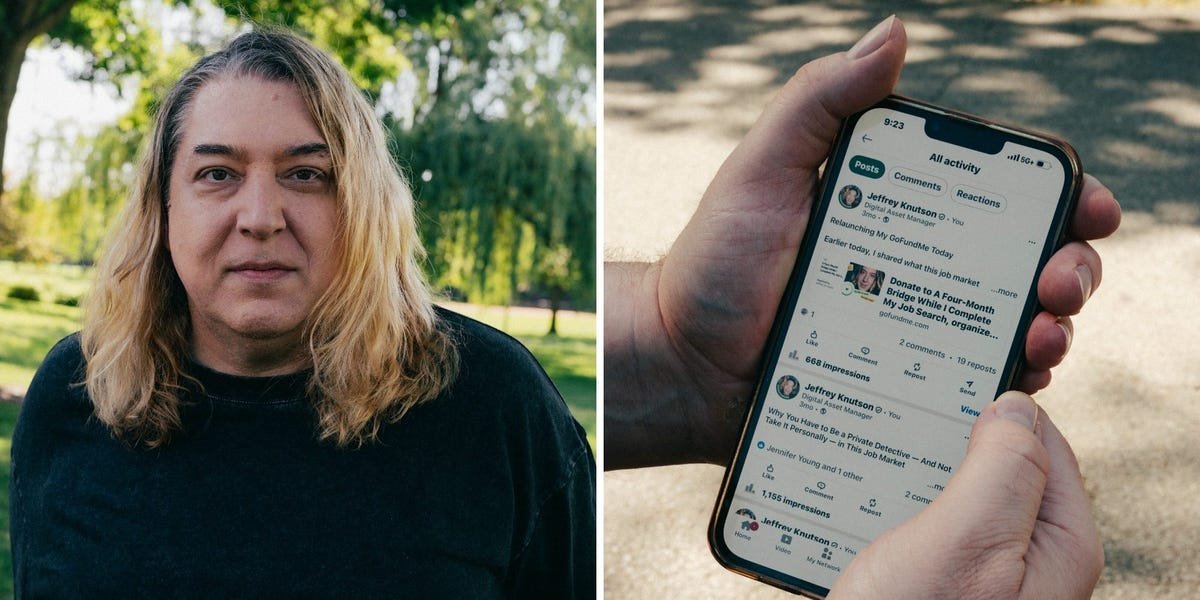
As his unemployment benefits began to run out and he feared losing his apartment, Jeffrey Knutson shared his own GoFundMe on LinkedIn recently, several months after losing his job as a digital asset manager. He’s raised over $6,500, which he said came primarily from longtime friends, acquaintances, and even some complete strangers.
“I wanted to be honest about the reality of the current job market and show that asking for help during a difficult period can be both practical and necessary,” said Knutson, who’s 54 and lives in Chicago.
This transparency can come with downsides, however. Knutson said publicly sharing his GoFundMe led to suspicious messages from people posing as recruiters or offering to help promote his fundraiser. Some interactions initially appeared legitimate before turning into requests for money or paid services.
“I would definitely advise people to be cautious,” he said.
On the whole, Knutson and other job seekers said they did not regret promoting their fundraisers online. For those making donations, GoFundMe’s website says an “overwhelming majority” of the site’s fundraisers are legitimate.
Read more about people who’ve found themselves at a corporate crossroads
Why certain people turn to LinkedIn for help
There’s another reason that LinkedIn specifically may be seeing an influx of GoFundMe campaigns: the networking site is largely a platform for white-collar workers who have been disproportionately affected by the hiring slowdown of recent years, Selepak said.
He added that the gradual onboarding of Gen Zers to LinkedIn — who are more accustomed to sharing personal experiences online — could also be contributing to more candid posts on the platform. At the same time, older workers may simply have larger networks there to turn to for support: LinkedIn launched in 2003, making it older than Facebook, YouTube, Twitter/X, Instagram, Snapchat, and TikTok.
After struggling to find work following a layoff from Morgan Stanley last year, Valerie Lockhart launched a GoFundMe to try to raise money for plumbing repairs that had left her family without hot water. She was hesitant to share the fundraiser on LinkedIn, but did so in part because she had a larger network there than on other platforms.
After losing his healthcare instructor role last year, Issac Jeremy Caballero started a GoFundMe, a step he said required him to put aside his pride. He eventually decided to share the fundraiser on LinkedIn after reflecting on the strength of the network he’d built there. Caballero has raised more than $2,500, which he said helped him stay afloat while he looked for another job.
“I wanted to be transparent about my situation and trusted that the same community I’ve supported would understand and potentially support me in return,” he said.
Read the full article here