







Wouldn’t it be awesome if you didn’t have to pay taxes? It would be so cool to be able to go out, work hard, and bring that money home without Uncle Sam or one of his 50 little nephews taking a cut. It’s a nice dream, but here in the real world you gotta pay your taxes. And we know—taxes suck. No getting around it.
But there are tax exemptions—aka, income you don’t have to pay taxes on. So, let’s try to figure out what they are and if you can take advantage of them.
What Is a Tax Exemption?
Simply put, a tax exemption is income you make that you don’t have to pay taxes on. Some tax exemptions only apply to the IRS, while others may apply to your state and local taxes.
Before the Tax Cuts and Jobs Act (also known as the tax reform bill of 2017), there was a personal exemption. Under the new law, personal exemptions were eliminated in favor of a larger standard deduction. In 2025, that deduction is $15,750 for single filers and $31,500 for married couples filing jointly.1
This change really simplifies that section of your tax return. In the old days of 2017, the personal exemption was $4,050 for each dependent (like a child or a relative) and per tax filer.2 So, a married couple filing jointly with no kids making $100,000 got $8,100 in personal exemptions and received a $12,700 standard deduction, leaving them with a taxable income of $79,200 ($100,000 – $20,800 = $79,200).3
For 2025, that same couple making $100,000 would receive no personal exemptions. But with the $31,500 standard deduction for a married couple filing jointly, their taxable income is now $68,500 ($100,000 – $31,500 = $68,500). As you can see, in this case, the increased standard deduction more than made up for the loss of the personal exemption.
In addition to tax exemptions, some organizations—such as charities, schools and churches—are considered “tax exempt” overall and don’t have to pay any income taxes to the government.
Different Types of Tax Exemptions
While that personal exemption is off the table, there are still types of income and earnings that are tax exempt (Hallelujah!), including:
Most Health Benefits
If you and your employer contribute to a qualified health plan, that money is exempt from income taxes. Also, any money you put in a Health Savings Account (HSA) or a Flexible Spending Account (FSA) is not taxed, and neither are the funds when you use them for qualified medical expenses.4 In addition, any interest earned in an HSA is exempt from capital gains taxes.
Interest Earned on Municipal Bonds
States and cities often issue bonds to raise funds for public projects like building schools, roads and sewer systems. While we don’t recommend investing in municipal bonds, the interest earned on them is tax exempt.5
Gifts
There are a number of gifts that are tax exempt. These include:
- Gifts that are not more than $19,000
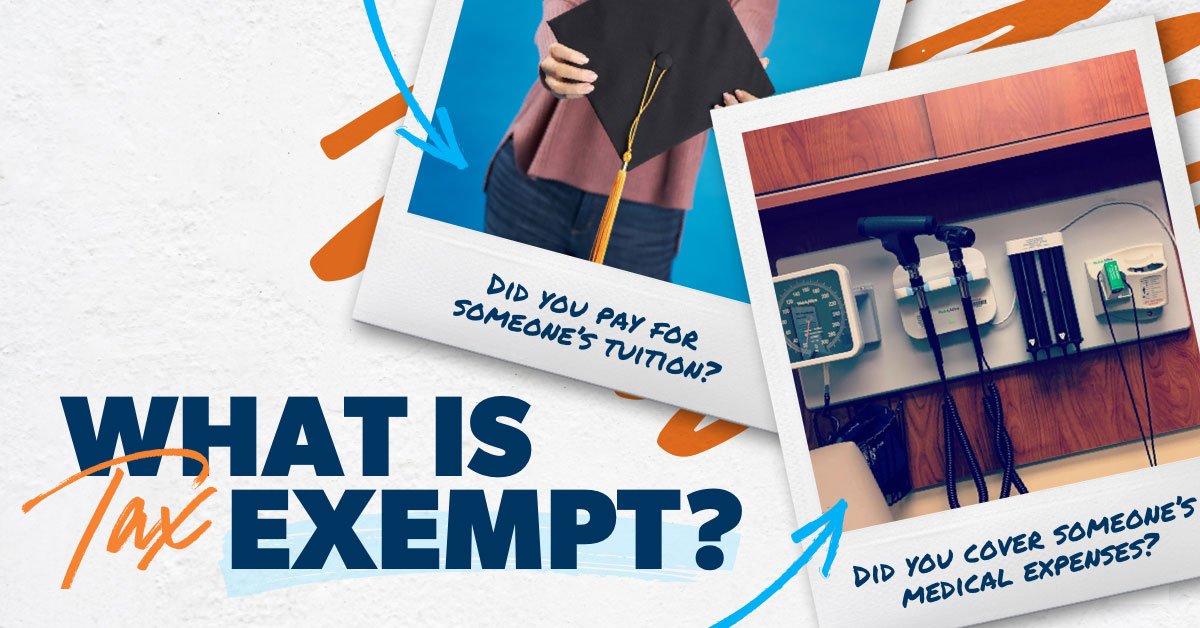
- Tuition or medical expenses you pay for someone
- Gifts to a political organization
Estate Taxes
When you die and leave money to your heirs, any amount below $13.99 million is tax exempt. Your heirs don’t even have to file a return on it.7
Alternative Minimum Tax Exemption
Wealthy taxpayers who have to calculate their alternative minimum taxable income (AMTI) still get a personal exemption. For the 2025 tax year, the AMT exemption is $88,100 for single filers and $137,000 if you’re married filing jointly. The exemption starts to phase out once your income hits $626,350 ($1,252,700 for joint filers).8
Long-Term Capital Gains Exemption
Long-term capital gains earnings—this is income from the sale of things like stocks you’ve owned for longer than a year—are tax exempt if your taxable income is no more than $48,350 per year ($96,700 for married couples filing jointly). You’re taxed at 15% if you make more than that, and the tax maxes out at 20% if your taxable income is higher than $533,400 ($600,050 for married couples filing jointly).9
Owner-Occupied Home Sale Exemption
Technically, when you sell your house for more than you paid for it, this is also a capital gain. But there’s an exemption for owner-occupied home sales.
To qualify, the IRS looks at two things: ownership and use. You must have owned the home for at least two of the last five years and lived in it as your primary residence for at least two of those five years. If you’re married filing jointly, either spouse can meet the ownership requirement, but both spouses must meet the living-in-the-home requirement.
If you qualify, you can exclude up to $250,000 of the profit from your taxes—or up to $500,000 if you file a joint return. Keep in mind, though, that you can only claim this exemption once every two years.10
A Better Way to File Taxes
If you’re confident you can handle your own taxes and exemptions and just want easy-to-use tax software, check out Ramsey SmartTax. Self-filing with Ramsey SmartTax makes it easy to file your return and take control of your taxes in a matter of minutes. You won’t be surprised by hidden fees, and you won’t have to make sense of confusing tax jargon—what you see is what you get!
File your taxes with Ramsey SmartTax!
But if all this tax talk is making your head spin, you don’t have to go it alone—RamseyTrusted® tax pros are here to help. All of them are certified public accountants or enrolled agents, so you can trust they know what they’re talking about.
They can guide you through your deductions and potential exemptions and get your tax return just right. And then they can help you plan for the future—so you’re maximizing what you take home without getting stuck with a big bill come April.
Read the full article here