







Copy link
X
Bluesky
Threads
Impact Link
Save
Saved
Read in app
subscribers. Become an Insider
and start reading now.
Have an account? .
- Lavish mansions from various eras often fall into disrepair.
- These eight sprawling mansions hint at the wealth they once embodied
- Years later, they sit abandoned in varying states of deterioration.
When they were built, these lavish homes bore ornate examples of their owners’ wealth, from towering turrets to marble archways.
Now, they’re falling apart.
Each of these properties — once worth millions — has faced misfortune, such as the financial ruin of their owners or failed preservation efforts.
While some have been restored to resemble their former glory or have opened to visitors, others have been deemed too dangerous to visit and too costly to repair.
Here are eight abandoned mansions around the world — and what happened to them.
Katie Warren, Libertina Brandt, and Taylor Ardrey contributed to earlier versions of this story.
The Swannanoa mansion in Lyndhurst, Virginia
Built in 1912 by railroad magnate James H. Dooley, the Swannanoa mansion in Lyndhurst, Virginia, is an Italian Renaissance-style villa overlooking the Blue Ridge Mountains.
Swannanoa has been vacant since 1988.
Dooley built the mansion as a summer house for his wife. The villa was converted into a country club for a few years after the couple’s deaths, but it was abandoned by 1932 as the Great Depression reached its peak, per the mansion’s website.
The mansion was purchased by a couple and converted into a museum while they resided there. Since their deaths in 1988, the mansion has sat vacant.
Today, the mansion is a tourist attraction.
Today, the mansion is a local attraction and wedding venue, offering public tours once a month from May to November.
Local residents have raised concerns over the conditions of the estate, local News Leader newspaper reported in 2015. In 2024, Andy Florance, CEO of CoStar, purchased the nearby Swannanoa Golf and Country Club, with plans for preservation.
Cambusnethan House in North Lanarkshire, Scotland
The Cambusnethan House in North Lanarkshire, Scotland, is one of the last remaining Gothic mansions in Scotland.
The mansion belonged to an ancient aristocratic family.
Built in 1819, the mansion belonged to the Lockhart family of Castlehill and was built to replace an early 17th-century house that burned down in 1810, per Scotland’s Buildings at Risk Register.
In the 1970s, the house was used for mock medieval banquets, but it was further damaged by fire in the 1980s.
Efforts to prevent further deterioration have emerged in recent years.
A group called “Friends of Cambusnethan Priory” was established in 2014 to try to save the building, which is categorized at a “critical” risk level by Scotland’s Buildings at Risk Register, from any further deterioration.
Lynnewood Hall in Philadelphia
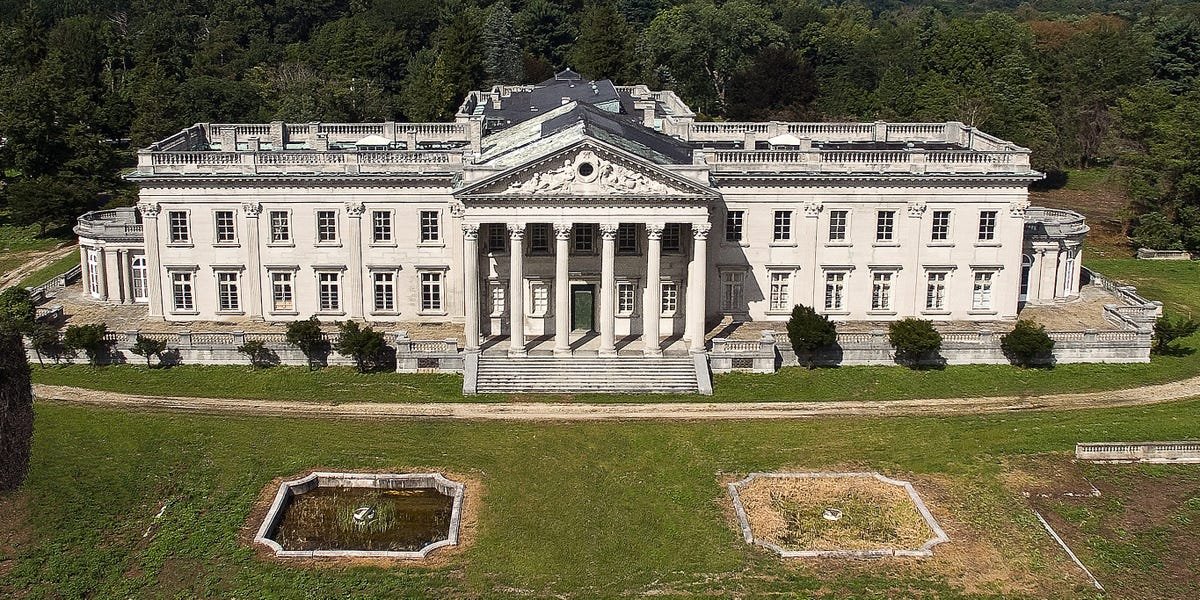
Lynnewood Hall, a 110-room, century-old Gilded Age mansion located just outside Philadelphia, was designed by Horace Trumbauer in the late 1890s.
Some of the mansion’s intended residents died aboard the Titanic.
When he built the mansion, industrialist Peter A. B. Widener intended to reside there alongside his two sons and their families.
However, his son George Dunton Widener, alongside his wife, Eleanor Elkins, and their son, Harry, were passengers on the Titanic when it sank. Only Eleanor survived.
The mansion was inherited by Peter’s surviving son, Joseph, who died in 1943. Various owners acquired the property after that, including the First Korean Church of New York, which listed the property for sale in 2014.
The mansion remained vacant for years after.
The mansion cost around $325 million in today’s money to build in 1897.
The mansion, which cost about $325 million in today’s currency when it was built in 1897, was documented as being in a dilapidated state, and repairs were estimated to cost up to $40 million in 2012.
In June 2023, the mansion was purchased for $9 million (or about $9.6 million in 2025 currency, adjusted for inflation) by the Lynnewood Hall Preservation Foundation, which aims to restore it to its former glory.
Pidhirtsi Castle in Lviv, Ukraine
Pidhirtsi Castle in the Lviv region of Ukraine was built as a leisure home for a high-ranking Polish military commander between 1635 and 1640 by Italian architect Andrea dell’Aqua, per the World Monuments Fund.
The mansion was in critical disrepair by the mid-century.
The mansion prospered for years, but in the 19th century, new owners took over and neglected the castle, so that by the end of World War II, it had significantly deteriorated.
Despite damage, the mansion has seen restoration efforts.
Pidhirtsi Castle has been damaged by fire and flooding over the years.
Preservation efforts have enabled the restoration of part of the mansion, which has also hosted events such as exhibitions and concerts in recent years.
The McNeal mansion in Burlington, New Jersey
The McNeal mansion, situated along the Delaware River in New Jersey, was constructed by industrialist Andrew McNeal in 1890, following his establishment of a pipe plant and foundry.
Built by a Gilded Age industrialist, the mansion barely stands today.
US Pipe bought the property in 1899 and used it as its headquarters until 1953. In the subsequent decades, it was abandoned.
Today, the mansion is collapsing in on itself, posing a danger to the urban explorers who visit.
Villa de Vecchi in Lake Como, Italy
The Villa de Vecchi, known as the “Ghost Mansion” of Italy, was built between 1854 and 1857. It was meant to be the summer home of a Count named Felix De Vecchi, who was head of the Italian National Guard. The home had all the modern amenities of the time, including indoor heating pipes and a large pressurized fountain.
The mansion has been spared from disaster despite being abandoned for decades.
A 2002 landslide destroyed nearby homes, but the once-lavish and now-battered “Ghost Mansion” remained standing.
Ha Ha Tonka in Kansas City, Missouri
Sitting just outside Camdenton, Missouri, the ruins of Ha Ha Tonka resemble an ancient European castle. The mansion was built by Kansas City businessman Robert Snyder at the turn of the century.
Today, the ruins are part of a state park and a popular hiking attraction.
Snyder started building in 1905, but he never saw the house finished as he died in a car crash the following year. His sons took over the construction and lived there until the family ran out of money due to the several lawsuits surrounding the castle’s property.
In 1942, parts of the castle burned down and sat abandoned until the state of Missouri bought the property for use as a state park in 1978.
Bannerman Castle in Pollepel Island, New York
Built by Scottish entrepreneur Francis Bannerman VI in 1901, the Bannerman Castle sits on Pollepel Island in New York’s Hudson River.
The castle was used as storage for Bannerman’s arsenal of military weapons.
Rather than living in the castle, Bannerman used it as storage for his business’s military weapons arsenal.
After the powder house exploded in 1920, the upkeep of the castle dwindled. It was eventually acquired by the Hudson Highlands State Park Reserve.
Today, the castle ruins are open to the public on a seasonal basis.
In 1992, the Bannerman Castle Trust was established to repair the ruins. Since then, it has raised over $1 million to refurbish the castle, which is now open to the public for tours.
During her 2019 visit, Business Insider’s Joey Hadden said visitors were told to stay at least 100 feet away from the castle due to its deterioration. Still, it was worth the visit.
“The combination of medieval architecture and overgrown trees and foliage makes Bannerman Castle a sight worth visiting up close,” she wrote.
Read the full article here