






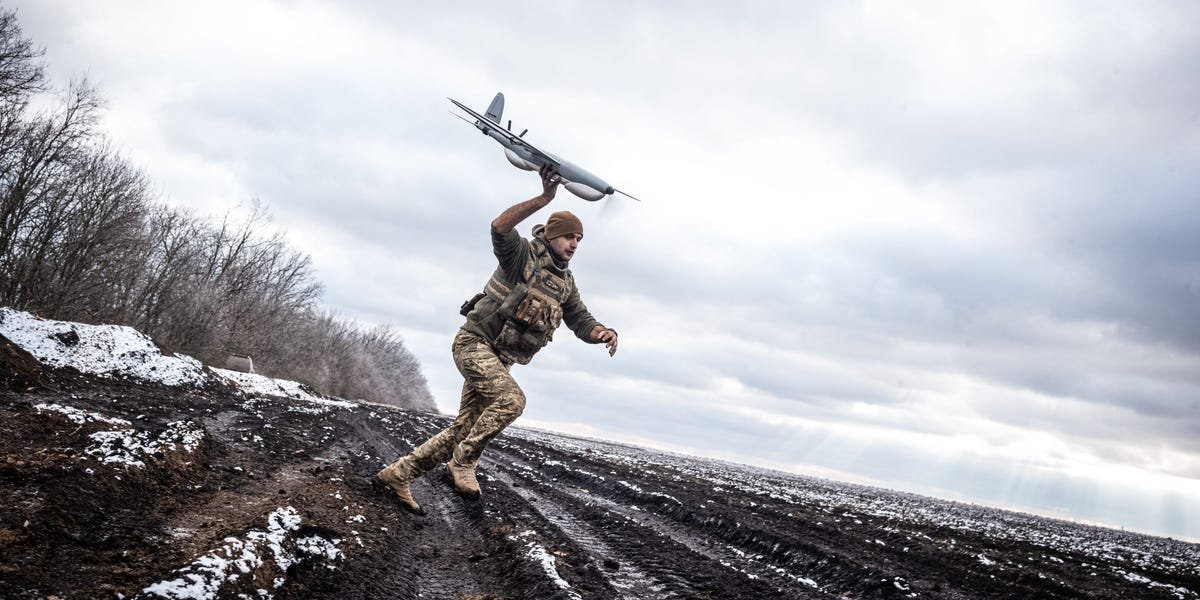

An elite British Army battalion is going all in on drones after working closely with Ukrainian soldiers and seeing how central these systems have become in modern warfare.
The 1st Battalion of the Irish Guards now has 78 of its 300 members qualified as drone operators, its commanding officer, Lt. Col. Ben Irwin-Clark, told Business Insider. The unit has big plans to increase its training and work with drones further.
“That just gives you an idea of how important this is,” he said.
The battalion has built a training facility with drone warfare in mind, and its soldiers are heavily invested, he said, sharing that he’s got soldiers asking if they can get in on the weekends and log some flying hours.
“That to me is absolutely incredible. Soldiers asking to do extra training over the weekend tells me that we must be doing something right, and it’s capturing the imagination of that generation,” Irwin-Clark said.
Ukraine has shown that drones are part of the “future of warfare,” he said, and that means knowing how to use them in combat is something that soldiers “need to be experts at.”
Western militaries, including the UK and US, are studying the drone war in Ukraine closely. The conflict has become the most drone-saturated in history, forcing armies to rethink how they fight.
Some units are doing more than watching from afar though. The 1st Battalion of the Irish Guards was able to learn directly from Ukrainian soldiers during a UK-led training initiative called Operation Interflex.
While the operation is designed to train Ukrainian soldiers, the exchange has not been one-way. Ukrainian troops — many with recent front-line experience — have shared hard-won lessons. Ukraine has far more experience employing drones at scale than Western militaries.
Irwin-Clark said his battalion is “learning the lessons on behalf of the rest of the army by picking them straight up from Ukrainians who, in some cases, were coming straight to us from the front line, passing on the benefit of their knowledge.”
He said he did not expect the learning to run so deeply in the other direction when the work first started. “I think what I hadn’t anticipated over a year ago when we started our stint on Interflex is how much we would learn.”
A battalion embracing drones
The battalion has built an obstacle course so soldiers can train to fly drones accurately. Irwin-Clark said he expects at least one module of each week’s training cycle to be drone-related.
Other battalion efforts include the recently built “drone hub,” a center where soldiers can fix drones, do virtual training, and use 3D printing to make drone parts. Irwin-Clark described it as “a new thing,” sharing that “no other unit in the British Army has one of these yet.”
The battalion printed its first drone body just last month. The aim is to eventually set up the hub in the back of a vehicle so that its technology, like 3D printing, can be accessible on the move and soldiers can make and repair drones in the field. Irwin-Clark said the effort is “in its infancy.”
The 3D printing and use of simulators for drone training came directly from Ukrainian recommendations, Irwin-Clark said. These are practices Ukraine’s military has deemed essential.
The battalion has copied other pieces of Ukrainian doctrine that Ukrainian soldiers told it about, like using anti-drone nets and viewing 60 hours as the minimum flying time typically needed to be competent.
Irwin-Clark said the biggest shock for him was how fast his soldiers were able to demonstrate drone skills. “What surprised me the most was how quickly people picked it up.”
Read the full article here