







Updated
Copy link
X
Bluesky
Threads
Impact Link
Save
Saved
Read in app
subscribers. Become an Insider
and start reading now.
Have an account? .
- Thanks to the postwar Baby Boom and other factors, families in the ’50s began moving to the suburbs.
- Levittown in Long Island, New York, is widely recognized as the first modern American suburb.
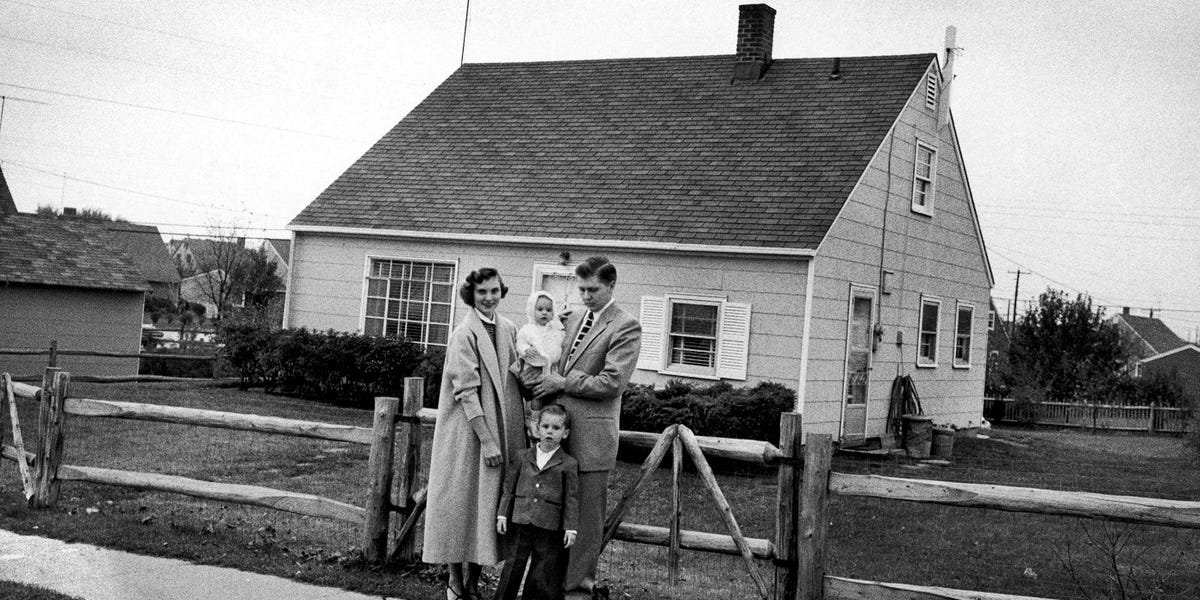
- Each home looked the same — they were all built in the Cape Cod-style and cost around $7,000.
As World War II came to an end, families looked for ways to start over. Emboldened by the GI Bill’s provisions for home loans, they moved out of the cities in droves for newly developed suburban communities.
In fact, the suburbs expanded by 47% during the 1950s, according to the Gilder Lehrman Institute of American History.
Levittown in Long Island, New York, was one of the first to introduce the idea of a pre-planned, mass-produced uniform suburban community, The New York Times reported. Families started moving there on October 1, 1947.
Though the community welcomed an influx of families, non-white prospects weren’t allowed. Notably, African Americans didn’t see the same benefits from the GI Bill, and it would take some years before racial and ethnic minorities broadly shifted to the suburbs.
Here’s what it was like to live in America’s first modern suburb in the 1950s.
Before the 1950s, people mostly lived in cities to be close to factory jobs.
At the time, most people lived close to the city center to work in factories, or they lived in rural communities to work on farms, according to economist Jay Zagorsky.
Everything changed in the 1950s when soldiers returned from World War II, sparking the great migration to the suburbs.
The 1950 Census found that 60% of people lived in cities, while 40% lived in the suburbs.
Thanks to factors like the construction of highways, the development of new neighborhoods from farmland, and even safety in the event of an atomic attack, these percentages would soon shift drastically.
The GI Bill made it easier to afford a new home, prompting this transition from urban to suburban.
The GI Bill provided each returning soldier with benefits designed to stimulate economic growth. Each soldier was given a year of unemployment and free tuition to go to college. The military pledged to back all home loans, which allowed veterans to buy houses with little to no down payments.
The Baby Boom started at the same time, causing many families to outgrow their city apartments.
Shortly after WWII ended, the Baby Boom began. In 1946, 3.4 million babies were born, more than ever before, and 20% more than in 1945, per History.com. This trend continued into the ’50s.
By the end of the boom in 1964, this generation made up 40% of the country’s population.
Most historians think it was because Americans were eager to have families after having postponed marriage and childbirth because of the Great Depression and World War II.
Whatever the reason, people flocked to the suburbs to accommodate their growing families.
In response to this growing need for space, suburban communities popped up at a faster rate in the ’50s.
During the war, factories focused on creating wartime essentials, like airplanes and barracks. In the ’50s, they refocused their efforts on building home components and automobiles using the new practices — like the assembly line — they implemented in the war,
As a result, factories were able to produce materials for homes faster than ever before.
Levittown in Long Island, New York, is widely recognized as the first modern American suburb.
Levitt and Sons, a construction company, purchased a 7-square-mile plot of potato and onion farms in Long Island in 1947. They set out to build one of the first uniform suburban communities in the US.
People flocked to home sale events to get themselves a slice of suburbia.
The first homes in Levittown cost new residents around $7,000, The Guardian reported. For veterans, there was no down payment.
When adjusting for inflation, a Levittown home in 1950 would be roughly $97,000 in today’s money.
Every house in Levittown was identical. The Levitt family called it “the best house in the US.”
At first, all the homes were built in the same style, and some residents even admitted to walking into the wrong house at times because they couldn’t tell them apart, according to Khan Academy, citing Kenneth T. Jackson’s “Crabgrass Frontier: The Suburbanization of the United States.”
Outdoor spaces, like backyards, became focal points.
With the growing number of children, outdoor spaces became increasingly important to the suburban neighborhood.
Inside each home, there were four rooms, a built-in TV set, and Hi-Fi for the radio.
At first, they were modest homes, but most families saw their new suburban lives as luxurious.
Most Levittown residents experienced the responsibilities of owning a home for the first time.
Many Levittown homeowners learned homeownership responsibilities, such as tending to a lawn.
The suburb helped cement the idea of the “nuclear family” in American culture.
Levittown also had seven shopping centers.
The shopping centers were called “village greens” and were designed to make the town more of a bustling community, per Encyclopedia.com.
The suburbs were also known for being a safe alternative to the gritty city streets.
Since the streets in the suburban neighborhood were considered safer than those in the city, parents used to allow children to bike around by themselves, per the National Center for Safe Routes to School.
Levittown was also known as a cheaper option compared to an apartment in the city.
The mortgage on a home in Levittown was reportedly about $29 per month, while most paid $90 per month in the city.
By comparison, the average rent in New York City in 2026 is just under $3,500, according to Zillow. The monthly cost of a 30-year mortgage on a Levittown home today would be roughly $2,000.
With all the amenities and perks, the community grew rapidly. In less than a decade, the population of Levittown reached 82,000.
The community has over 17,000 homes, making it one of the largest private housing projects in the history of the US.
As a result, Levittown became a model for other suburban communities in the US during the 1950s.
Suburban home construction boomed in the 1950s. In fact, at least 15 million units were under construction by the end of the decade, according to the Wealth Management Group.
Although suburban communities boomed in the ’50s, the shift was reserved for white Americans.
For years, there were rules that restricted minorities from buying homes in Levittown, and even as the Civil Rights Movement was starting to take form and the rest of the country began integrating after Brown v Board of Education in 1954, Levittown remained mostly white.
Two-thirds of Levittown residents today are white, according US Census estimates.
Some of the few non-white families resisted this standard.
In 1952, William Cotter, a Black man, and his family, sublet a home at 26 Butternut Lane. When the lease was up, Levitt refused to renew it or sell them the home.
The refusal sparked support for the Cotters, and the family eventually purchased another home from a white homeowner.
With modern highways leading to the suburbs, men commuted into the city.
The suburban boom corresponded with the expansion of interstate highways in the US, starting the modern iteration of the commute from the suburbs to the city.
In 1950, 80% of men in Levittown commuted to Manhattan for work, The Guardian reported.
During a typical day, the streets of Levittown were filled with women, as the men were mostly working in the city.
When men left to fight in WWII, women began entering the workforce, gaining newfound independence and freedom. However, they were suddenly expected to give this up again and instead focus on childbearing and rearing.
In 1963, author Betty Friedan wrote in “The Feminine Mystique” that the suburbs “were burying women alive.” However, some believe that women’s dissatisfaction with staying home “contributed to the rebirth of the feminist movement in the 1960s,” History.com reported.
Women also got active in civic engagement.
In 1959, women of Levittown, with children in hand, protested in favor of putting stop signs in an area with automobile-related deaths.
Levittown became a symbol of prosperity and anticommunism in American politics and culture.
As American politics increasingly centered on anticommunism and Cold War tensions rose, Levittown and suburbs like it took on a symbolic meaning in American culture, representing prosperity and the “American Dream.”
Levitt was once quoted saying, “No man who owns his own house and lot can be a Communist. He has too much to do.”
In 2026, Levittown is still a sizable community with a population of about 50,000. Though it’s full of modern businesses and technology, the community still holds a legacy as a post-war suburban haven.
Read the full article here