






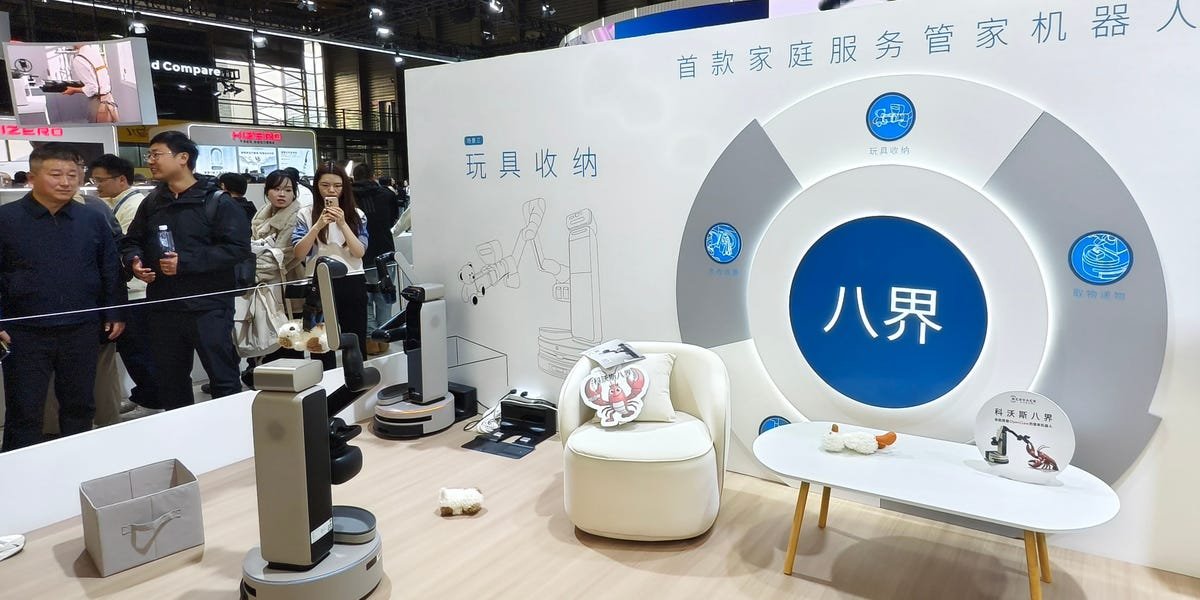

While much of the world is still experimenting with OpenClaw, China is already putting it into robots.
Chinese home robotics giant Ecovacs unveiled its new robot, Bajie, powered by OpenClaw, at a consumer electronics expo in Shanghai last week.
Advertised as a home “butler,” the robot can perform household tasks such as tidying shoes or putting away toys.
Ecovacs founder Qian Dongqi said in an interview with Chinese outlet Ifeng that the long-term goal is for robots like Bajie to take on more household chores.
A writer from the Chinese tech outlet 36Kr who saw the robot in action reported that it required multiple prompts to complete tasks and “there were also unstable situations.”
It’s not just home robots. Developers have begun integrating OpenClaw into Chinese robot-maker Unitree’s G1 humanoid robot, allowing it to interpret commands and navigate physical spaces in real time. A US-based team, Dimensional, has open-sourced the system behind these integrations.
Another Chinese company, AgileX Robotics, earlier this month published a guide showing how OpenClaw can be integrated with its robotic arm, letting users control the machine through natural language.
Chinese tech giant Xiaomi is also testing its version of OpenClaw across its ecosystem, from smartphones to smart home devices.
China has been gripped by an OpenClaw craze lately. Users rushed to install the AI agent on their devices, with some paying strangers to set it up for them and others forming long queues outside Tencent’s Shenzhen headquarters and Baidu’s Beijing office to get help from engineers.
The OpenClaw obsession is partly driven by the viral phrase “raising the lobster,” which Chinese users use to describe deploying the AI agent to automate everyday tasks.
To meet the demand for AI agents, China’s tech giants, including Tencent, Alibaba, and ByteDance, have begun launching their own versions of OpenClaw in the past few weeks.
US concerns about security
Meanwhile, in the US, concerns about AI agents going rogue continue to grow.
Last month, Meta’s alignment director, Summer Yue, connected OpenClaw to her inbox, and said in an X post that the bot tried to delete her emails.
“I had to RUN to my Mac mini like I was defusing a bomb,” Yue wrote on X.
In a separate incident, an AI agent set off a major internal security alert at Meta after acting without approval, exposing sensitive company and user data to staff who weren’t authorised to see it, The Information reported on Thursday.
Tech leaders have also sounded alarms. Elon Musk last month posted an image of a monkey being handed a rifle on X, captioning it: “People giving OpenClaw root access to their entire life.”
Even Nvidia CEO Jensen Huang, who has praised the technology, has emphasized the need for stronger safeguards. His company is working on its own agent system, NemoClaw, with a focus on security.
Read the full article here