





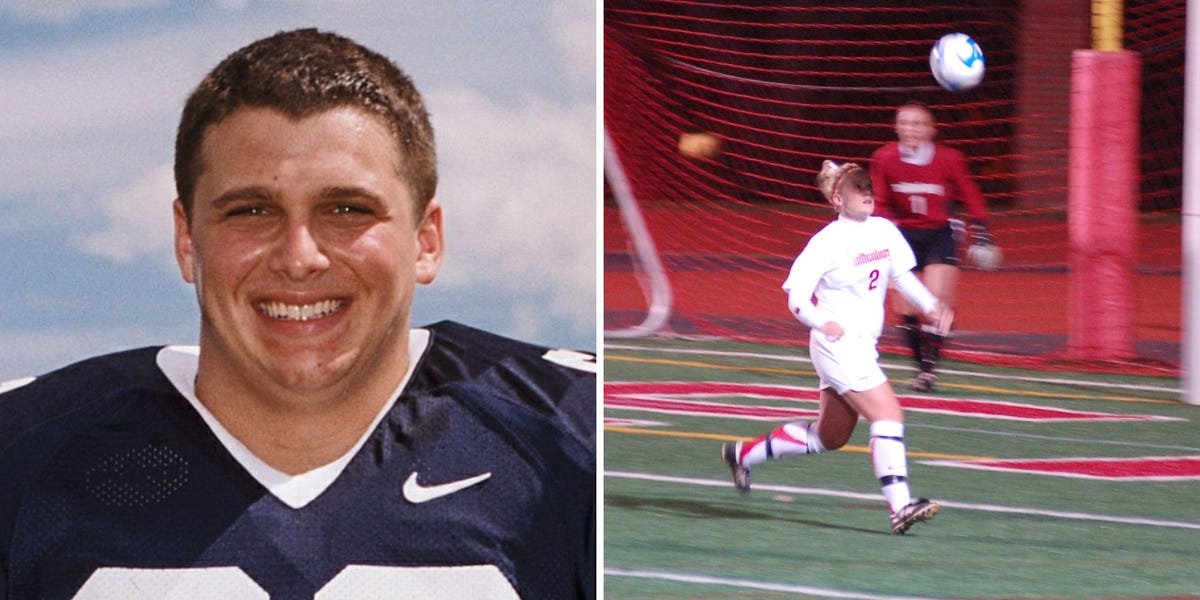

My husband and I were both college athletes. When we had two boys, I think people naturally assumed we’d push the sports route hard. After all, I was a four-year starter on my college soccer team, while my husband played football for an Ivy League college.
But we’ve actually taken the opposite approach, and in addition to the expected soccer, baseball, and flag football dalliances, many of my kids’ activities are non-sports-related. Think piano, musical theater, and Cub Scouts. Our kids are 6 and 8, and we’re not pushing sports on them right now. Here’s why.
We want them to be well-rounded
Kids around us are engaging in competitive sports earlier and earlier. Hospital for Special Surgery, citing the National Council of Youth Sports, reports that about 27% of the 60 million children and teens who participate in organized sports each year play only one sport. These kids are often practicing year-round, competing on travel teams, and in some cases, playing on multiple teams for the same sport.
While parents’ intentions are good — their kid loves a sport, they’re good at it, why not encourage it? — research has shown that there’s not always a clear benefit to early sports specialization, or ESS. Instead, I’ve read that it could be detrimental to kids’ sports success, as it can lead to overuse injuries and burnout, and may actually impede overall motor development.
Free play is a priority for us
One of the rules we have in our home is that each kid can play one sport per season. With two kids, we have practice at most twice a week and games on Saturdays. That leaves lots of time for free play. Studies have shown that unstructured play is immensely important to kids’ developing brains, but it is being summarily replaced by youth sports and its demands.
I consider it a win that with two kids, I’m able to reserve three afternoons a week solely for free play. Will that change if they choose to embrace travel sports? Sure. But for now, they make up elaborate games with their neighborhood friends, ride their bikes and scooters, and honestly, make the biggest messes, both inside and out.
We want to avoid injuries and burnout
My laundry list of soccer-related injuries is long. I’ve had countless sprained ankles, a broken nose, a badly hyperextended elbow, chipped teeth, and torn ligaments in both my knees, one of which resulted in surgery. My husband suffered two concussions, which ended his collegiate career.
Early sports specialization (ESS) is a surefire way to increase the risk of overuse injuries. At this stage, I’ll do just about anything to avoid the ER, including putting off competitive sports. With two boys, we’re already frequent fliers. We also don’t want them to burn out. As seasoned athletes, we know what it’s like to burn out, and we don’t want the same for our kids.
After sitting in school for 7 hours a day, we want them to choose extracurriculars that truly light them up, speak to their passions, and are, well, fun. That means that sometimes it’s flag football, and sometimes it’s ukulele lessons. Both are equally valuable.
We’re taking a thoughtful approach
Both my kids play baseball, but with a few caveats. Both are playing on an official Little League team, which means fields are uniform, playing time is mandated, and there are limits on things like the number of pitches allowed per day. We don’t require them to practice on their own time, unless they want to.
We do require them to finish the season if they sign up to play on a team, but we don’t require them to sign up for any sport again if they truly don’t like or enjoy it.
It sounds random, but it seems I’ve modeled my philosophy after the Norwegian approach to youth sports. This was brought to my attention after the recent Winter Olympics. In short, Norwegians prioritize joy over winning, don’t keep score until kids are older, and don’t allow ESS. The result is a country that boasts a record of 447 Winter Olympic medals (including 166 gold), an impressive soccer team (hello, Erling Haaland, who we all enjoyed during the World Cup), and many other elite athletes — all without pressuring children to excel in sports early.
But don’t get me wrong. I’m not anti-sports.
Playing soccer for most of my life gave me so much — a work ethic, lifelong friends, a sense of belonging, and a sense of responsibility to the greater good. But sports aren’t the only way to learn those skills, and I won’t freak out if my children choose not to pursue the college sports route. At the end of the day, all I want is for them to be happy, well-rounded kids. And if that means playing sports, great. If not, that’s OK, too.
This article is not a substitute for professional medical advice, diagnosis, or treatment. Always consult your qualified physician or healthcare provider.
Read the full article here