






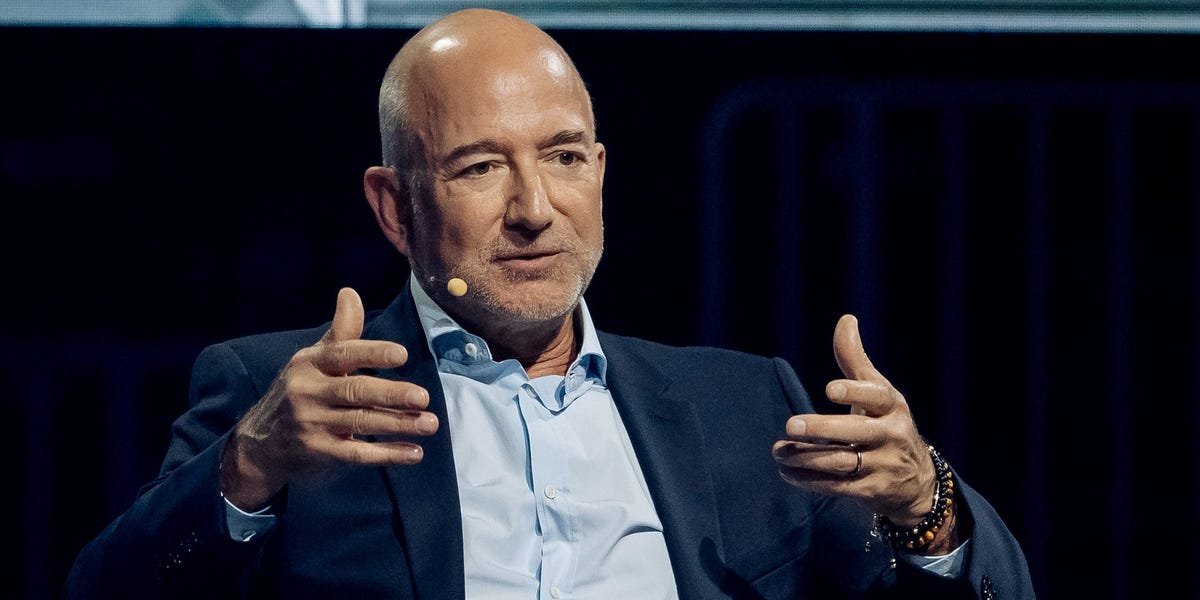

The way Jeff Bezos sees it, AI and the data centers that support the novel technology are like knives.
“You don’t want to accidentally outlaw the knife because it can be used in a bad way,” the Amazon cofounder said on CNBC on Thursday.
“Knives are important tools and yes, every once in a while they get misused by someone, but you don’t say the solution to that isn’t to say, ‘OK, no more data centers, right? No more knives.’ That’s not a smart approach to regulation.”
Bezos said that government regulation has a lot of “reasonable” purposes, pointing to federal regulatory agencies like the FAA and the FDA ensuring public safety when people board planes or take prescription drugs.
“There’s lots to be said for healthy government regulation to improve safety and products and so on,” he said. “And I don’t see why that won’t be applied at some point to the kinds of new tools that are being built by AI.”
The balance, Bezos said, is not going too far.
“You want to regulate the application level,” he added.
Bezos, in addition to advising Amazon on AI as executive chairman, is taking on his first CEO role since stepping down from his post as Amazon’s CEO in 2021. Bezos is serving as co-CEO of Prometheus, a physical AI startup that he launched with Vikram “Vik” Bajaj, who helped create Google’s life sciences company, Verily. Prometheus raised $12 billion in a Series B round.
“That is a big chunk of the funding we’ve raised,” he said. “And one of the reasons we’ve had to raise a significant amount of funding is because what we’re doing is very compute intensive.”
Addressing speculation about what Prometheus will do, Bezos said the startup is not building robots. Instead, the company wants to build AI models that change the future of engineering and manufacturing, ultimately achieving Bezos’ goal of creating an “artificial general engineer.”
“It’s really a set of tools that will give those engineers the ability to turn their dreams into reality much, much more quickly than is possible,” said Bajaj, who was interviewed alongside Bezos.
AI regulation is top of mind
The debate around AI regulation has heated up in the last year amid wider backlash against the technology. Meanwhile, AI companies are spending big on lobbying efforts as various states weigh potential regulations.
President Donald Trump recently signed an executive order that allows frontier AI model makers to voluntarily submit models for federal review up to 30 days before their public release.
On Wednesday, Trump said he expects leading AI companies to agree to “giving back” to the public, a reference that came after news outlet NOTUS reported that the White House is considering whether the US government should hold equity in AI firms.
Bezos did not directly address Trump’s order, nor did Anthropic CEO Dario Amodei, who on Wednesday suggested that “models above a threshold of compute” should undergo mandatory third-party testing by the government or private organizations. Amodei also wrote in an essay that the government should have the power to block the release of AI models if such testing showed they would “present unacceptable risks.”
Read the full article here