





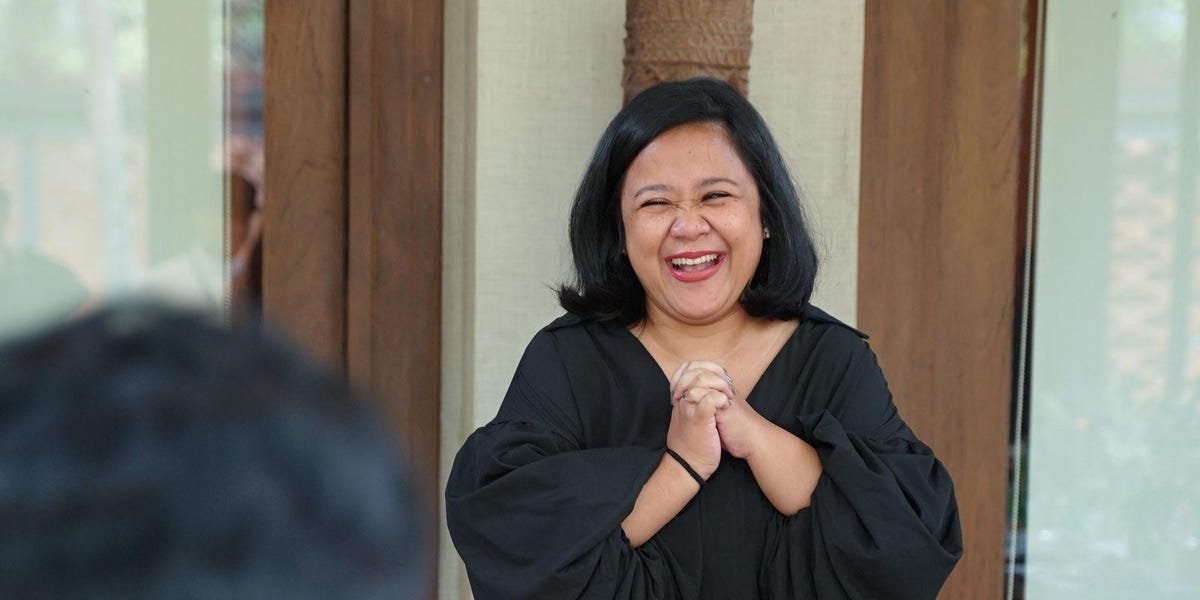

This as-told-to essay is based on a conversation with Chatrine Siswoyo, a communications leader. Her words have been edited for length and clarity.
I turned 40 this year, and I still think about the moment I almost forgot how to define myself.
It happened 10 years ago on a plane. We were flying from Singapore to Hong Kong. My husband had accepted a new role there, and after a long stretch of conversations about timing, family, and careers, I decided to pause my career to follow him.
I’d spent about 6 years working in journalism, public relations, and marketing across Indonesia, the US, and Singapore, for companies like Philips and Twitter.
So when the immigration form arrived on that flight, and I reached the line asking for “Occupation,” I expected my instincts to take over.
Instead, I froze. I stared at the page for a long time. Then I wrote nothing.
It forced me to confront a question I had never really faced before: Who am I without my career? It sounds small, but for someone who had always tied my identity so closely to my work, it felt like a quiet existential crisis.
I grew up in Indonesia
I was raised in Central Java by parents who used a simple philosophy — if you work hard enough, very little is out of reach.
I studied international relations at Arcadia University in Pennsylvania. Back then, my plan had been to become a war journalist.
My first job, a broadcast journalist at Voice of America in Washington, DC, brought me close to that dream.
Then, almost unexpectedly, everything shifted. While interviewing Indonesia’s trade minister, I met someone in her delegation who suggested I consider a career in communications. That conversation led me to Jakarta and quietly rerouted my whole career. I joined a global communications agency and quickly moved across accounts and industries, learning fast.
From there, I stepped into a leadership role at Philips Indonesia, becoming a young female manager in a large, male-dominated organization.
Later, I moved to Singapore, continued in communications, and eventually transitioned into tech, accepting a job at Twitter.
The pace was intense, and the learning curve steep — especially navigating how differently business culture and communication styles play out across markets.
Leaving Twitter in 2015 because of my husband’s job opportunity wasn’t easy — I had finally found my professional footing. But when my husband was offered a role in Hong Kong, we chose to move together, especially as we were thinking about starting a family.
Then, life shifted again
The first three months in Hong Kong were disorienting in ways I hadn’t anticipated.
I had always been defined by motion — teams, deadlines, decisions, output. Suddenly, I had none of that structure.
I still remember a conversation with a headhunter who, after hearing my background, bluntly told me I would likely struggle to find work in Hong Kong — I was neither a native English nor a Cantonese speaker.
I had come from environments where my voice was recognized, and my perspective carried weight, but in Hong Kong, I was starting again from nothing.
Socially, I noticed a shift in myself, too
When people asked, “What do you do?”, I reached for my past. I would say “I used to work for this company” or “I did this role”. I was constantly translating myself into something legible.
Almost instinctively, I found myself leaning on past titles as a way to justify my place in the room. Looking back, it made me realize how quickly we can reduce people to their credentials — and how easily that shapes who we choose to listen to.
But being on the other side of that experience changed something in me. It reminded me that value isn’t tied to status or company names, and that everyone carries a story far richer than what appears on paper.
Through volunteering, I met women whose lives were not defined by corporate structures. On paper, some might have been described simply as “housewives.” Their dedication reminded me that a person’s worth can never be measured by their title alone.
During my time in Hong Kong, I took a short break — about three months — before returning to marketing. I quickly realized I needed to keep myself busy and engaged.
I later moved between Jakarta and Singapore, further building my career through roles at Uber, USAID, ByteDance, and Netflix over 10 years.
These days, I wear multiple hats
I left Netflix after two years, and in 2024, I became the senior advisor for ASEAN at Vero, a board member, and founder of several charities.
Do I miss corporate life? I miss the depth — being inside one organization long enough to see its long arc unfold — the politics, the culture, the slow evolution of ideas into reality.
In the end, it wasn’t the pause itself that changed me; it was everything around it. Letting go of what I thought was my dream role at Twitter, then arriving somewhere new where no one knew who I was, forced a kind of reset I hadn’t expected.
Read the full article here