





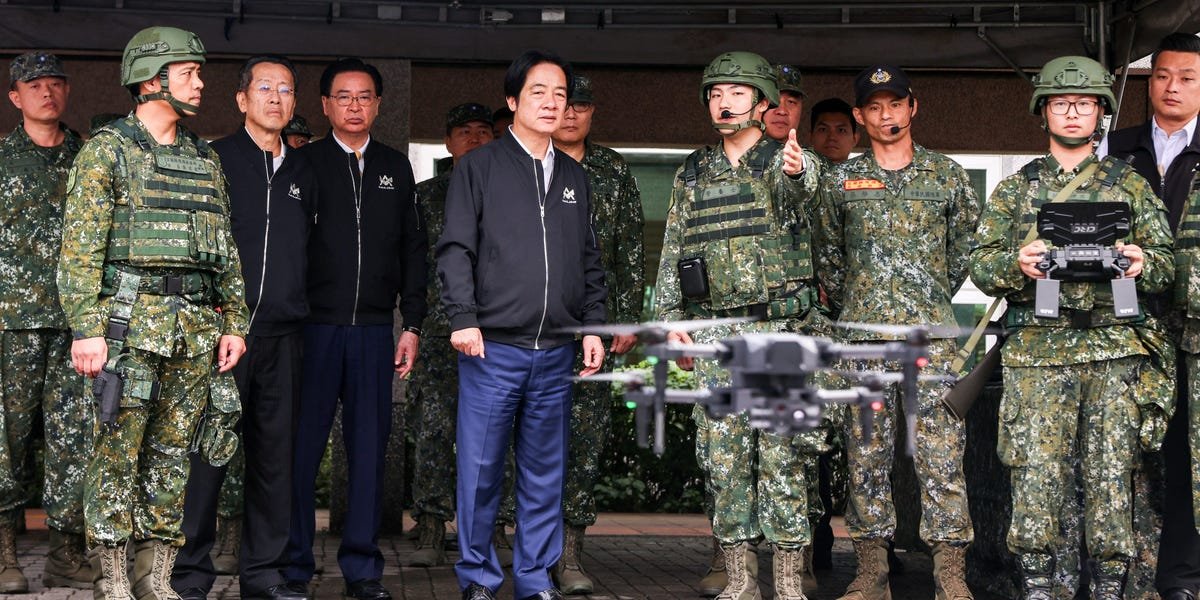

While still investing in traditional defense capabilities, Taiwan is also turning to drone technology to keep Beijing’s forces at bay. To expand the sector, though, it needs to have its powerhouse industries fully engaged, a former US commerce official said recently.
Drones — whether used for surveillance, disruption, or cheap precision strikes — are increasingly central to Taiwan’s push for an asymmetric edge as China looms as an imposing threat. Taipei has watched how Ukraine has used drones for survivability and flexibility on the battlefield and now wants to field them at scale.
After the US led its first major drone and counter-drone trade mission to Taiwan last fall, “the country woke up to the opportunity” that uncrewed systems represent for both defense and the economy, Betsy Shieh, a former senior commercial officer with the US Department of Commerce, said at a Hudson Institute event last week. “They could see the trend lines, and Taiwan moved very, very quickly.”
Taiwan’s government has strived in recent years to build up its drone industry. The defense ministry bought thousands of systems last year, with deliveries running through 2028, and this year rolled out a plan to buy tens of thousands more.
By 2030, Taipei aims to achieve domestic production of nearly 200,000 drones annually. It’s also working to stand up a China-free supply chain. The overarching goal is to accelerate industry growth, deepen its overall self-reliance, and expand ties with democratic partners.
Taiwan’s drone sector is being cultivated with strong government support, anchored by the state-affiliated National Chung-Shan Institute of Science and Technology, which has partnerships with over 60 firms to accelerate development and production.
Taiwanese manufacturers like Thunder Tiger have teamed with international partners on first-person-view (FPV) attack drones and other platforms. Key technological areas for the industry include artificial intelligence, autonomy, and concepts like drone swarming, which are focal points for both commercial innovation and Taiwan’s defense strategy.
Shieh, who said she’d previously established conversations between Taipei and Washington about how to steer industry in the right direction, said during the panel that the next step is for Taiwan to get out of the way of business-to-business relationships. This would speed up the country’s drone ambitions.
Now, she said, Taipei needs to “lay the foundation for those companies to really redirect their resources from current industries, such as space industry, semiconductor industry, electric vehicle industry, and into these new defense technologies, both because it’s a huge economic opportunity but also to defend their own country.”
Taiwan’s government-backed national drone team pulls from a wide mix of companies, including established uncrewed systems manufacturers, firms like Thunder Tiger, Tron Future, and GEOSAT Aerospace & Technology.
Advanced technology firms such as Coretronic Intelligence Robotics Corp. and Mitac Advance Technology deliver additional expertise, while consumer-electronics firms and Taiwan’s powerful semiconductor sector are positioned to supply the technical, AI, and autonomy solutions that modern drones require.
Those sectors are home to some of Taiwan’s most dominant businesses. While Taiwan has brought dozens of companies into government-backed drone development efforts, many of the island’s flagship tech, semiconductor, and electronics firms remain only partially engaged. Getting the biggest power players to shift strategic resources, rework strategies, and invest heavily in drones may demand more state-level support.
“I think government assistance could be really, really helpful there,” Shieh said.
Taiwan’s commerce and defense ministries did not respond to requests for comment from Business Insider, nor did the National Chung-Shan Institute.
A major hurdle for drone makers is securing approval that their systems contain no Chinese-made components — from sensors to antennas — and meet strict cybersecurity standards.
Both the US and Taiwan have banned obtaining parts from Chinese firms like DJI, a challenge given China’s dominance of the global drone market. That’s pushed Washington, Taipei, and other partners to work more closely to build alternative supply chains and stand up companies that aren’t reliant on Beijing.
The cost of making and selling these drones without these parts is high, presenting another challenge.
In a Research Institute for Democracy, Society, and Emerging Technology think tank report earlier this year, analysts argued that while the drone sector nearly doubled in value from 2023 to 2024 and has seen a major surge in exports, “high manufacturing costs driven by reliance on non-China components, limited domestic procurement beyond the MND [Ministry of National Defense]’s landmark 2024 order, and a scarcity of foreign government contracts impede further scaling.”
The challenges come as Taiwan considers the role of drone technology in its defense plans for countering a potential Chinese invasion. Military exercises have increasingly included aerial drones and drone boats, and experts and officials have said these systems would be key assets in the event of a conflict.
Taiwan, however, is still assessing the overall role of drones in its larger defense planning.
A report from the S. Rajaratnam School of International Studies published earlier this year said that drones give Taiwan a subtle way to counter China’s increasingly aggressive grey zone tactics without sparking full-blown conflict. There is a risk, though, that some incursion or incident will lead to escalation.
Beijing has already reacted to Taiwan’s growing drone efforts — and its cooperation with the US — by expanding its own counter-drone training, “including electronic warfare drills, swarm-jamming exercises, and targeting of UAV [uncrewed aerial vehicle] command centers,” the report said. China has also sanctioned some US defense companies involved in supporting Taiwan’s drone industry.
Read the full article here