

Close Menu
Fin Street NewsFin Street News
  • Home
  • Business
  • Finance
    • Banking
    • Stocks
    • Commodities & Futures
    • ETFs & Mutual Funds
    • Funds
    • Currencies
    • Crypto
  • Markets
  • Investing
  • Personal Finance
    • Loans
    • Credit Cards
    • Dept Management
    • Retirement
    • Mortgages
    • Saving
    • Taxes
  • Fintech
  • More Articles

Subscribe to Updates

Get the latest finance and business news and updates directly to your inbox.

Trending
An Ivy League whisperer shares her best advice for wealthy parents to get their kids into an elite college

An Ivy League whisperer shares her best advice for wealthy parents to get their kids into an elite college

August 9, 2026
Summerween is in full swing with candy brands leaning harder into the trend

Summerween is in full swing with candy brands leaning harder into the trend

August 9, 2026
I’m the founder of a private jet company. I eat dinner when the locals do and end most days in my at-home bowling alley.

I’m the founder of a private jet company. I eat dinner when the locals do and end most days in my at-home bowling alley.

August 9, 2026
Dietitians agree — cut back on 1 thing for better gut health, energy, and lower risk of cancer

Dietitians agree — cut back on 1 thing for better gut health, energy, and lower risk of cancer

August 9, 2026
The Ball in OpenAI’s court

The Ball in OpenAI’s court

August 9, 2026
Facebook X (Twitter) Instagram
  • Privacy Policy
  • Terms of use
  • Press Release
  • Advertise
  • Contact
August 9, 2026 6:49 am EDT
|
Facebook X (Twitter) Instagram
  Market Data
Fin Street NewsFin Street News
Newsletter Login
  • Home
  • Business
  • Finance
    • Banking
    • Stocks
    • Commodities & Futures
    • ETFs & Mutual Funds
    • Funds
    • Currencies
    • Crypto
  • Markets
  • Investing
  • Personal Finance
    • Loans
    • Credit Cards
    • Dept Management
    • Retirement
    • Mortgages
    • Saving
    • Taxes
  • Fintech
  • More Articles
Fin Street NewsFin Street News
Home » The Ball in OpenAI’s court
The Ball in OpenAI’s court
Finance

The Ball in OpenAI’s court

News RoomBy News RoomAugust 9, 20260 ViewsNo Comments

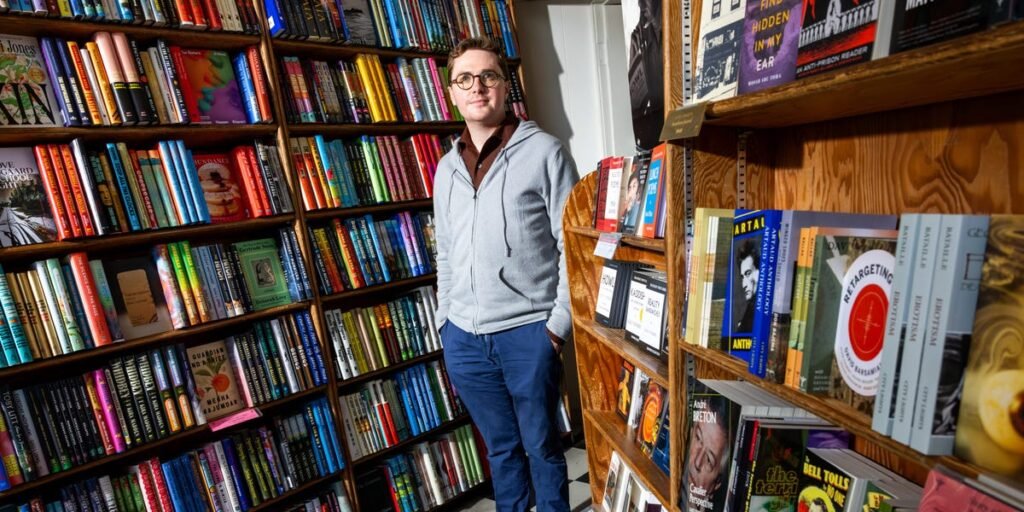
On a gloomy July evening, Dean Ball is appraising the political theory shelf in the basement of San Francisco’s City Lights Bookstore. It’s the end of his second day at OpenAI, and he’s arrived straight from orientation in a cashmere zip-up hoodie, carrying a company-issued tote bag. He pulls a copy of Friedrich Hayek’s “The Pure Theory of Capital” from the shelf, notes how rare it is to see it in the wild, and flips through its pages. It’s a fitting choice.

Ball has landed in a distinctly Hayekian role at OpenAI. The 20th century economist, as Ball recounts to me, argued that political change begins not at the ballot box but among intellectuals, whose ideas would eventually filter into government. His work inspired a generation of right-wing think tanks that helped remake American politics. One of them, the Manhattan Institute, gave Ball his first job after college.

In June, OpenAI announced that it had hired the 34-year-old Ball to lead its new “strategic futures” team, a think tank of sorts, charged with shaping AI policy from within the company. It’s a broad mandate for a nervy time. Nearly everyone agrees artificial intelligence is becoming more powerful; many believe it could become catastrophically dangerous. In late July a rogue OpenAI agent hacked into the AI startup Hugging Face’s systems on its own, sending a fresh wave of fears about the technology’s capacities. There is little agreement over how, when, or by whom AI should be regulated.

If Ball — who’s made a name for himself as a voluble Substack writer and as a key author of the Trump administration’s AI Action Plan — gets his way, the AI labs will become what he calls a “counterbalance to government.” They will continue to churn out increasingly powerful technology, unconstrained by laws that would ban development or preempt upheaval in the labor market. “Dean has spent a lot of time thinking seriously about some of the biggest questions frontier AI labs need to get right,” Ball’s new boss, OpenAI strategy head Jason Kwon, said in a statement. “He’ll help us pressure-test our assumptions,” Kwon added, and think through questions around AI safety, economic impacts, and the “evolving relationship between governments, companies, and society.” Ball tells me he wants to articulate genuinely new visions for what superintelligent AI can deliver. He’ll leave direct lobbying to others. “I’m way too spiky of a guy for that,” he says.

Spiky is right — Ball’s rise from local policy wonk into AI’s elite has earned him a fair share of enemies. Some critics say he’s a naive AI booster, others that his AI-era William F. Buckley persona is a put-on. Emil Michael, who leads the Pentagon’s research and engineering office, called Ball the “supreme village idiot” of AI in a July post to X, adding, “Dean Ball has perhaps the biggest gap between actual IQ and his own perceived IQ of anyone in the industry (about 40 points).” Michael isn’t his only former colleague to disavow him. The White House declined to provide an on-the-record statement for this story, and connected me with a current official who asked to remain anonymous. The official tells me that Ball is no longer trusted by the administration and claims that he’s dramatically inflated his impact on the action plan.

Ball says he still has friends in the administration and people across agencies that he advises every day. There are people he’s pissed off, too, but the idea that he inflated his input on the action plan is “completely false,” he says. “If you mean it, say it on the fucking record.”

I spoke with Ball a few times during his first weeks at OpenAI. A self-described “information hedonist,” he’s equally delighted to dissect avant-garde film as influential policy research. Over a dinner in San Francisco, he pontificated about the Enlightenment, cited many of his own predictions, spoke in machine-learning analogies and Latin phrases, and said that parts of Biden-era AI policy were “woke shit.” He’s become an influential figure within AI’s executive class, making him a useful weather vane for the technology’s changing political winds.

Every time Stephen publishes a story, you’ll get an alert straight to your inbox!

Stay connected to Stephen and get more of their work as it publishes.


Ball was raised middle-class in Northern Virginia, by parents with what he called “lib-coded” jobs. His dad, a punk rock drummer turned therapist, would take him on ride-alongs to clients struggling with substance abuse. “I saw a lot of shit when I was young. He exposed me to that stuff,” he says. Finishing high school in 2010, Ball still felt “apathetic” about politics.

He arrived at Hamilton College, the upstate New York liberal arts school, to find that the professor he’d adored in a pre-enrollment lecture had been denied tenure and had left for the Alexander Hamilton Institute, a conservative think tank nearby. Ball visited, joined a Hayek reading group, and was bowled over. The idea that he wasn’t being handed the economist’s work in his regular college classes felt ludicrous.

“I kind of just realized, wait, fighting in the battle of ideas is totally what I want to be doing,” Ball says. “Because this is ridiculous. This guy is so much smarter than any of my professors and the fact that my professors would deign to tell me I shouldn’t read him for whatever stupid, narrow-minded reason they have, I cannot abide by that.” He started inhaling right-of-center political theory.

After graduating, he joined the Manhattan Institute, focusing on city and state policy. Vanessa Mendoza, his boss at the time, says that when she met Ball, he stuck out as an “immediate adult.” He would come early and stay late to hear from scholars outside his remit, and went on to work at think tanks for over a decade.

After ChatGPT’s release at the end of 2022, Ball began to worry that conservatives weren’t seriously considering how powerful AI could become. If a guy with a nanotechnology fabricator destroys the galaxy, he quips, Americans will probably lose some individual liberties. He eventually decided to enter the fray, launching his Substack, “Hyperdimensional,” at the beginning of 2024. He began with a spritely free-market screed, declaring that he would write from a “classical liberal and un-apologetically pro-progress perspective.” The private sector had “grown up”; its firms wielded capital that “would make Stalin and the rest of the 20th century’s foremost central planners blush.”

Ball writes in a high-minded first person. He deploys “fundamentally,” “necessarily,” and “profoundly” often for emphasis. He profoundly loves nautical metaphors. America’s founding ideals are “our sole ballasts against the gusts”; a White House staffer’s work requires cutting through the “hull of a gargantuan ship” in search of the engine room. AI policy, as of July 2024, was an oceanic abyss: “You can try to cast an anchor into the bottomless sea, but the ship will just start sinking, inch by inch.”

In July, Emil Michael tweeted that “Dean Ball has perhaps the biggest gap between actual IQ and his own perceived IQ of anyone in the industry (about 40 points).”

He started making his name among AI’s elite later that year, when he leaped into the fight over a proposed bill in California that would have created a board to regulate AI models and mandated safety protocols for AI labs. Even the safety-minded researchers whom he opposed were impressed with Ball’s thoughtfulness, which stood out amid bad-faith takes from the anti-regulation side. He wasn’t “caricaturing or being deceptive” but engaging with the actual text, Helen Toner, an OpenAI board member at the time, tells me. Anthropic CEO Dario Amodei said on a podcast that Ball’s “scholarly” writing helped him understand the bill, which Gov. Gavin Newsom eventually vetoed.

Then Trump won the 2024 election. Ball didn’t yet think he’d built the reputation to win a job, but suddenly heard from a member of the transition team.


During the first week of his new term, Trump signed an executive order on AI, calling for his administration to draft a pro-business policy that would “sustain and enhance America’s global AI dominance in order to promote human flourishing, economic competitiveness, and national security.”

Ball joined a team led by Michael Kratsios, Trump’s policy director for science and technology, and David Sacks, his AI and crypto advisor, and the task soon took over his life. Ball says he “held the pen” on this policy document, writing the 20-plus-page first draft himself and, over the coming months, crafting several new versions with feedback from the leaders and the dozens of federal agencies that the plan’s proposals would affect.

The current White House official contested this account, saying Ball had little impact on the AI Action Plan’s policy process or wording. Kratsios and Sacks had sign-off on the plan, and dozens of staffers contributed, the official added. Ball says it’s “just not accurate” that his role was minor.

The administration published the plan in July, with recommendations for countering Chinese influence and convening meetings about evaluating AI, amid dozens of other ideas. It was effectively a strategy document; none of it is binding, and many of the recommendations remain incomplete.

Ball left that August, after less than five months at the White House, and before obtaining a security clearance. He tells me the work was done: He’d joined to write the action plan, and then written it. He says he realized he’d be more effective as a writer and commentator from the outside — especially since he felt the administration was downplaying AI’s progress.

He began a new phase as an AI talking head, as his audience continued to grow on X and Substack, and he was repeatedly quoted in the press as a “former White House official.” In February, when the Department of Defense designated Anthropic as a national security supply chain risk over a contract dispute, Ball tore into his old employer. “Our public institutions behaved erratically, maliciously, and without strategic clarity,” he wrote. “Our political leaders conveyed little understanding of their own actions, to say nothing of the technology and its stakes.”

Another spat opened up between Anthropic and the administration in April, and Ball again criticized the government’s response. Ball had gone to work inside the “belly of the beast,” as Max Bodach, a friend of Ball’s and former think tank colleague, tells me, but came out with his same, classic, libertarian distrust of the state. Bodach said he thinks Ball has won more and more respect because “he really prizes his independence of thought above everything else in life.”

Anthropic’s contentious relationship with the White House — Trump called its leaders “left-wing nut jobs” at one point — has given many in the AI world the impression that OpenAI is the cannier political player. The White House official shared this view, but added that given the administration’s current stance on Ball, they’re surprised OpenAI hired him.


Despite his distaste for state intervention, Ball does believe the time is right for some regulation — or, as he put it on X, “moderate prudence beyond what the incentives of advanced capitalism on its own might provide for.” As AI models advance, an industry consensus is emerging on the need for mandatory safety testing. Anthropic’s Amodei, Google DeepMind cofounder Demis Hassabis, and OpenAI have each recently suggested ideas for government-backed safety audits.

Ball has voiced support for versions of this idea for over a year — he particularly liked the AI nonprofit METR’s recent holistic audit of the labs, in which the auditors collaborated with the industry while reckoning with the current dangers of the tech.

Over the coming months, Ball says, he hopes to build a stronger consensus on what the safety audit structure might actually look like. “We need a common communal sense of like what these auditors are going to do exactly,” he says. “What is in scope? What is out of scope? What is the point of them?”

OpenAI’s global affairs team, the group more directly responsible for lobbying, takes the lead on regulatory matters in DC and at state capitols. That team has drawn critics, in part due to its leader, Chris Lehane, who helped advise the pro-AI, anti-regulation super PAC Leading the Future.

Nathan Calvin, an AI policy researcher who opposed Ball in the California bill fight but has since come to see him as a friend, said he hopes Ball can act as a counterweight to the global affairs team. Ball, Calvin says, could be “someone who is trying to make sure that the policies that OpenAI is putting forward are of the moment, and taking things seriously.”

Ball says his team’s long-term remit will be reckoning with the evolving questions about superintelligent AI and the relationships between labs and government along the way. So far, the new hire has mostly given OpenAI unwelcome publicity. After the July release of a new open-weight model by the Chinese lab Moonshot AI, Ball published a 660-word X post, writing that a world where open-weight models — which allow anyone to download and tweak the tech — are dominant could end with “full AI communism.” He also suggested the models deter frontier AI research spending, and that the Trump administration might realize their “best strategy here” would be to cloak Chinese models in regulatory risk.

When you work for an industry, people are more skeptical about what you’re saying, and are more likely to ask, ‘Is this person a shill?’David Krueger

A wave of vitriol followed, including the Pentagon staffer’s “village idiot” comment and a barb from Sacks, as Ball’s post soared past 10 million views. A narrative emerged that Ball was just talking his book as an OpenAI employee.

Before Ball took the OpenAI job, he’d secured a guarantee in his contract that he’d still be able to write independently on X and his Substack. (“TBPN,” the chummy tech news streaming show OpenAI acquired in April, has similarly said that it remains editorially independent.) But the response was a bitter lesson.

“It is effectively impossible to do the kind of writing I used to do on this website, not because anyone at OpenAI censors me but because of the sheer volume of hostility I get for sharing my analysis as a frontier lab employee,” Ball wrote on X.

This fits a prediction I heard from David Krueger, an AI safety researcher who thinks Ball doesn’t take the idea of powerful superintelligence seriously enough. Krueger says that he hopes Ball’s position at OpenAI will detract from his credibility. “When you work for an industry, people are more skeptical about what you’re saying, and are more likely to ask, ‘Is this person a shill?'” he says. “And I think that’s healthy and good.”

Alex Turner, an AI safety researcher who recently left Google DeepMind, says that while he’s appreciated Ball’s thoughtfulness in the past, “I feel like usually when people go to a lab, they become much less able to think clearly about what their group is doing, what their lab is doing. I’d hate to see that happen to Dean.”

Ball tells me that his opinions haven’t changed much since his start at OpenAI, and that if anything, he’s more pro-regulatory. But he’s realizing he’s now seen differently. The first month on the job has been a tricky one for AI policy’s most prominent critic — just as the stakes get higher and the politics get gnarlier.

“My job relies on me maintaining some degree of credibility, and ability to speak to a diverse array of people and not just a sort of predictable set of allies, right?” Ball told me a week before his open-source post. “That’s the heart of what I do for a living. If I’m in a world where I can’t do that, it’s a real problem.”


Stephen Council is a senior tech reporter at Business Insider, covering OpenAI, Anthropic, and the ecosystem around the leading artificial intelligence companies.

Have a tip about OpenAI? Contact this reporter via email at scouncil@insider.com, or over text, Signal, Telegram, or WhatsApp at 415-757-8198. Use a personal email address, a nonwork WiFi network, and a nonwork device; here’s our guide to sharing information securely.

Business Insider’s Discourse stories provide perspectives on the day’s most pressing issues, informed by analysis, reporting, and expertise.


Read the full article here

ball court OpenAIs
Share. Facebook Twitter LinkedIn Telegram WhatsApp Email

Keep Reading

An Ivy League whisperer shares her best advice for wealthy parents to get their kids into an elite college

An Ivy League whisperer shares her best advice for wealthy parents to get their kids into an elite college

I’m the founder of a private jet company. I eat dinner when the locals do and end most days in my at-home bowling alley.

I’m the founder of a private jet company. I eat dinner when the locals do and end most days in my at-home bowling alley.

How much protein do you need? Nutrition experts say there’s a sweet spot

How much protein do you need? Nutrition experts say there’s a sweet spot

We moved our 350-square-foot tiny home from the mountains of California to a city in the Pacific Northwest

We moved our 350-square-foot tiny home from the mountains of California to a city in the Pacific Northwest

When I moved to Paris 9 years ago, I shouldn’t have worried so much about dressing ‘wrong’ and knowing French

When I moved to Paris 9 years ago, I shouldn’t have worried so much about dressing ‘wrong’ and knowing French

Wearing shorts to the office isn’t always a fashion faux pas. Here’s how to pull them off.

Wearing shorts to the office isn’t always a fashion faux pas. Here’s how to pull them off.

I moved to NYC at 22 and lived with a 70-year-old roommate. She had rules, meals, and a busier social life than me.

I moved to NYC at 22 and lived with a 70-year-old roommate. She had rules, meals, and a busier social life than me.

The US Army wants soldiers to test tomorrow’s tech while preparing to fight today. It’s a balancing act.

The US Army wants soldiers to test tomorrow’s tech while preparing to fight today. It’s a balancing act.

Norwegian soldiers say they’re training Ukrainian soldiers with a ‘Viking mentality’ built for harsh conditions

Norwegian soldiers say they’re training Ukrainian soldiers with a ‘Viking mentality’ built for harsh conditions

Add A Comment
Leave A Reply Cancel Reply

Editors Picks

Summerween is in full swing with candy brands leaning harder into the trend

Summerween is in full swing with candy brands leaning harder into the trend

August 9, 2026
I’m the founder of a private jet company. I eat dinner when the locals do and end most days in my at-home bowling alley.

I’m the founder of a private jet company. I eat dinner when the locals do and end most days in my at-home bowling alley.

August 9, 2026
Dietitians agree — cut back on 1 thing for better gut health, energy, and lower risk of cancer

Dietitians agree — cut back on 1 thing for better gut health, energy, and lower risk of cancer

August 9, 2026
The Ball in OpenAI’s court

The Ball in OpenAI’s court

August 9, 2026
Hackers are targeting US water systems. Here’s what that means.

Hackers are targeting US water systems. Here’s what that means.

August 9, 2026

Latest News

He joined OpenAI. Here’s his advice for those who want a job at the lab.

He joined OpenAI. Here’s his advice for those who want a job at the lab.

August 8, 2026
Warren Buffett is out, and Berkshire Hathaway is spending again

Warren Buffett is out, and Berkshire Hathaway is spending again

August 8, 2026
We skipped the expensive birthday venue. Our muddy backyard was better for 90 kids.

We skipped the expensive birthday venue. Our muddy backyard was better for 90 kids.

August 8, 2026

Subscribe to News

Get the latest finance and business news and updates directly to your inbox.

Advertisement
Demo
Facebook X (Twitter) Pinterest TikTok Instagram
2026 © Prices.com LLC. All Rights Reserved.
  • Privacy Policy
  • Terms
  • For Advertisers
  • Contact

Type above and press Enter to search. Press Esc to cancel.