
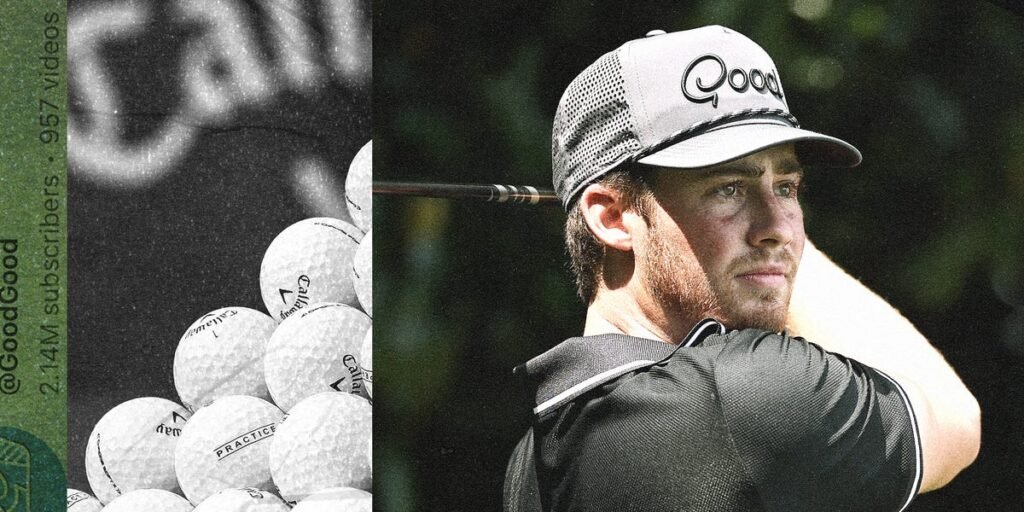
The stars of YouTube supergroup Good Good could hardly contain their enthusiasm as they unveiled an expansive partnership with one of golf’s best-known names: Callaway.
“It’s a dream of ours,” one said, as another gushed it would be “super dope.”
That was 2023, and the reveal — which Good Good called its “biggest announcement yet” — felt like a sign of golf’s new era. Good Good’s high-energy pranks and challenges were getting the backing of a blue-chip equipment maker. Good Good followed the deal up with a string of retail partnerships and $45 million in investment. The creator economy had come to breathe new life into an aging sport, and Good Good was its star.
Three years later, Good Good’s dream unraveled in nightmarish fashion over the course of two weeks. An ill-fated ad with Callaway — which many saw as a poor attempt at humor at best, and promoting violence against women at worst — caused the golf giant to cut ties and other key partnerships to evaporate.
Good Good’s CEO went nuclear on Callaway in a series of early-morning posts. Days later, he was out, along with a newly installed president, who arrived just as the ad was published and didn’t stick around to try to clean up the mess.
To Good Good fans, the crisis seemed to come out of nowhere, and stood in sharp contrast to the brand-friendly image the group had cultivated for years. The group had rolled out a campaign earlier this year, called “There’s more to Golf,” to promote inclusivity and reach new audiences.
Inside the company, however, there were signs that leaders and investors recognized a need for greater professionalization and a steadier hand.
As the scandal broke, Good Good was onboarding its new president, Joe Flannery, who was tasked with overseeing most of the company’s operations. The scale of Flannery’s remit suggested that investors felt CEO Matt Kendrick needed reinforcements.
Flannery, a veteran of Nike and Adidas, was described by a former Callaway colleague as a “respectful” exec who didn’t fit in with some of his more bro-y counterparts at the equipment maker.
One person who worked on other projects with Good Good said the company was run in a casual manner, and that they had seen ads fly out the door with little oversight.
“I think a lot of things get brought to them very quickly and they say, ‘Let’s do it,'” this person said.
Creator-led companies are talent-driven by nature, and many — including category leader MrBeast — are hiring outside leaders to help them level up their businesses. As the industry matures, creators face a central question: Can I professionalize my company without killing what makes people love it? Audiences want authenticity, and so do brand partners — up to a point. Good Good’s scandal is an extreme example of a risk that many creators face.
“Brands are rightly advised to give creators breathing space because nobody understands how to engage their audiences better than they do,” said Ben Woods, head of creator economy at Enders Analysis. “But that freedom inevitably comes with some reputational risk when content crosses a line or generates controversy.”
An attempt at humor
The 56-second ad, called “The Driver,” opened with ominous music. One of Good Good’s cofounders, Garrett Clark, runs toward a female member of the group, Alexis Miestowski, and tackles her, saying, “Do not touch my new driver.”
According to Kendrick and Clark, the ad was meant to riff on the horror movie “Obsession,” popular with Gen Z. The idea: Clark had become obsessed with the golf club to the point of insanity. The ad landed with a thud.
The backlash was fast and furious, with thousands of negative comments across social media platforms, many saying the video made light of violence against women.
Clark apologized on Instagram and said the concept came from Good Good’s marketing team.
“Looking back, super dumb ad concept, terrible ad in general,” he said. “The worst ad known to man.” He also denounced threats of violence against Miestowski that were made on social media.
Good Good took down the ad and apologized, as did Callaway, which said that while the company was not involved in its production, its review process was inadequate. Both said the ad was inconsistent with their values.
Still, the fallout continued. Dick’s Sporting Goods yanked Good Good products from shelves, and the YouTube group pulled out as a title sponsor for a PGA Tour event in the fall.
The Golf Channel scrapped the upcoming season of its reality golf series “Big Break,” whose grand prize was entry into the PGA Tour event that Good Good was set to sponsor. Good Good’s marketing head, Jeff Lefkovits, and a second marketing team employee were fired. Callaway’s content head departed.
Kendrick added some drama of his own to the situation, letting loose in a string of early-morning posts on X.
“Interesting that @CallawayGolf asks us to make an ad then approves it then asks us to take the fall then drops us in a coordinated media blitz and covers it up by giving a million dollars away thinking everyone will be ok with it,” he wrote in a post that was viewed 8.8 million times.
He went on to post that he wasn’t “opposed” to suing Callaway and was “down to boycott” the company. Callaway didn’t respond to the posts. In the days following the ad, CEO Chip Brewer posted that Callaway shouldn’t have approved the ad, while Callaway wrote that it strengthened its approval procedures and made a $1 million donation to organizations that combat violence against women.
In an interview with Front Office Sports, Kendrick said that he’d been “reactionary.”
“It’s been tough,” he said. “The company is one thing, but family is a whole other thing.”
Five days later, he was out of the company he helped found.
“This is a difficult day for the entire Good Good family. Matt helped build something extraordinary that exceeded all expectations and continues to bring countless new fans to the sport. What began as a small group of friends playing golf is now a growing global community,” Alex Puchala, who leads finance and operations at Good Good, wrote in a staff memo.
The creator economy is still maturing
It now falls to Good Good’s interim CEO Nahid Giga, a cofounder of the group and early investor, to find a path forward. The company said that, despite the recent controversy, retail sales and its social media followings had grown, and investors remain on its side. It declined to share specific numbers.
Even so, some partners and sponsors may keep their distance for a while — and creator economy insiders previously told Business Insider that Good Good could benefit from focusing on its core users through in-person events and paid offerings while it rides out the scandal.
Optimism for the creator economy has abounded as marketers race to work with these new stars of entertainment. An industry that barely existed 20 years ago has boomed into a $250 billion category, enticing brands and rattling Hollywood. Netflix and other streamers are racing to sign creators and podcasters before YouTube eats their lunch, and investors are pouring money into the space in search of the creator who could build the new-media equivalent of Disney.
Yet, in some ways, creator-led media companies are still in their adolescent phase. The industry leaders are trying to turn their fandoms into scaled businesses by bringing on outside professionals. Not all those transitions have gone smoothly. Star creators MrBeast, Alex Cooper, Ashley Flowers, Steven Bartlett, and Dude Perfect have all had key departures from their companies in recent months.
Creators say they still aren’t getting the trust — or budgets — they deserve from brands. Much of their money comes from experimental or sponsorship pots, not the much-bigger TV budgets. YouTube may rule the TV screen, but it hasn’t captured a commensurate share of ad dollars.
The Good Good episode may play into marketers’ fears: That this new crop of entertainers hasn’t adopted the processes and guardrails needed to fully earn the trust of brands.
That could mean brands give creators a shorter leash.
“There’ll be an overcorrection,” said Joe Perello, CEO of Props, a creator marketing company. Perello said he has seen a recent uptick in brand clients seeking to measure the work they do with creators since the Good Good episode cast light on the practice.
“Execs are asking themselves not, should we be doing this, but instead, let’s make sure we’re measuring it right,” he said.
The debacle also comes as Good Good’s category, golf, faces something of an identity crisis. Good Good has helped grow the sport, but the expansion has come with growing pains as traditionalists complain that the hoodie-wearing newcomers don’t understand or respect golf’s rules and etiquette. Golf’s popularity surge is bigger than one YouTube group’s screwup, though.
To quote another ad that remains on Good Good’s site, “Since day one, golf’s been a work in progress.”
Read the full article here