






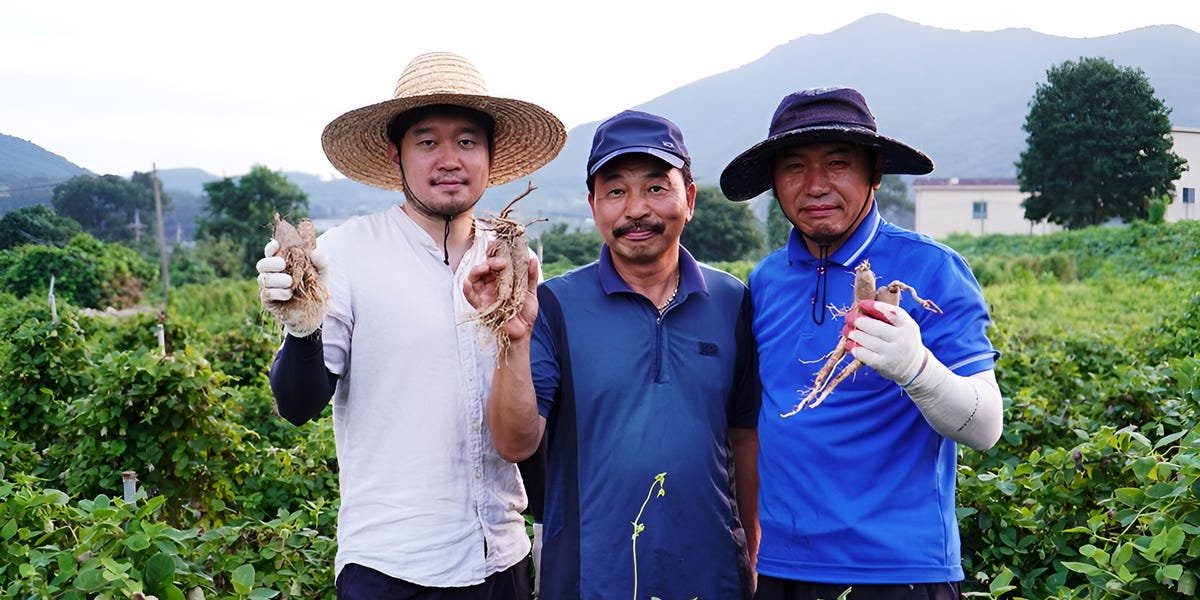


This as-told-to essay is based on a conversation with Kang “Kay” Soo-il, a 39-year-old South Korean national who quit his job and traveled, before returning home to run a farm. It has been edited for length and clarity.
Eight years ago, at 31, I was living in a Korean city south of Seoul, and working as a software developer and designer for Samsung Electronics. Burned out, I texted my friends, “I’m quitting my job to travel the world!”
Lily, then my childhood friend, who’s now my wife, replied: “I’m also quitting my job.” At the time, she was working as a flight attendant. The timing was a complete coincidence. We’d known each other since middle school, and got back in touch.
We both grew up in Yesan, a rural town that’s about a two-and-a-half-hour drive from Seoul. She grew up on her family’s farm where they grew deodeok, or bonnet bellflower. It’s a mountain root vegetable commonly used in Korean cooking. I lived a 10-minute walk away.
We started dating in January and were married by May. A month after our wedding, we started traveling the world together.
Newlyweds traveling the world
We started in Russia, cut through Europe, and traveled through North and South America for about two years from 2018 to 2020. We funded our travels with the savings from our work. We spent extra time in Calgary, Canada, because I’d loved it there as a study abroad student. During that year in Calgary, we noticed how proud the local farmers were of their work.
In South Korea, that kind of atmosphere doesn’t exist. Farming can often be viewed with a sense of shame. But since my wife’s father is a farmer, she’s always taken pride in her roots.
Traveling abroad, Lily noticed that deodeok was impossible to find abroad. It’s not an ingredient that’s widely exported, and when it is, it’s rarely cooked the same way outside Korea.
Returning to the countryside
During our travels, we also came to realize that we preferred the calm countryside towns over big capitals like Paris. In 2020, we decided to return home and take over my wife’s family’s farm. It wasn’t difficult to get permission from her parents. They were OK with it from the start.
Want more Business Insider in your news feed?
Add BI in Google so our reporting is easier to find when you’re searching for what matters.
Back then, it was called Ssabdari Deodeok. It’s a third-generation family-run farm started by Lily’s grandmother nearly 45 years ago. At the end of 2022, we launched it as Deodeokmong, or Dream of Deodeok.
Other than helping out my parents when I was young, who grew food on their weekend plot, I’d never really raised a crop from start to finish. We trailed her father at first to learn the basics of farming.
During our first two years, we operated the farm as usual, but I noticed that we threw out almost 50% of our produce because it wasn’t attractive enough for the market. We couldn’t afford to sustain the business by selling only half our harvest. We decided to pivot by using these in popular products like butter cookies, lattes, and scones studded with deodeok.
In 2022, we also secured a local government small-business support program grant for about 100 million South Korean won, or about $70,000, bought new equipment, and hired a design studio to help with the rebrand and renovation. It took nearly a year, and we’re still developing the business, but the program grant changed everything.
Soon, local resorts reached out to feature our products in their lobbies. The Hyundai Department Store invited us to host pop-up markets in Seoul.
Older customers have told me that they love that young farmers are keeping traditional crops alive. The younger city buyers are probably attracted to our packaging; it’s not the usual old-fashioned, medicinal stuff you find elsewhere.
My wife focuses on branding, marketing, and product development. I focus on planting, farming, accounting, and making the products.
Running a farm while raising a family
We have a five-year-old daughter and we’re expecting our second child soon. Honestly, I haven’t found the right balance between parenthood and work yet. I wake up around 6 a.m., send our daughter to kindergarten by 9 a.m., work, and when she comes home at 4 or 5 p.m., I focus on her.
My candid advice to anyone dreaming of quitting their corporate job to farm? Don’t do it!
Farming is so difficult that it often feels like a futile endeavor. But if you’ve deeply considered your options and won’t give up, test-drive the lifestyle first.
Try living in the countryside for at least three months. If you still enjoy the lifestyle, then go ahead. And read widely — not just technical farming guides, but business and branding books. Building a modern farm isn’t just about growing crops; it’s as complex as sales and marketing.
Read the full article here