





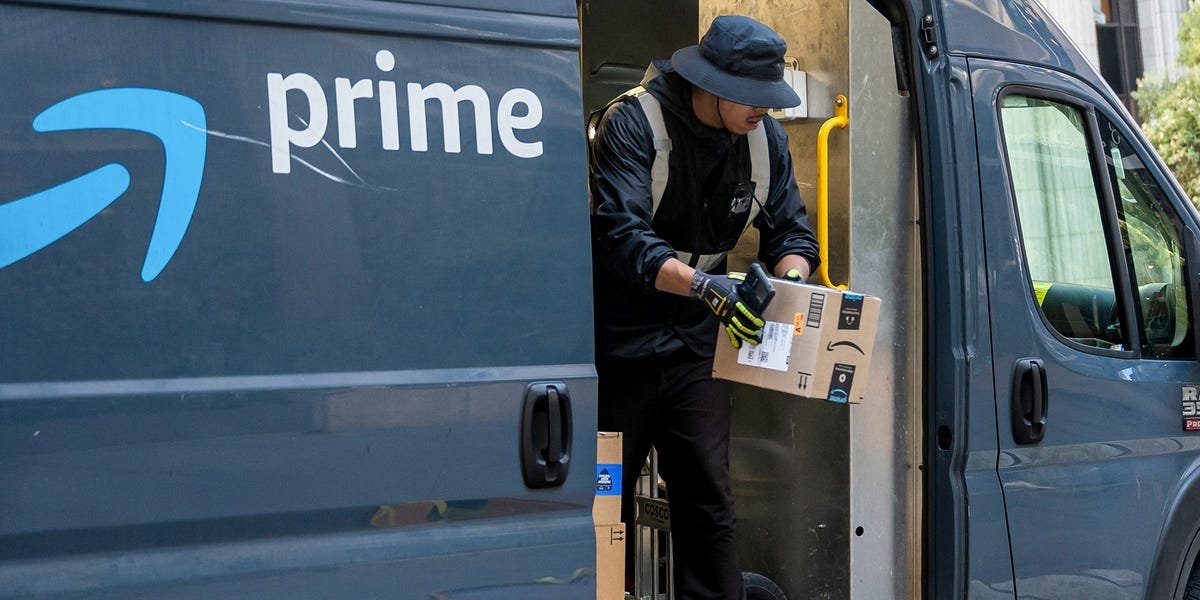


Amazon’s plan for more than 1,000 same-day fulfillment centers is fundamentally an attempt to close Walmart’s long-held proximity advantage, Bank of America analysts wrote in a research note.
Business Insider reported this week that Amazon is considering an internal project called Mercury, which would expand its same-day fulfillment network from roughly 85 facilities today to more than 1,000 by 2031. The goal is to place inventory within 10 miles of about 80% of Prime members in the US, according to internal planning documents reviewed by Business Insider.
BofA analyst Justin Post said Project Mercury’s strategy is less about expanding selection than making a smaller set of high-demand products more immediately accessible. Amazon’s ability to compete with same-day delivery is “very important strategically,” he wrote.
“We see Project Mercury as another piece of Amazon’s broader effort to build a denser, faster, and increasingly automated countrywide fulfillment network,” Post wrote in the note.
The bank called the project’s estimated $6.8 billion investment “manageable” for Amazon. Internal projections reviewed by Business Insider forecast that Mercury would turn cash-flow positive by 2030 and generate $7.1 billion in economic value over 10 years.
Walmart has a major head start. Its roughly 5,000 stores put fast delivery within 10 miles of 90% of the US population. The retailer has increasingly used those stores as local fulfillment centers, helping it deliver 70% of e-commerce orders the same day.
Amazon’s same-day sites carry a narrower assortment — roughly 90,000 fast-moving products such as paper towels, cough medicine, and fresh food — rather than the broad selection of a conventional fulfillment center. The strategy is to move those everyday purchases closer to customers without trying to replicate Amazon’s full catalog in every market.
The Bank of America note added that Amazon’s investments in faster delivery and automation could bolster its retail profit margins for years. It cited an earlier Business Insider report on Project Tetromino, Amazon’s automated delivery-station initiative.
“The combination of greater network density, faster delivery, and continued automation can improve customer experience while extending the Retail margin improvement cycle for multiple years,” the note said.
Have a tip? Contact this reporter via email at ekim@businessinsider.com or Signal, Telegram, or WhatsApp at 650-942-3061. Use a personal email address, a nonwork WiFi network, and a nonwork device; here’s our guide to sharing information securely.
Read the full article here