


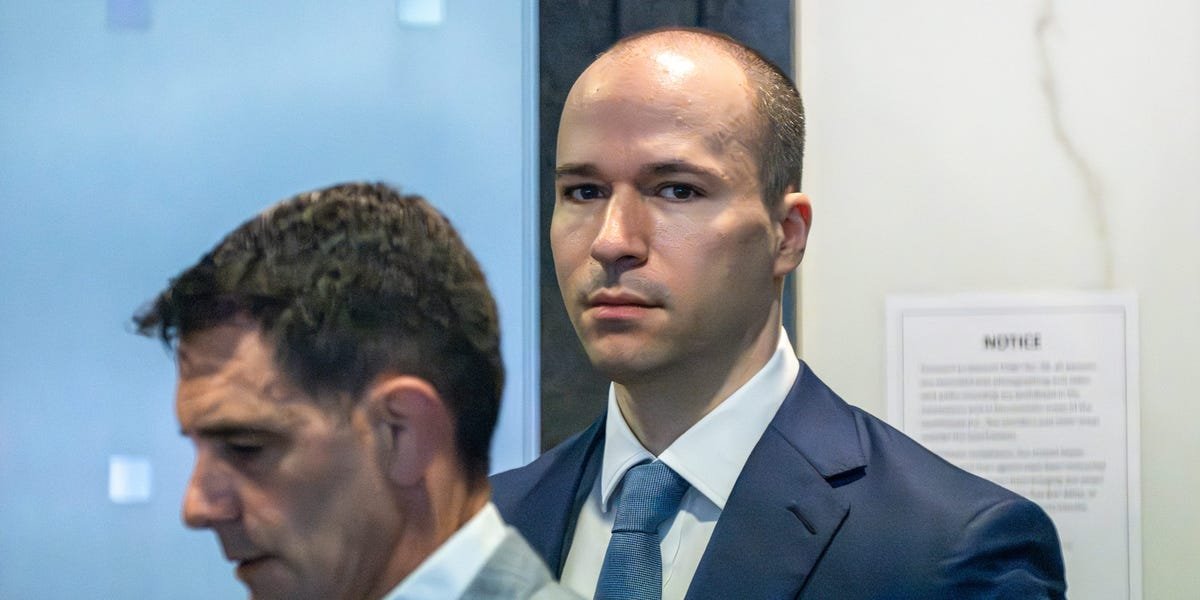


Greg Brockman’s second day of testimony revealed many insights into Elon Musk’s interactions with OpenAI’s founders.
Brockman, OpenAI’s president, returned to the witness stand on Tuesday, seeking to add “context” to journal entries about how it would be “morally bankrupt” to “steal” the OpenAI nonprofit from Musk.
Musk is seeking more than $100 billion in damages from OpenAI in the high-stakes trial, where he said the company deceived him and that its founders, including Brockman, unjustly enriched themselves.
Here are the key revelations from Brockman’s latest testimony.
Musk wanted a big win for OpenAI before entertaining a for-profit
In a bid to compete, Musk told the OpenAI team they needed a big win, Brockman told the jury. “Once we have a big result, then and only then can we entertain the for-profit,” Brockman said Musk told them.
Brockman says the team finally got their win in 2017 when an OpenAI bot defeated a top player in the video game Dota 2 on an international stage.
Twenty thousand people watched the win, which Musk crowed about on Twitter, before it was renamed X.
Celebrating at Musk’s haunted mansion with Amber Heard
After the big win, the OpenAI team was invited to Musk’s “haunted mansion” in San Francisco to discuss the company’s next steps, Brockman said. In his email, Musk warned of “party carnage” from the night before.
“There was confetti and cups and the whole thing all around,” Brockman said of the scene.
Actor Amber Heard, Musk’s girlfriend at the time, was also there.
“I remember Amber served some nice whiskey,” Brockman said. “Elon asked her to be part of the conversation. She didn’t really want to,” he said, adding, “But we had a conversation about the for-profit, and it was a very celebratory moment.”
Musk said he deserved more because he had more money
Musk wanted a controlling, 51% equity stake in OpenAI and to be its CEO, Brockman told the jury.
“He said he deserved more because he had started the most multi-billion-dollar companies in history, that he had zero failures,” Brockman testified.
“Look, you guys are great,” Brockman said, quoting Musk. “But I can start another AI company tomorrow, like in one tweet.”
This was something the rest of the founders — Brockman, Sutskever, and Altman — objected to.
The breakup fight with Musk
After that, things went downhill. The founders agreed to structural changes to the company, but they fought over the details, Brockman said.
Brockman recalled a meeting in August 2017 where they told Musk they would each be getting founding shares. If Musk wanted additional shares, he could pay the market price.
“Then the conversation turned to equity, and something really changed,” said Brockman of how Musk reacted. “Something just shifted in him. It was like, you could just sense it. And he was angry.”
“He just sat quiet for several minutes, just thinking,” Brockman added. “And he said, ‘I decline.'”
Brockman said later in the testimony that he thought Musk was going to “physically attack him” and that Musk “stormed around the table.”
Musk said he wanted to compete with the “wolves” at Google
Around the time Musk resigned from the board, he met with OpenAI’s employees, Brockman said. Brockman said Musk told the team at the 2018 meeting that he was resigning because OpenAI would require “billions of dollars per year” and “the only path” he saw to make it work was to have Tesla run it.
Musk told the group that in pursuing artificial intelligence at Tesla, “he would not work on safety,” Brockman said. “He said the most important thing would be to catch up to DeepMind,” Brockman said, speaking of Google’s AI lab.
“If the sheep are dictating safety and the wolves are not, there would be no purpose,” Brockman recalled Musk saying.
OpenAI’s compute costs have skyrocketed
OpenAI expects to spend about $50 billion on computing power in 2026, Brockman said when addressing the amount of funding OpenAI would need to stay competitive.
According to Reuters, Brockman said that the ChatGPT maker’s computing costs have surged from roughly $30 million in 2017 to tens of billions of dollars this year.
“We went down the list of the Forbes 500, the wealthiest people in America, and tried to find people excited about AI,” said Brockman as he detailed the difficulty of OpenAI’s fundraising efforts back when it was still a nonprofit.
Read the full article here