







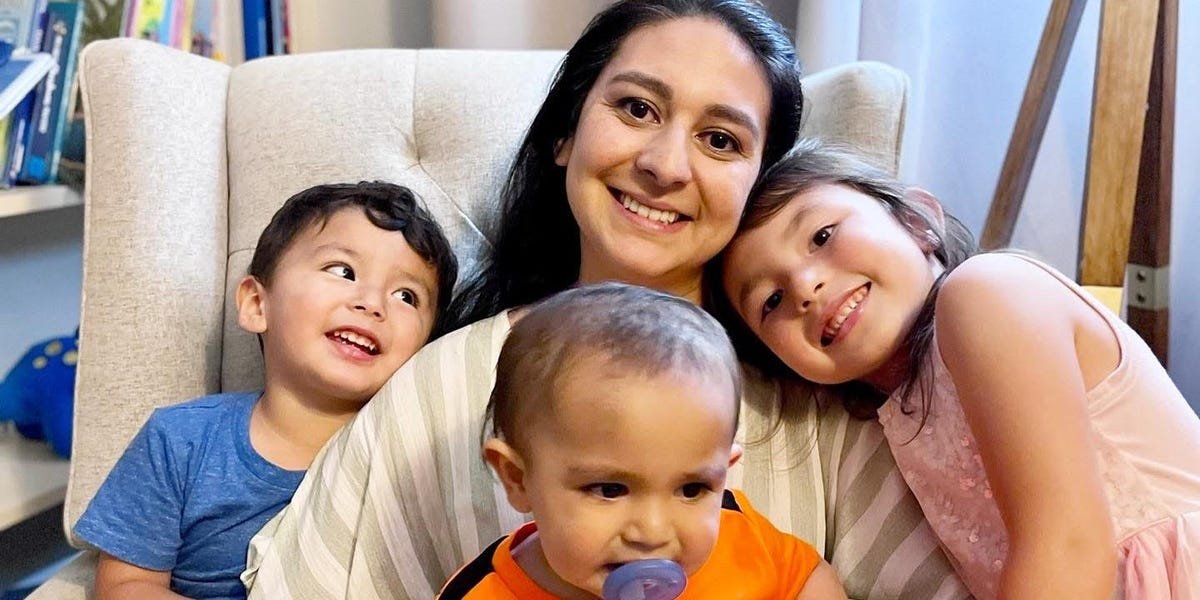


Monica Trott was about to turn 30 when she started to notice blood in her stool.
As a gastroenterology nurse who helped people prepare for colonoscopies, she was deeply familiar with common symptoms of colon cancer and knew rectal bleeding was serious.
During 2019, however, she was well into her second pregnancy. When her doctor said it was likely hemorrhoids related to pregnancy and being on her feet all day, Trott went along with it. She ate more fiber, as instructed. The blood went away temporarily, but kept coming back.
Then, in 2021, during her third pregnancy, the symptoms returned worse than ever, even as the doctors treating her insisted nothing was out of the ordinary.
“I’m seeing blood. I’m seeing mucus now. I’m so tired all the time. So I was bringing them all these symptoms. And every time they would just tell me, ‘It’s hemorrhoids. You’re pregnant, and there’s not much else we can do,'” Trott told Business Insider.
Weeks after she gave birth in 2021, she insisted on a colonoscopy. The procedure found a golf ball-sized tumor in her rectum at age 32. She was diagnosed with stage 3C, meaning the cancer had spread to nearly a dozen lymph nodes.
After successful treatment, Trott is now 38 and celebrating five years cancer-free alongside her husband and three children. As a military spouse, the family adapted to unique challenges during her diagnosis and treatment.
She shared what everyone should know about colon cancer, from screening to survivorship. “You have to advocate for yourself,” Trott said. “Learn to ask for help and accept help.”
Coping with a young cancer diagnosis
After months of reassurance from doctors, the last thing Trott had expected was a cancer diagnosis. Still, she was grateful it hadn’t spread to her liver or elsewhere beyond the lymph nodes.
“It was a big shock,” she said. “It does feel like a miracle that it did not spread to other organs.”
Trott scheduled a surgery two weeks after receiving her diagnosis, followed by six months of chemotherapy.
She grappled with uncertainty about what to tell her children, and if she’d miss out on seeing them grow up. Her family, including her husband, parents, and sisters, became a source of strength, a reason to endure the side effects of chemo and stay focused on healing.
“My kids, at the very beginning, it was so hard because they were so little, and the depression was just telling me, ‘Don’t get close to them. There’s no use,” Trott said. “Thinking of my kids alone is what eventually got my mindset that, OK, I need to fight. Whatever is next, I’m going to do it.”
To manage the side effects of chemo and surgery, she relied heavily on her community, moving back in with her parents in Texas while her oldest daughter stayed in Alabama with her husband, stationed there at the time. Her sisters also helped.
“That was a crazy family dynamic,” Trott said. “I think about it now, how it must have been and how hard it must have been to see their daughter going through this. But thankfully, my parents are the strongest people, so they were there for me through it all.”
She now lives with her husband and three kids — ages 9, 7, and 5 — in San Antonio.
Trott’s takeaway from the experience: Don’t be afraid to seek support, whether that’s screening for colon cancer at the earliest sign of symptoms, or leaning on your community to manage daily life.
“I’ve seen so many people…that they don’t want to be a burden, or they’re the helpers,” she said. “Just learn to ask for and accept help. There’s no benefit in saying you did it all by yourself.”
Life after cancer
Six months after starting chemotherapy, Trott got to “ring the bell,” signaling she had finished treatment. Scans at the time showed she was NED — short for no evidence of disease — meaning her scans were cancer-free.
It started a countdown to five years, the milestone when the risk of colon cancer recurrence drops significantly. Trott hit the five-year mark in May and is still reflecting on what being a cancer survivor means to her.
After taking a few years to focus on her health and her family, Trott is gradually returning to work, subbing as a school nurse at her kids’ school. She’s also considering a move to oncology nursing.
Reclaiming her life after cancer, Trott said she has been navigating the stigma of colon cancer and the misconception that she was somehow to blame for getting the disease. All the while, she’s still dealing with the effects of treatment, as she’s experiencing early menopause symptoms, which can be a side effect of chemo.
“When I first was diagnosed, I was almost embarrassed to tell people, and I never shared my stage at the beginning. I almost felt like it was my fault, and people were going to look at me like, ‘Oh, well, you must have been eating really bad food.’ Like this is an old people’s disease,” she said.
Now, Trott is finding meaning in her experience by urging others to listen to their bodies, and to be aware of the most common symptoms of colon cancer, like abdominal pain and changes to bathroom habits.
“Now I’ll meet a stranger, and I’m like, ‘Hey, how are your bowel movements?'” she said.
Read the full article here