








Magna is one of those companies most drivers have never heard of — but have almost certainly interacted with.
The 66-year-old Canadian firm is one of the largest automotive parts suppliers in the world, building everything from seats and mirrors to advanced driver-assistance systems for major car companies.
It supplies components to at least 59 global automakers, including BYD, Tesla, Hyundai, Ford, Volkswagen, and Xiaopeng. It’s even hand-built entire vehicles, including the Mercedes-Benz G-Wagen.
With 330 manufacturing and assembly plants spanning 28 countries and roughly $42 billion in annual sales, Magna sits deep inside the global auto supply chain.
Now, the company is embedding artificial intelligence across that footprint.
“AI is already embedded across multiple layers of Magna’s supply chain and manufacturing operations,” Sharath Reddy, the company’s SVP of R&D, told Business Insider. “We don’t view it as a stand-alone technology.”
Magna’s AI bets
Magna’s AI investments focus on five areas: product quality, equipment maintenance, factory safety, energy reduction, and output speed.
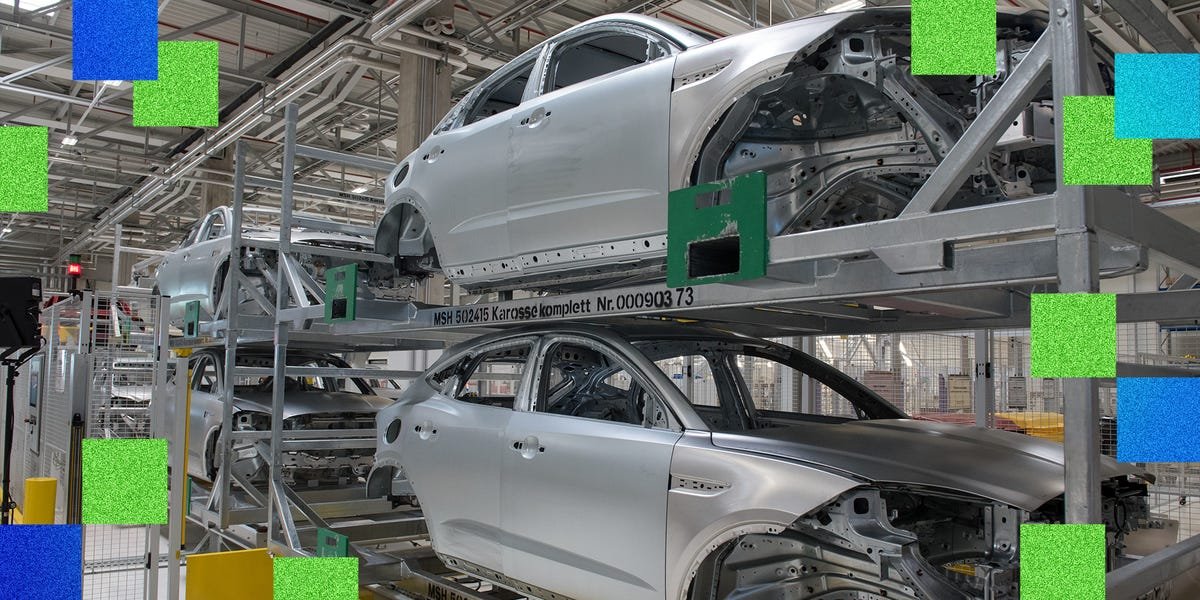
For customers, the most visible example is the AI-powered vision inspection system. Like the camera system Business Insider covered in Ford’s plants, Magna uses high-resolution scanners and machine learning to detect parts defects and irregularities in real time.
The biggest gains from AI aren’t coming from sweeping, end-to-end automation. Instead, Reddy said the clearest payoff comes from applications “closest to the physical operation.”
There are two key examples. Magna is using AI to keep its factories running more smoothly. Systems that monitor vibration, temperature, and pressure can predict equipment failures before they happen, helping plants avoid costly downtime. The company is also deploying autonomous mobile robots to move heavy materials between workstations.
Another layer focuses on efficiency. Magna uses machine learning to track energy use, water consumption, and industrial waste across facilities, flagging anomalies and identifying ways to reduce costs.
Ultimately, Magna is also working toward what it calls a “unified factory,” where data, software, and automation systems are connected across factory-wide operations.
The challenge is that the unified system’s value is more diffuse, Reddy said.
“It shows up across scheduling, material flow, and decision-making rather than in a single metric,” he said. “The value is real, but it’s more distributed.”
AI that helps predict global risk
The auto industry has been hit by years of disruption — from tariffs and trade tensions to material supply shortages and uneven global EV demand.
Automakers have deployed news-monitoring models to help adjust to that unevenness. For example, last year, Business Insider reported that General Motors uses AI to monitor disruptions to its global supply chain.
Reddy said Magna has a similar approach. AI doesn’t replace “the fundamentals of supply chain management,” he said. Instead, it acts as an “amplifier” for potential threats.
“The near-term impact will be better visibility and faster decision-making — earlier signals, stronger scenario modeling, and more coordinated response,” he said.
Rather than a single breakthrough, Magna’s factories are becoming more software-defined step by step — with intelligence layered into the parts of the system where it can reliably deliver results.
Read the full article here