








Want to be a successful marketer today? Think more about risk-taking, less about AI.
Top marketing executives argue that ditching the traditional “brand safety” approach in favor of authenticity, moving fast, and taking creative risks are the only ways to survive in a fragmented digital world.
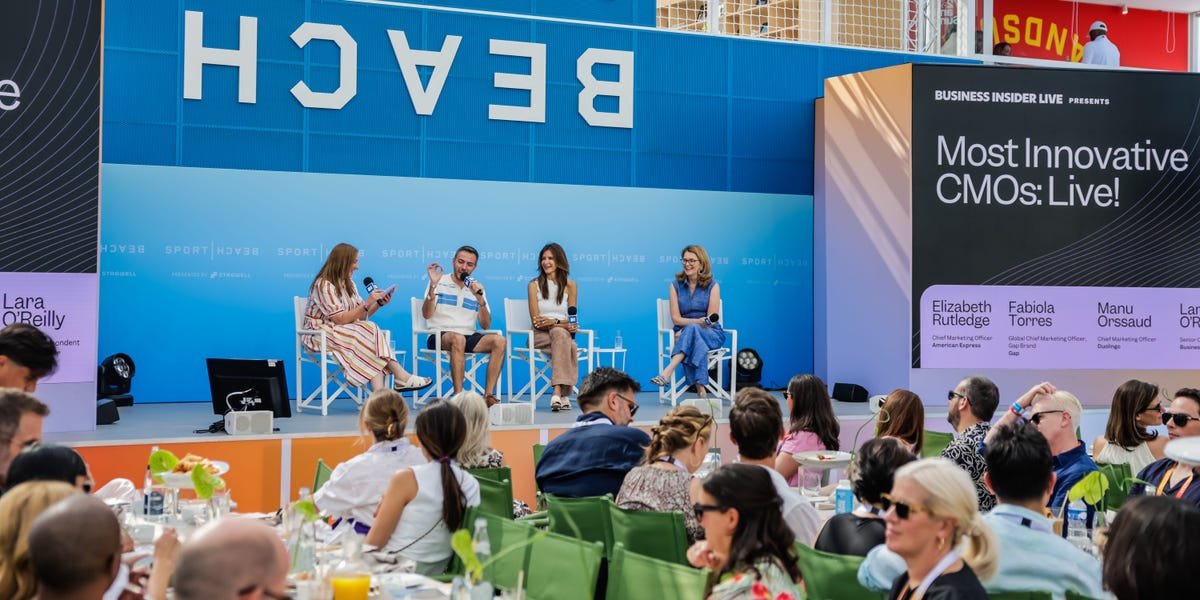
Execs from Duolingo, Gap, and American Express spoke Tuesday on a panel at Business Insider’s annual CMO Insider Breakfast at Cannes, which had support from founding sponsor BCG, supporting sponsor PayPal, and contributing sponsor LinkedIn.
Taking big swings
Duolingo’s Manu Orssaud talked about pushing the envelope with the brand’s five-second farting Super Bowl ad that was a bold move, even for the boundary-pushing brand.
“It was very weird, but I think we proved that our content-first strategy over the years on social media really has paid off,” he said.
AmEx’s Elizabeth Rutledge discussed persuading internal stakeholders to create an in-house agency to complement the company’s outside partners.
“Those perspectives, both internal and external, are really important to have great work,” she said.
Fabiola Torres discussed Gap’s 2025 “Better in Denim” campaign that featured the global pop girl group Katseye dancing to “Milkshake” by Kelis. The campaign went viral, and Gap said it was the brand’s best-performing.
“I told my team, I feel like this is going to be the best one yet because it felt so different, but it was a risk — the outfits, the genre, the talent, the point of view itself,” Torres said.
It’s not all about AI
For all the talk these days about AI in marketing, AI-related skills aren’t the first thing some CMOs are looking for in their next hire.
For Torres, love for the brand is paramount.
“If you don’t have an affinity to the brand that you’re going to be working with, why are you actually applying?” Torres said.
Rutledge said she’s looking for a mix of generalist and specialist creative skills in new hires as AI expertise becomes democratized.
“We’re all going to have access to the same capabilities at the end of the day,” Rutledge said.
Cutting through the clutter
Marketers are constantly trying to find new ways to break through, as people’s attention becomes more fragmented.
Some CMOs shared tips for getting noticed.
Torres said Gap tailors content to each platform, like TikTok or YouTube, from the outset — rather than shooting a project and adapting it later.
“We actually produce and edit the content according to the platform. So far, it has been performing better when you think platform-first, and you shoot it accordingly to that,” she said.
Rutledge focuses on how AmEx can improve customers’ experience when they’re going to a restaurant, traveling, or seeking entertainment at home or outside. She emphasized the need for deep expertise in the platforms where people spend their time.
“The average US consumer is on 11 video services” across linear, streaming, and social platforms, she said. “What I am really proud of in terms of our team is that they see that media fragmentation not as a negative, but as an opportunity to kind of meet customers where they are.”
Duolingo is constantly reacting to culture and coming up with ways to grab people. Still, Orssaud said it’s important to know when it’s time to move on from tried-and-true strategies, like being sassy with its social media accounts. He said the brand is dialing back its unhinged playbook because it’s become expected. It’s also moving from short-form to long-form content that allows for more character development.
“There is also the risk of trying to always go and chase the next big viral moment by increasing the shock factor,” he said.
Brand safety views change
Marketers used to pound their chests a lot about protecting their brands from appearing near unsavory content, but in recent years, they’ve gotten quieter about it. Marketers discussed how authenticity is taking priority these days.
Rutledge said automation has made it easier for brands to protect themselves online. She focuses on “premium” environments that align with customers’ dining and travel, music, and entertainment interests.
Torres cautioned against focusing too much on brand safety at the expense of staying true to one’s identity.
“If you use the terminology on brand safety, you just may close yourself to opportunities,” she said. “This is the era where Gen Z is asking you for more. Millennials are asking you for something new and different, and Gen X are saying: ‘Take me back to the things that I love.’ So it’s important to really make sure that you don’t get distracted by brand safety versus following your DNA.”
Read the full article here