







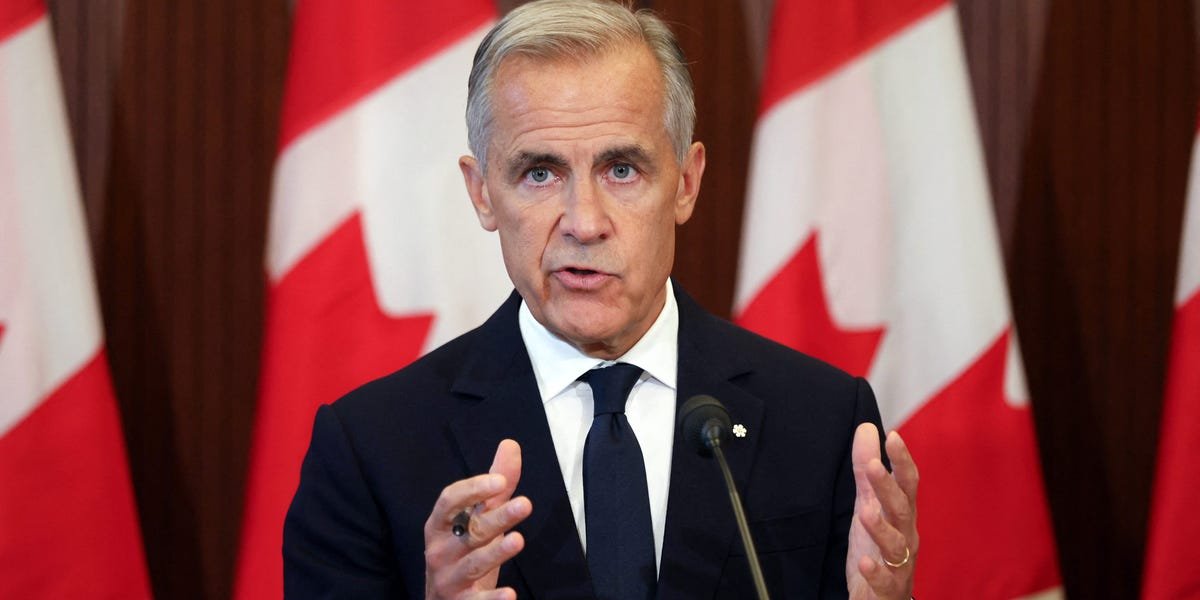


Mark Carney is facing a challenge familiar to many company leaders: how to deal with a more powerful partner you can’t afford to lose.
The Canadian prime minister is in a trade fight with US President Donald Trump. Though Carney lacks the upper hand because Canada depends more on access to the US market than vice versa, he walked away from trade talks with Trump, arguing that the US had produced unfair terms.
The dispute has escalated in recent days, with Washington imposing new tariffs on Canadian goods and Ottawa announcing retaliatory ones on US imports.
Whether Carney’s approach ultimately benefits Canada remains unclear. For business leaders who have to negotiate with vital suppliers or customers, however, his approach offers a window into what it’s like to hold one’s ground in a dispute with someone more powerful.
“It’s about how to maintain strategic discipline when the person across the table is completely unpredictable, has more leverage than you, and is trying to dictate the terms of the relationship,” said Chris Kaufman, a leadership consultant who cofounded the e-commerce giant StockX.
Carney’s approach also shows the importance of updating assumptions when a once-reliable partner stops behaving as expected, he added.
“You can’t let history become your strategy,” said Kaufman.
In a statement, White House spokesperson Kush Desai said Canada rejected “the most generous deal that had been offered to any of America’s trading partners” and that the country’s position “is less about defiance and more about short-term foolishness.”
Nintendo v. Amazon
Reggie Fils-Aimé said he faced a similar imbalance of leverage when he was president of Nintendo of America. In the early 2010s, he said Amazon wanted enough promotional funding to match or beat other retailers’ prices for a popular handheld console and its forthcoming successor. Amazon also sought to undercut other retailers when they ran promotions, he said.
“I made the decision that we would just stop doing business with Amazon,” Fils-Aimé said. Agreeing to its demands, he said, could have encouraged Nintendo’s other retail partners to seek similar treatment.
Nintendo went without Amazon for roughly six to eight months. A few weeks before the new handheld was set to debut, Amazon agreed to Nintendo’s terms. Fils-Aimé said the outcome made clear that the company “wasn’t going to get pushed around no matter the size” of the partner.
Amazon didn’t respond to a request for comment.
‘Emotions are contagious’
When the other side holds the leverage, a good first step is to make clear what is nonnegotiable, said Jo-Ellen Pozner, a professor at Santa Clara University’s Leavey School of Business.
Carney’s response was grounded in Canada’s values and interests, she said, because he said he wouldn’t compromise on Canada’s sovereignty.
“That’s an appropriate starting point for any corporate leader, regardless of the outcome,” said Pozner. “If you don’t have that commitment to values and demonstrate it repeatedly, especially when times are difficult, then your word kind of means nothing.”
Carney’s measured approach also illustrates the importance of keeping calm under pressure, said Jamie Shapiro, an organizational psychologist and executive coach.
“Emotions are contagious,” Shapiro said. “If you’re not staying composed, it can make it harder for the people around you to stay composed.”
Staying focused
In Carney’s previous role, as the head of the Bank of England, the UK’s central bank, Carney got plenty of practice staying calm under political fire.
In 2018, when a prominent member of Britain’s parliament described Carney as a “second-tier failed Canadian politician” after the Bank published a grim scenario about the potential economic consequences of a disorderly Brexit, Carney’s public response was not to answer the insult, but to explain the analysis. “Our job is not to hope for the best but to prepare for the worst,” he said.
Now, as Canada’s leader, Carney can’t control what Trump says or does next, but Shapiro said that Carney can decide how Canada responds — an example of the distinction leaders must make between what they can control, what they can influence, and what is outside both.
For a CEO, that distinction might arise if a major customer were to say it is considering a competitor. The executive controls the value proposition the company puts forward, but not the rival’s offer or the customer’s decision, Shapiro said.
Strength in numbers
In a much-discussed speech at Davos earlier this year, Carney bluntly framed Canada’s shifting relationship with the US.
“Great powers have begun using economic integration as weapons, tariffs as leverage, financial infrastructure as coercion, supply chains as vulnerabilities to be exploited,” he said.
Carney went on to put a stake in the ground.
“The powerful have their power,” he said. “But we have something too — the capacity to stop pretending, to name reality, to build our strength at home and to act together.”
Those remarks — and Carney’s actions since — show that allies can strengthen a leader’s hand, said Jeffrey Sonnenfeld, author of “Trump’s Ten Commandments: Strategic Lessons From the Trump Leadership Toolbox” and senior associate dean for leadership studies at Yale School of Management.
“When leaders take a strong stand to counter someone trying to bully them, they need to have the fortification of allies with them,” he said.
Carney has benefited from support from Canadian leaders across the political spectrum, as well as leaders in the UK and Europe, added Sonnenfeld. A strong opponent who detects division will press for more concessions.
“They see the vulnerabilities and just push for more,” Sonnenfeld said. “Appeasement never works.”
Read the full article here