






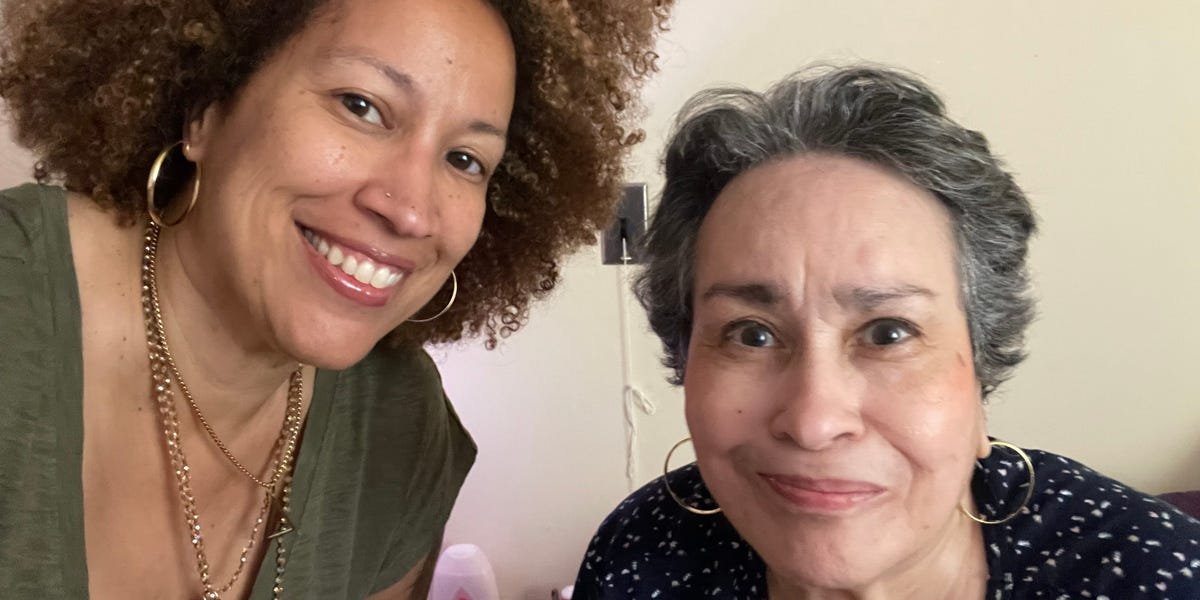


This interview is based on an interview with Natalie Tucker, 54, director of communications and development at a church, who splits her time between New Jersey and Maryland. She also works as an actor and voiceover artist. It has been edited for length and clarity.
In the Spring of 2025, my 75-year-old mom fell a total of four times over six weeks at her apartment in an independent living community in northern Virginia.
She spent hours on the floor before she was found and received help. Her dignity suffered, especially when she had to be lifted to her feet by emergency responders.
It was heartbreaking, and I worried so much, especially because I split my time between Maryland, close to where she lives, and New Jersey, about four hours away, because of my job.
Mom would forget to take her medication
Mom, who had undergone two strokes during the pandemic, was losing her memory. She’d often forget she’d taken her pills.
Perhaps it was pride, but Mom showed good coping skills when I took her to the county social services for an assessment last year.
I knew she needed help, but they said she didn’t qualify for anything because she’d followed their instructions, like standing up and sitting down on her own.
Then, on March 3, 2026, she had another fall. She wasn’t wearing her medical alert and couldn’t reach her phone or the emergency cord for hours.
I wound up sleeping on her couch for three weeks, working remotely. I’d be sitting in an important Zoom meeting while Mom was sitting on her bed, struggling to get dressed.
It was like living with a toddler all over again. I never cried in front of her, but I’d walk around the block to get some air, tears in my eyes.
In-home care services were expensive
I called social services again, but they couldn’t see her until the end of April. Then I looked into assisted living, which was private pay, and cost between $3,000 and $5,000 a month.
Read more of our coverage on long term care
Mom, a retired cashier who had no savings or retirement fund, received a Social Security payment of $994 a month. Her rent was subsidized at a monthly rate of $280 because she was classified as low-income.
I didn’t know how on earth she would afford assisted living, but I got another shock when I inquired about in-home services. A health aide for companion care costs between $34 and $38 per hour in her area, with a minimum of four hours per day.
One weekend, when I had to return to New Jersey, the cover cost $780.
Then a friend told me about Cherry Blossom PACE, which stands for Program of All-inclusive Care for the Elderly.
It helps “nursing home eligible” people like my mom stay in their existing properties by providing services such as adult day care, doctors, medications, physical therapy, social workers, and nutritional advice.
Mom received Medicaid
It also includes transportation to and from the day center and home-based services, such as daily meals.
Mom had an assessment and qualified for the scheme. She also received Medicaid, which meant her co-pays were zero.
Mom began the program at the beginning of May. She loved the adult day care, where they have lunch and do activities like word-finding and coloring.
On her second day, she was awake from 6 a.m., got dressed, and put on her makeup well before the bus picked her up.
She proudly packed her little bag with apple juice, apple sauce, a comb, a brush, Polident, a book, a nail clipper, tissues, an eye glass case, and hand sanitizer.
It was like watching an excited 5-year-old setting off for kindergarten.
The program has given us a huge sense of relief
She has on-site occupational and physical therapy and was provided with a free home medical alert system.
This new system of care has been a huge relief, both financially and emotionally. Of course, we don’t know what the future holds for Mom, but our family feels so blessed.
Read the full article here