







The Marine Corps is preparing to field tens of thousands more drones for troops to watch and attack enemy positions, and leaders say the challenge isn’t just getting them into the hands of trained Marines — it’s the behind-the-scenes prep that comes with.
Think: batteries.
Small drones rely on lithium batteries that need to be specially stored, monitored, and kept charged — and the Corps is set to receive 40,000 more drones later this year, meaning a surge of volatile batteries will need to be safely and properly managed.
“If they get wet, they catch fire, and then you’ve got a runaway fire. You can’t put it out with water because it’s already wet,” Col. Jeremie “Hank” Hester, director of the services’ Combat Development and Integration Aviation Combat Element, told Business Insider during the service’s annual Modern Day Marine symposium in Washington, DC on Wednesday.
Many military systems already rely on lithium batteries, and units have procedures in place to manage them. But scaling that up across a service with 170,000 Marines comes with new demands for personnel, considering that ill-maintained batteries will go bad and could even cause a fire.
“We’ve got young kids right now that are going out, and their sole job is to make sure that these things are keeping their charge,” Hester said of batteries currently stored in modified shipping containers.
That administrative load doesn’t stop with storage.
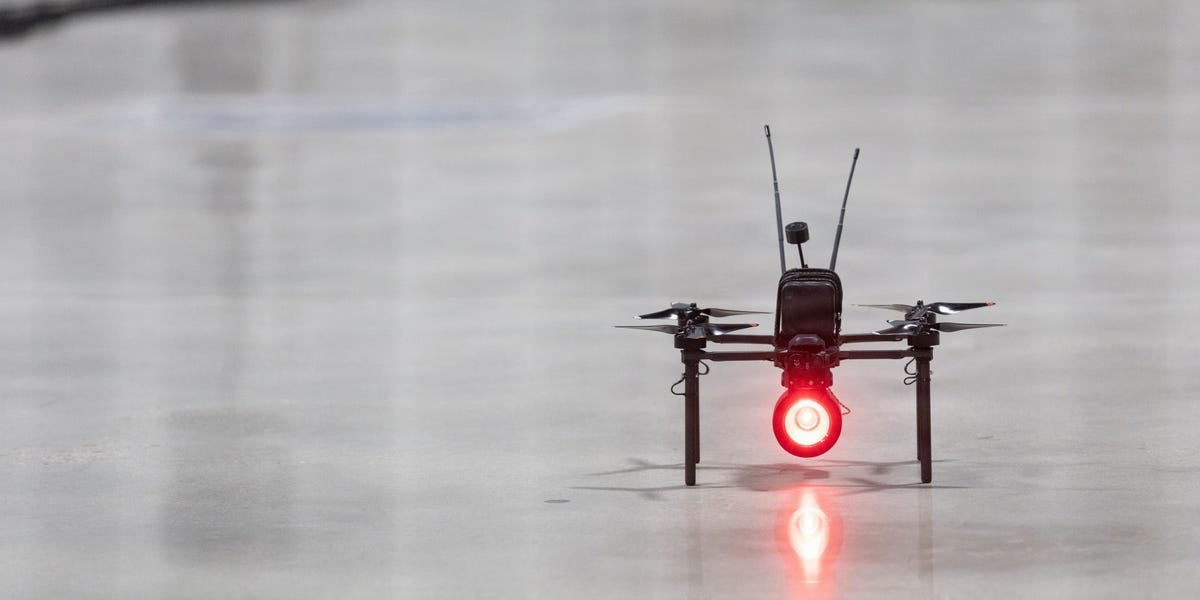
The Corps sees drones as critically important for Marines to prepare for future combat, and are experimenting with them across a wide range of tasks, from surveilling their enemies and probing their defenses to resupplying Marines at far-flung outposts. One of the primary ones they’ve been using is the Neros Archer, a remotely piloted quadcopter that can carry around five pounds beyond 12 miles.
As drone use increases, including courses focused on counter-drone measures, Marines will be required to maintain proficiency. Hester said new requirements for drone operations could take a page from the Corps’ aviation branch, which mandates pilots log enough hours to stay qualified.
“We’re heavily reliant on incidental operators,” Hester said of Marines trained on drones now, meaning troops who operate them as part of their broader job — such as infantry who usually specialize in things like machine guns or mortars — rather than as dedicated specialists. Those operators don’t yet have formal requirements to maintain their skills over time and stay sharp.
Even getting pre-approved systems into units has proven complicated. Small military drones need to be approved for operation in US airspace and must comply with federal regulations governing the electromagnetic spectrum, which also supports civilian systems like cellular networks and aviation.
At the same time, the Corps is preparing to absorb a growing mix of drone systems, which may need different types of maintenance and use different batteries.
Under a Pentagon push to expand drone use, Marines are expected to receive at least six types of small drones, Hester said. As those systems move into units, Marines will have to work across platforms from different manufacturers, each with its own controls and communications.
Getting them to operate in tandem with other drones or aircraft, and to transmit information to create a sensory picture, remains a technical challenge, a problem Hester compared to making different brands of phones connect seamlessly with a universal language.
“You should have a Rosetta Stone, so no matter what waveform all these things are talking in, you have this one central hub that allows it to not only interpret whatever is being said digitally, it knows where to take that command to and be useful to the decision makers.”
Read the full article here