









KYIV, Ukraine — Ukraine started out in uncrewed naval combat by rigging driverless speedboats to slam into Russian warships and explode. The unusual tactic worked, rattling a classically superior navy.
Then Russia adapted, forcing Ukraine to again get creative.
Now, Ukraine is increasingly transforming its drone boats into drone motherships. These vessels can set attack drones loose on enemy defenders or launch interceptors for a new kind of coastal air defense. The approach allows Ukraine to strike or defend from farther away, from less predictable directions, and with cheaper systems than traditional weaponry.
“The vessels were required to do more than simply function as kamikaze platforms,” a unit commander in Ukraine’s military intelligence agency, known as the GUR, told Business Insider. “They had to carry and deploy FPV drones, interceptor drones — which are part of today’s battlefield reality.”
The emergence of drone motherships marks a distinct shift in how the drone war is being fought. Small drones make precision attacks cheap and widely available, but they still face limits in range, endurance, resistance to enemy jamming, and operator exposure.
By turning boats, aircraft, and vehicles into mobile launch platforms, Ukrainian forces can push smaller systems much deeper into the battlespace in unexpected ways.
Business Insider recently traveled to Ukraine and spoke with arms makers, service members, and defense officials working on these systems. They shared war stories and described motherships not as a single breakthrough weapon but as a practical adaptation for a battlefield where launch points, range, speed, and survivability increasingly determine whether small drones can be effective.
Russia first saw the potential of drone motherships in the air
Motherships began to appear on the battlefield last year, ushering in a new chapter of drone warfare.
Conflict analysts at the Institute for the Study of War, a US-based think tank, said in October that Russian forces had been using motherships since at least August 2025 to target Ukrainian logistics routes and positions in the near rear. They said the systems were based on variants of Russia’s fixed-wing Orlan and Molniya drones.
Ukrainian soldiers later described the Molniya motherships to Business Insider as something akin to an “aircraft carrier,” able to fly dozens of miles, release a few first-person-view (FPV) drones closer to Ukrainian positions, and even carry heavy payloads such as anti-tank mines.
Ukraine has since begun to develop its own motherships, capitalizing on the concept.
Oleksiy Vyskub, Ukraine’s first deputy defense minister, framed motherships as part of the country’s constant cycle of wartime adaptation, where new battlefield problems demand new technical solutions every few months.
Motherships have “been actively tested right now by our advanced units,” Vyskub told Business Insider in Kyiv. He hesitated to call them game-changing on their own, though. They are, he said, one more component in an arsenal that keeps changing as the war evolves.
Ukraine moved the mothership concept to ground robots and sea drones
While motherships began as fixed-wing drones carrying FPVs into battle, they have since expanded to all types of drones, including ground and naval systems.
The idea is rapidly spreading across domains. Ukrainian arms makers, for instance, are adapting uncrewed ground vehicles for wider missions, and Business Insider saw inside one of the companies driving this shift. Ratel Robotics is building war robots that can launch FPVs and may eventually deploy interceptor drones.
However, the clearest example of the mothership concept may be at sea, where naval drones are changing both coastal air defense and waterborne strike operations.
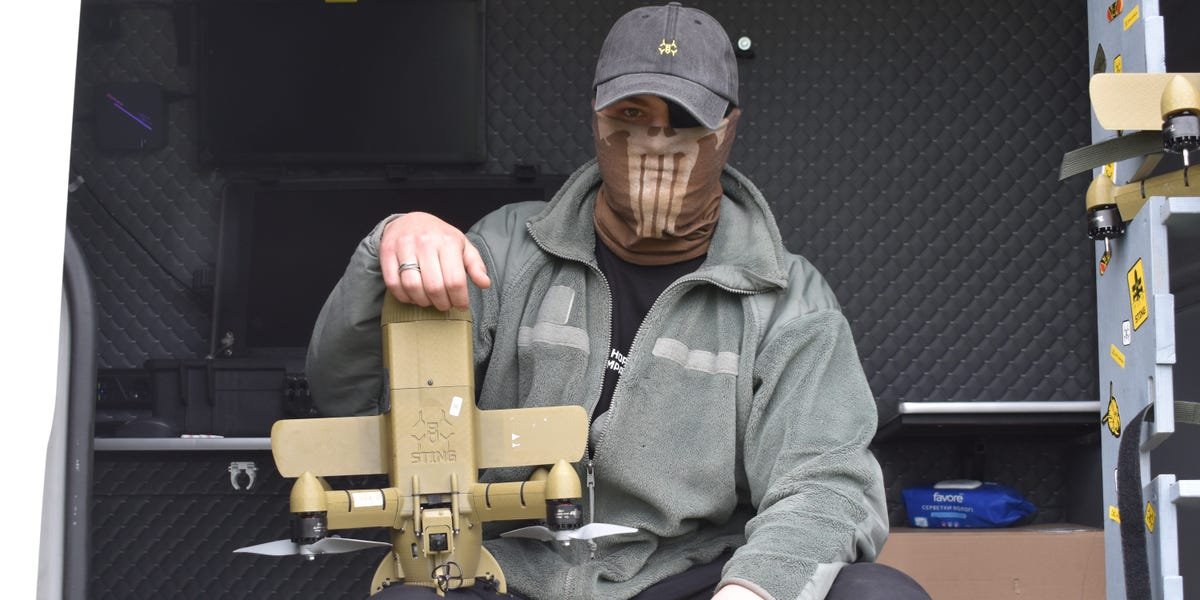
In April, the Ukrainian military said it had destroyed a Russian Shahed for the first time using an interceptor launched from a naval drone. Wild Hornets, a Ukrainian company that makes the popular “Sting” interceptor drone for combating Russian Shahed-style one-way attack drones, later confirmed its involvement in the operation.
A Wild Hornets spokesperson, who spoke on the condition of anonymity to discuss sensitive details, told Business Insider at a secret training site near Kyiv that naval drones offer a practical launch platform for the Sting because they can help defend cities along the Black Sea. Odesa, Ukraine’s major Black Sea port, is a frequent target of Russian drone attacks.
For Ukraine, naval drones have become one of the clearest examples of how flexible the mothership concept can be.
The GUR commander, who asked to be referred to by his call sign Ninth, oversees a unit that uses a multi-purpose naval drone called the “Katran.” Made by the Ukrainian enterprise Military Armored Company HUB, the uncrewed vessel can launch FPV and interceptor drones.
Ninth recalled one attack in which Russian Coast Guard personnel tried to stop a group of Katran drones with small-arms fire. He said he ordered the motherships to launch FPV drones, which swarmed the Russian personnel and killed several of them.
For Ninth’s unit, strike operations remain the main mission. Air defense is secondary, but he said the naval drones can help when needed.
“We do not function as a conventional air defense formation,” he said. “We contribute selectively, as one element within a larger operation.”
Even crewed aircraft are becoming drone carriers
Motherships are not limited to uncrewed systems. Ukraine is also using crewed aircraft as launch platforms for smaller drones.
Wild Hornets said in April that it launched a Sting interceptor from an Antonov An-28, a Soviet-era turboprop aircraft, during a combat mission.
The Wild Hornets spokesperson said the company is working to make Sting more compatible with airborne platforms. The approach is harder to execute than a ground launch, he said, but it could get interceptors into position faster and widen the area they can defend.
Nazar, a Wild Hornets instructor who requested to be identified by his call sign over security concerns, said motherships are the future and described their development as an important investment for Ukraine.
“It moves us away from the tactic where the interceptor launches from the ground,” he told Business Insider. “Instead, we can use some kind of carrier that can stay in the air longer and even fly closer to the target, reducing the distance the interceptor itself has to cover.”
The shorter that final flight, be it that of a defensive interceptor or an offensive drone, the more dangerous Ukraine’s smallest weapons ultimately become.
Read the full article here