







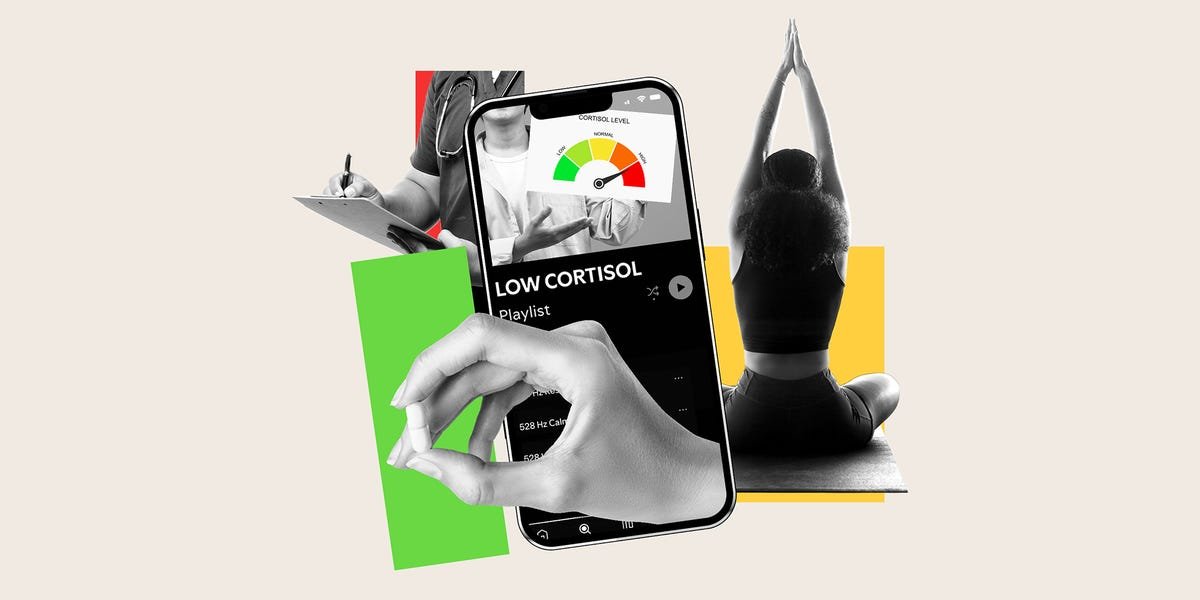


Your cortisol is probably fine. I mean, I’m not a doctor, and if you’re concerned, you should get yourself checked out. But the people on Instagram and TikTok telling you to be Very Worried about your cortisol do not have any more information about your health than I do. The difference is, I’m not trying to sell you a supplement over it.
Cortisol is the internet’s favorite wellness boogeyman. Per social media, too much of it is why you’re experiencing 3 a.m. wake-ups, have a “cortisol belly,” and see an extra-puffy face when you look in the mirror. Google searches for cortisol in the US have climbed significantly over the past five years, including anxiety-indicating entries such as “cortisol triggering foods,” “cortisol detox,” and “how to lower cortisol.” Facebook’s ad library is filled with hundreds of active posts mentioning various cortisol-related issues — and selling supposed fixes.
“A lot of the hype on the internet is not real,” says Dr. Scott Isaacs, an endocrinologist and the former president of the American Association of Clinical Endocrinology. “The obsession on Instagram is just a fundamental misunderstanding of cortisol, which is a vital hormone that we can’t live without.”
Cortisol has become an easy scapegoat for a wide range of ailments, especially in an era when people distrust the traditional medical establishment and are eager for quick fixes. The online fixation on it is a classic example of wellness culture taking a legitimate scientific concept, stripping it of its clinical context, and turning it into a lucrative villain. I spoke with multiple doctors to get their read on the cortisol craze and find out just how concerned people should be about it. My takeaway: We would all do well to relax.
Cortisol is a normal, healthy hormone made by the adrenal glands — located atop the kidneys — when the pituitary gland at the base of the brain sends the signal. It helps us respond to stress, regulate blood sugar and blood pressure, and suppress inflammation.
Cortisol is generally diurnal, meaning it’s highest in the morning (and helps us wake up), drifts down during the day, and falls to its lowest level at night. It rises and falls throughout the day, increasing when we feel stress or anxiety, when we exercise, and when we eat.
Yes, your cortisol will go up after you run a marathon, but no, that doesn’t mean you should skip the marathon.
“If you think about hunter-gatherer times, what we used cortisol for was to wake up in the morning and go out and hunt and gather, or run from a bear if we had to. You need cortisol to do that,” says Dr. Rekha Kumar, a senior medical advisor at weight-loss company Found and an endocrinologist at Weill Cornell Medicine.
These small spikes in cortisol are not only natural but helpful. They help the brain encode memories and regulate blood sugar after eating. There are perfectly reasonable times when cortisol levels should be high: Yes, your cortisol will go up after you run a marathon, but no, that doesn’t mean you should skip the marathon.
Some people do have serious cortisol-related health conditions where levels are persistently too high or too low. Cushing’s syndrome, for instance, is a medical condition in which cortisol is chronically elevated, often due to a pituitary gland tumor or nodules in the adrenal glands. Symptoms can include weight gain, especially around the face, neck, and abdomen; stretch marks on the abdomen; high blood pressure; and bone loss. On the flip side, there’s Addison’s disease — an adrenal insufficiency where not enough cortisol is produced — that can cause low blood pressure and weight loss. These conditions are rare and are diagnosed by physicians using urine, saliva, and blood tests that measure cortisol levels and fluctuations. They shouldn’t be self-diagnosed because what you see online is making you feel extra-anxious.
“When somebody says, ‘I know when you order my cortisol levels, they’re going to be high because I’m stressed,’ they’re always normal,” says Dr. Caroline Messer, an endocrinologist in New York City. It’s not the first time she’s seen a cortisol-related fad trigger concern among patients. When she first started training, everyone thought they were tired because they had “adrenal fatigue” and had burned out their adrenal glands’ ability to produce cortisol. “It’s not a real condition,” she says.
I will admit that I have become quite susceptible to all of the cortisol information — more precisely, misinformation — floating around online. Google’s Gemini AI regularly warns me to avoid high-intensity exercise to avoid raising my cortisol levels, so I used this story as an opportunity to ask doctors whether I should worry about cortisol making me gain weight or if I should change my workouts. When I tell Dr. Kumar about the AI’s concerns, she’s quick to point out that it’s not getting that information from medical journals. “The large language models are getting their advice from what is in the chat rooms, what’s on Reddit,” she says. She sees all of this messaging, too. “For all of us that get targeted with this stuff, it’s compelling,” she says. “We’re in this echo chamber of, ‘It must be my cortisol.'”
It’s not that there’s absolutely no there there on cortisol — it’s that human nature, the algorithm, and culture have turned this molehill into a mountain. The human body is a complex organism, and the idea that anything that feels off has an obvious cause and obvious solution is alluring.
Whenever someone’s trying to sell you something, you have to be so skeptical.
“Short-form videos like Instagram and TikTok provide very simple, easy explanations for what is usually a very complicated topic,” says Jennifer Vander Loop, a Ph.D. student and research assistant at DePaul University who’s studied health and wellness misinformation on social media. It’s easy for people to understand them, “even though they may not be accurate.”
The more you see and engage with cortisol-related content — even if it’s out of basic curiosity — the more the algorithm feeds it to you. If you tell the algorithm that it doesn’t fall within your interests, it may not stop the ads. Many of us have had the experience of scrolling through Instagram and Facebook, seeing an ad that isn’t up our alley, asking not to see it again, and then … seeing it again a week later. It’s relatively easy for advertisers to retarget users to get in front of them again or show them another campaign. In case you haven’t noticed, most of the people and companies talking about cortisol online want you to open your wallet.
“Whenever someone’s trying to sell you something, you have to be so skeptical,” Dr. Messer says.
Dr. Isaacs is more blunt: “The supplements are not necessary at all. Whatever these are, there’s no evidence at all for that that they’re helpful in any way.”
The rise in distrust in medical and scientific establishments makes people more open and susceptible to online wellness content. Add to this the growing partisanship around health, the Make America Healthy Again movement, and the heightened skepticism toward public officials that arose during the pandemic, and you have a recipe for trust-related disaster.
“More and more people don’t feel like they can trust conventional medicine and feel like they need to take matters into their own hands,” says Matthew Motta, an associate professor of health law, policy, and management at Boston University’s School of Public Health. A greater openness to alternative medicines has created a market and demand for a variety of less-than-proven remedies and supplements, including those that promise to help people deal with cortisol issues they don’t have.
The supplements industry is very lightly regulated in the US — manufacturers don’t need FDA approval for safety or efficacy, which generally treats them as a category of foods rather than drugs. This creates “a lot of legal gray area and opportunities for marketing,” Motta says. What’s more, companies tend not to fund extensive research to test their supplements, which he speculates is “probably because they think it won’t work.”
That means many supplements can be marketed as the one-fell-swoop solution to a laundry list of issues, from sleep disruption to stress to hair loss to hunger and more. Businesses and advertisers get to make those sorts of promises because they don’t have to prove it.
Why can’t we flood the zone with facts and science and information?
It’s a convenient setup: Convince people they have a problem, offer up a simple solution. Browsing through Facebook’s ad library, I found ads for mushrooms, pills, coffee creamers, rings, playlists, and even bedsheets that promise to help people lower their cortisol levels.
Some doctors are trying to fight fire with fire, putting information out there to combat the health misinformation floating around online, including about cortisol. Research shows that medical debunking campaigns can be effective.
“Why can’t we flood the zone with facts and science and information?” Motta says.
Much of the conversation around cortisol is actually a conversation about stress. We know that chronic stress can increase the risk of hypertension, heart disease, and depression. Trying to reduce stress is an admirable goal, but lifestyle changes would likely help many people better control their stress levels and, in turn, their cortisol levels.
Our bodies send us signals about our stress that we can and should pay attention to, says Dr. Rajita Sinha, a psychiatry professor at Yale and the professor of the Yale Interdisciplinary Street Center. Your heart rate increases, your mind starts to race, you feel tension in your muscles, you’re irritable. “Those are all stress signs and symptoms, signals, right?” she says. “Your body’s not telling you, ‘Hey, check your cortisol.’ You don’t know how to check your cortisol, but the body is giving us a lot of signals about stress.”
In moments of stress, one easy way to try to calm down isn’t popping a supplement — it’s breathing. “Notice your breathing, and you slow down your breath,” Dr. Sinha says. “That is going to slow down your body.”
I’m not an expert on stress or on cortisol by any means. The thing is, neither are the bulk of influencers and businesses online trying to freak you out about it so that you’ll buy their products. While the advice may seem rote, it’s true: If you are cortisol concerned, talk to your doctor — not TikTok or ChatGPT.
Emily Stewart is a senior correspondent at Business Insider, writing about business and the economy.
Business Insider’s Discourse stories provide perspectives on the day’s most pressing issues, informed by analysis, reporting, and expertise.
Read the full article here